Three Hyderabadi Parsi pioneers who imparted knowledge to the blind,
tiny tots and college students are relatively unknown
Yezdyar S. Kaoosji
This article memorializes pioneering, innovative and often revolutionary contributions of three dedicated Parsi professionals who worked diligently under the radar of hype and fanfare to leave a legacy of added value and benefits in the causes they chose to serve.
My father Sheheryar Kaoosji was a teacher, social worker, religious scholar, orator and a revolutionary who always worked for the disenfranchised and subjugated sectors of society. He started his career as a teacher in the Nizam’s State school system in Hyderabad. As a child he had watched his aging father lose his eyesight to cataracts and it left a lasting impression on him. So, when a special School for the Blind, Deaf and Mute was founded in Malakpet, he trained in the education of the blind. Years later he advocated a separate School for the Blind and was appointed its first headmaster. He personally walked the poor neighborhoods of the city to rescue young blind children whom he took to the school hostel where they were cared for and educated. He found many of his future students in the back alleys of Hyderabad, living in Dickensian squalor. There were also a few students from working and middle-class families who attended the new school. Besides their basic education, he advocated for the blind to receive university education and fair employment.
He spent countless hours trying to place his first two students, Abraham Lincoln (so named by his pastor father Rev John of the Bidar Diocese) and Syed Hussain, in the Osmania University. Both had passed their matriculation exams with high scores, yet the University bureaucrats refused to admit them, for they believed the image of the institution would be tarnished with blind students walking around the campus!
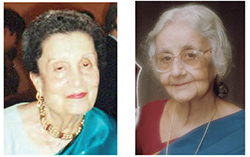
Meheroo Jussawalla (left) and Khursheed Taraporewalla
Sheheryar Kaoosji introducing Dr Helen Keller (seated fourth from left)
Undaunted, he sought the assistance of his school classmate, Hadi Bilgrami, assistant secretary for education of Hyderabad State, for an introduction to his cousin and brother-in-law vice chancellor Nawab Ali Yavar Jung, who in later years was a distinguished diplomat and governor of Maharashtra. Being an advocate for the handicapped, Nawab Jung immediately approved the admissions. Both Abraham and Syed, and later others who joined college spent long nights in our house, where father used to read to them from their text books while they took notes in braille.
In 1951 my father earned a Colombo Plan Fellowship and received his Master’s degree in Social Work at the University of Adelaide in Australia. With this qualification and his reputation as a problem solver and honest administrator he was deputed to reorganize a poorly managed quasi-government orphanage, the Victoria Memorial Home in Saroornagar. His first task was to find suitable husbands for over 20 young women. They had entered the orphanage as infants following the atrocities of the Police Action of 1948. Years later, after he had completed the brief assignment and returned to the School for the Blind, young couples would visit our house with their babies, to receive the blessings of the man they respected and fondly called their father.
In 1960 the Government of India introduced the National Award for Teachers, and Sheheryar Kaoosji was the first honoree, receiving the citation from the President of India Dr Rajendra Prasad.
My father remained active in the community following mandatory retirement from government service at age 55. First as manager of Aram Ghar, a women’s rescue home founded by another distinguished Parsi social worker, Roda Mistry. His last assignment was as office administrator of the Parsi Zoroastrian Anjuman of Secunderabad and Hyderabad. He passed away suddenly in 1974 following a brief illness when he was 64.
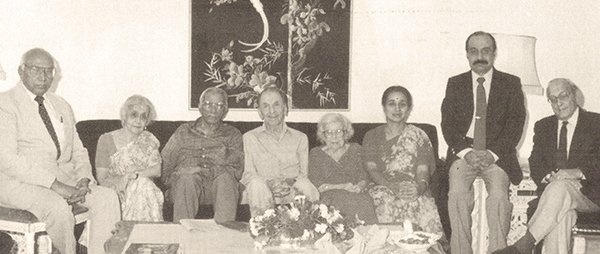
Montessori Training and Research Trust members with J. R. D. Tata (center)
Over the last decade, with the advent of social media, my siblings Bakhtyar Kaoosji, Nasreen Patel and I often receive messages from people we never knew, asking whether we are related to Sheheryar Kaoosji. They recall their interactions with him, either as his students or as Boy Scouts where he was a lifetime Scout Leader and Commissioner, or when they had attended one of his many popular public lectures at various social and religious occasions.
My mother’s sister, Khursheed Taraporewalla, was another education pioneer in our family of teachers. Energetic and entrepreneurial, she loved working with little children. She had graduated from the Montessori training program in Adyar, Madras State, in 1939, under the supervision of Madame Maria Montessori. My aunt had distinguished herself as a maverick and Montessori had nicknamed her "My Little Soldier!”
In the early 1950s she decided to start her own Montessori school. It soon became a family project. My grandfather, Eduljee Taraporewalla, a retired government auditor, assumed the role of project manager. My parents cleaned out the garage at our Church Road house, and it became the workshop where carpenters crafted the tiny chairs, tables and shelves, to the exacting specifications stipulated by Montessori herself.
My brother, sister and I were already past the Montessori age in 1953 when the school was inaugurated with three students in a rented room of a large house in Chiragh Ali Lane. The popularity of the school increased rapidly, with word of mouth publicity of the many Kaoosji cousins and network of friends. With more students joining each year, my aunt opened new environments (class groups) and the entire building was soon rented and bustling with little children. In 1967 the institution earned the designation of Montessori House of Children and was officially affiliated to Association Montessori Internationale (AMI). The AMI also started using the institution for international training courses, and my aunt became the convener of the Montessori Training and Research Trust, with J. R. D. Tata as its chairman.
In 1998 the Federation of the Parsi Zoroastrian Anjumans of India recognized her with the Mazda Education Award which was presented to her at a ceremony in Sanjan by Field Marshal Sam Manekshaw.
My aunt passed away two days after her 93rd birthday in 2006. She had led her institution actively all her life and personally trained the present owner of the school Kalpana Vishwas Kumar. Her pioneering vision and life’s work is immortalized in the growing success of Taraporewalla’s Montessori House of Children.
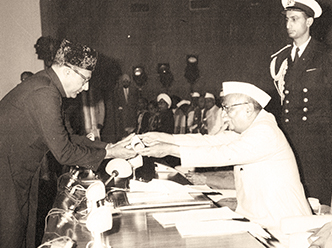
Sheheryar Kaoosji with then President of India Dr Rajendra Prasad
I came to know Prof Meheroo Jussawalla personally when I joined Nizam College in 1959 where she was head of the economics department and students union advisor. Always very caring and accessible she was above all an erudite scholar, thinker and wonderful human being. She balanced all tracks of her life very ably. Her personal life was dotted with challenges and bereavements, starting with the sudden demise of her father in 1936 when she was barely a teenager, to a devastating one-year period during which her 49-year-old husband, his parents and her mother passed away.
The story of her professional life is equally challenging. A brilliant student since her childhood, she fought to enter college at age 15, having chosen economics as her field of interest. This was at a time when young women who wanted to go to college were expected to study literature, languages or engage in music or the fine arts. If they wanted a career it was expected they would be secretaries or school teachers. Jussawalla however was already determined to break the glass ceiling, more than four decades before the term was conceived!
In her case as well, vice chancellor Ali Yavar Jung came to the rescue by supporting her appointment as the first woman to teach economics at the Nizam College in 1949. Soon after that she had the opportunity to join the American postwar PL-480 Academic Exchange in the USA. She received her doctorate and eventually was conferred a professorship and appointed chair of applied economics, and later promoted to dean of social sciences of Osmania University in 1974, the first female dean of the university. She also served as principal of the Osmania University Women’s College.
Her academic compass was disturbed by the happenings at the national political level in India. When the Central Censorship Order was issued in June 1975 by Prime Minister Indira Gandhi, she realized that her academic freedom as an economics professor was in jeopardy. She immediately planned to migrate to the USA where she had enjoyed that freedom as a student and visiting professor. Now, as a middle aged widow, with her daughter Feroza already emerging as a rising star in academia in the USA, she left behind all her personal belongings, awards, citations and family heirlooms, and with only her most valued books and papers she boarded a plane to New York, with the stringent six dollars foreign exchange allowance in her purse!
After a couple of years in Maryland she found an exciting assignment, and as a phoenix she rose once again in a new life at the East West Center in Honolulu. Here her seminal work, Economics of Telecommunications, brought her international recognition as the pioneer of studies in that field. She was eventually Emerita Senior Fellow and Economist at the East West Center, affiliate faculty at the University of Hawaii School of Communications, had published 15 books on the subject and travelled worldwide to teach and consult. In 1998 she was honored with a festschrift titled Communications and Trade: Essays in Honor of Meheroo Jussawalla, com-prising 19 chapters written by specialists and edited by her professional colleague Prof Donald M. Lumberton.
In 2006, six years before her demise, she published a short and very thoughtful memoir that recalls the touchingly intertwined story of her challenges and successes, and the events in Hyderabad and Indian history that framed her life. From its 150 pages aptly titled On Six Dollars to America — A Tale of Adventure, Courage and Reward, she speaks to those of us who follow her, concluding with this compelling epilog: "We cannot change the past, but we can learn to release the painful memories that no longer serve us. I am convinced that human beings have the magnificent ability to overcome the past and to soar above adversity. My quest for academic freedom and many difficulties I endured in that process gave me strength and courage, and I am hoping that my story will serve to inspire others who come after me.”
.jpg) Born and raised in Hyderabad, Yezdyar S. Kaoosji migrated to the USA 45 years ago. Now retired after a career in management and as a consultant for national and international NGO and non-profit organizations, he keeps busy in community and political activities. An earlier version of this article was published in Threads of Continuity-Zoroastrian Life and Culture, edited by Dr Shernaz Cama for the Ministry of Minority Affairs and the UNESCO Parzor Foundation, 2016.
Born and raised in Hyderabad, Yezdyar S. Kaoosji migrated to the USA 45 years ago. Now retired after a career in management and as a consultant for national and international NGO and non-profit organizations, he keeps busy in community and political activities. An earlier version of this article was published in Threads of Continuity-Zoroastrian Life and Culture, edited by Dr Shernaz Cama for the Ministry of Minority Affairs and the UNESCO Parzor Foundation, 2016.