Unlike the Muslim migrants from Iran, the Zoroastrian migrants started at a lower rung
Simin Patel
Extracts pertaining to the migration of "Persian Zoroastrians” to India from the 18th century onwards from a doctoral thesis "Cultural Intermediaries in a Colonial City: The Parsis of Bombay c.1860-1921.” The entire thesis can be viewed on bombaywalla.org
The Great Famine of 1871-72 in Persia occasioned an extensive pan-Parsi effort to provide relief to the Persian Zoroastrians afflicted by the calamity. Parsi communities based in Amoy (in South East China), Cannanore (Kerala), Poona, Surat, Ahmedabad, sent sizeable donations to Messrs Godrez Mehrban and Company, a mercantile firm in Bombay that was the chief organizer of the relief efforts. Through networks involving British Political Agents and military personnel in Muscat and Bushire and prominent Parsis and Zoroastrians in Persia, the funds and food provisions were distributed among the famine struck coreligionists. By July 1871 Messrs Godrez Mehrban and Company had received over Rs 10,000 in subscriptions and its distribution networks had reached Zoroastrians in 33 villages and the major centers of Yazd, Kerman and Tehran. In comparison, at this time the Board of Deputies of British Jews in London was first alerted to the condition of the famine stuck Jews in Shiraz.
The flows were not all westward or one-way. Efforts were also directed towards organizing the passage of groups of Persian Zoroastrian famine refugees from Bandar Abbas via Kurrachee (Karachi) to Bombay. The first group of 29 refugees that arrived in Bombay on June 6, 1871 had the cost of their passage defrayed by Messrs Nicol and Company, the managers of the steamers. Acts of diasporic cooperation included the Parsis of Kurrachee providing food and clothing to the refugees during the brief stopover in the port city. In Bombay, the refugees were accommodated at an asylum for Persian Zoroastrian migrants and celebrated the Parsi New Year with new clothing and meals, sponsored by their coreligionists from Mhow.
The Persian Zoroastrians who fled or migrated to Bombay in the late 18th and first half of the 19th century were often supported by local Parsi families in the city. Through tracing the trajectory of one Persian Zoroastrian family and their Parsi hosts, we can get a sense of ways the migrants were accommodated in the city over this period.
Migrants to Bombay partook of the city’s Parsi landscape of fire-temples, asylums and the Towers of Silence. They were formally organized into an Iranian Zoroastrian Anjuman as late as 1918. How did Persian Zoroastrians, referred to as ‘Persian Parsis,’ come to be identified and established as ‘Iranis’ by the 20th century? Of interest then, is the unmaking of ‘Persian Parsis’ and the making of what came to be called ‘Irani’ identity.
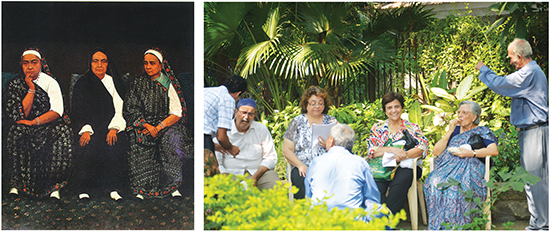
Left: Portrait of Gulbai Panday (center) and her daughters
Photo: Peonies and Pagodas; right: At the Irani Zoroastrian Anjuman elections, September 2014
From banu to bai
Kai Khusran i Yazdyar with his family fled Kerman for Yazd and from Yazd to Bombay in 1796 to save his daughter Gulistan-Banu from being abducted by a wealthy Muslim. In Bombay, the family was hosted by a local Parsi, Edulji Dorabji Lashkari, who helped Kai Khusran travel to Persia on three subsequent visits, to relocate his extended family to the city. At the age of 12, Gulistan-Banu, popularly called Gulbai Velatan (Gulbai, the foreigner) was married to Framji Bhikaji Panday, a Bombay Parsi. The change in the suffix of her name from the Persian banu to the Gujarati bai indicates the shift in identity and kind of socialization that occurred in the new setting. Panday helped several Persian Zoroastrian migrants settle in Bombay. He was called ‘the father of the Irani Parsis.’ The title captures the paternalism that would come to premise the relations between the Parsis and Persian Zoroastrians and the way myths of the father would be made in the community.
In 1834, Gulistan and Framji’s eldest son, Burjorji, began a fund to assist Persian Zoroastrian fugitives in Bombay. Their third son Merwanjee’s activities mark a major shift in kind of assistance — from a largely informal system of support for the migrants in Bombay to a transnational, institutionalized effort towards ameliorating the Persian Zoroastrian population based in Persia. Merwanjee was a founding member of the Association of Zoroastrians in Persia. The Association’s aims, as stated in its slogan, ‘Formed in 1855 by the Parsis of Bombay for ameliorating the condition of indigent Zoroastrian inhabitants of Persia,’ highlighted how the founders chose to locate and identify themselves and the recipients of their aid, especially given Merwanjee’s mixed lineage. In Persia, the Association was referred to as the Anjoman-e akaber-e parsian or the Society of the Parsi nobles. Maneckji Hataria would spend four decades in Persia administering the funds sent from Bombay. Among the projects Merwanjee financed in Persia was the construction and restoration of structures that commemorated the legends of Khatun Banu and Hyat Banu, the daughters of Yazdgerd III (624-651 AD), the last king of the Sassanid dynasty. At the locations where the daughters were believed to have ended their lives to escape Arab captors, an assemblage area for pilgrims was constructed and a reservoir and its surrounding wall restored. He also funded the marriages of a number of Zoroastrian girls in Persia. Merwanjee’s mother could have influenced the causes he chose to support. Merwanjee’s sister Sakarbai was married to Dinshaw Manockjee Petit, a prominent Parsi businessman, who was also a founding member of the Association of Zoroastrians in Persia.
Cursetjee Ardesheer Dadysett, a member of a well-established Parsi mercantile family, funded an asylum for the migrants in Bombay in 1853. The asylum appears to be the first institution built for the Persian Zoroastrians in Bombay. It was located in the Chowpatty area near the Tower of Silence funerary estate and an asylum for invalid and blind Parsis. Both the asylums shared facilities like dining arrangements and a small library.
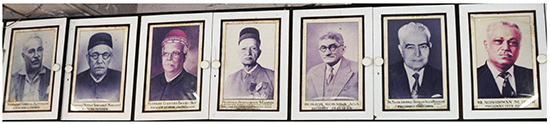
Above: portraits at Irani Zoroastrian Anjuman office (from left): Khodadad Kermani, founder and patron;
Khodadad Nasrabadi, founder member; Pestonjee Eranee, founder member and president;
Pestonji Marker, founder, Marker Institutions, Iran; Burjor Aga, president;
Dr Maj Adarbad Irani, president; Noshirwan Irani, president;
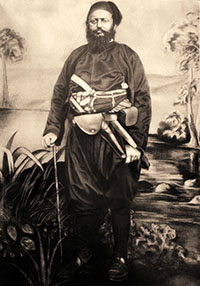
Persian Zoroastrians in mid-19th century Bombay
By the mid-19th century Persian Zoroastrian migrants in Bombay were engaged in a number of occupations — as tea stall and shop owners, theater actors, planters, gardeners, florists, merchants, lawyers, domestic servants. The Persian Zoroastrians carved a niche in a crowded and competitive culinary market by selling tea to the city’s population from stalls and corner shops. Parsi and European proprietors had a strong hold over the hotel trade in the city as well as over culinary establishments like refreshment rooms that were not attached to a hotel. Both hotels and the culinary establishments largely catered to a European clientele. They required substantial capital to set up. Muslim vendors, usually Arab or African migrants or local residents, were the dominant providers of coffee to the city’s population. These vendors toured localities carrying a large number of coffee cups fitted one into another, in one hand and a kettle rested on a portable stove in the other. Persian Zoroastrian migrants joined and developed the culinary economy of the street with their new offering of the corner teashop. These shops soon expanded to sell provisions, aerated waters, ice creams and comestibles (eatables). They were the forerunners of the popular Irani cafes.
The migrants also joined Bombay’s thriving theater industry. Persian Zoroastrian actors were promoted as lending authenticity to the productions, particularly in the staging of stories from the Persian epic, Shahnameh. A review of the performance of Roostum and Burjor by The Persian Theatrical Club in December 1870 noted: "The principal parts of Roostum and Burjor were taken by real Persian Parsis, and as ancient tradition ascribes them giant proportions, the gentlemen who personated them gave us some idea of their huge forms.” In this instance the actors also lent credence to the title of the company, The Persian Theatrical Club. Plays performed in Persian were followed by a rendition in Gujarati. A show included the performance of a few songs, usually in praise of local personalities or the British monarchy, and the staging of farces on local subjects or a didactic skit on the ‘evils’ of an immoral lifestyle, particularly alcoholism. A night’s entertainment could include significant, separate acts in Persian, Gujarati and Hindustani, possibly to attract a more varied and larger audience. S. M. Edwardes, a civil servant and chronicler, noted that for middle class citizens visiting the theater and the Irani shop were popular recreational options.
If young, the middle-class Memon and Rangari (communities) were fond of the native theaters where they rewarded Parsi histrionic talent by assiduous attention and exclamations of approval. He and his friends broke their journey home by a visit to an Irani or Anglo-Indian soda-water shop, where they repeated the monotonous strain of the theater song and assured themselves of the happiness of the moment by asking one another again and again: "Kévi majha (what bliss)!” to which came the reply "Ghani majha” or "sari majha” (great bliss)!”
Persian Zoroastrian migrants also took up the occupations of planters, gardeners and florists. Since several Zoroastrians in Persia were agriculturalists, these occupations enabled the migrants to use the skills they honed in Persia in the new landscape of Bombay. Some migrants found employment as gardeners at the Towers of Silence. The migrant gardeners could also reside on the estate. For example they were allowed to sleep in the sagdi, a room in which mourners prayed after the corpse had been disposed in the towers. They were entitled to meals at the asylum for invalid and blind Parsis that was adjacent to the estate. These provisions suggest how Persian Zoroastrian migrants partook of the Parsi institutional landscape of Bombay as well as the ways in which Parsis configured the presence of the migrant on the wider social map of the city through these settings.
Interestingly, the position of the Persian Muslim migrants in Bombay during this period was significantly different from the Persian Zoroastrians. By the mid 19th century, the Persian Muslims were already organized into a community called the Moguls. The community had several influential members like wealthy merchants and religious and political exiles from Persia. It had a strong infrastructure of a consul, mosque, shrines and residential strongholds. The boundaries of the community were reinforced by differentiating and even distancing itself from the various other Muslim communities of Bombay particularly during the festivities of Mohurram. As Nile Green, author of Bombay Islam: The Religious Evening of the Western Indian Ocean has suggested, Persian Muslim migrants also understood and seized the opportunities for advancement that the setting of Bombay offered. The most famous example is of Aga Khan I, who migrated to Bombay in 1848 and utilized the city’s mercantile, technological and administrative facilities to consolidate and legitimize his position as the leader of the Ismaili Shia Muslims, a community that was dispersed across India and Persia and that was fairly disconnected. Aga Khan invested some of the vast wealth he would go on to acquire in areas like horses racing. This sort of diversification into the world of sport and betting could also be viewed as emblematic of the city’s culture; just as an involvement in the commercial and civic spheres were compatible so were investments in the religious and recreational marketplace. Other emerging Persian religious leaders, like those of the Bab and Baha’i movements, also utilized Bombay’s print and communication technologies to expand their base. Overall, the position of the Persian Muslim community in Bombay, in terms of its infrastructure, wealth and aspiration, resembled the position of the Parsis in the city more than it did the Persian Zoroastrians.
It was perhaps the association of ‘Persian Parsis’ with ‘poor Parsis’ that spurred the migrants to more actively adopt the identity of ‘Iranis.’