Bombay’s oldest surviving fire temple, the 312-year-old Banaji Limji Agiary in Fort, has "re-opened with a re-enthroned fire, after a hiatus of almost two years spent in renovations, which were delayed by the pandemic,” wrote managing trustee Adi Banajee to Parsiana on April 26, 2021. Although no structural repairs or alterations are permitted for the present Agiary structure that dates back to1845, "the main entrance has been given a facelift…with a pedestal in pure white Makrana marble featuring an afargan. The pedestal has relief carvings of the chipya and chamach in the front, the Fravashi on the sides and floral patterns all round,” Banajee noted. The 33 fareshtas are depicted in a braid-like arrangement on the four vertical edges of the pedestal.
The restoration efforts included renovations of the gumbaj area, repairs of the leaking roof, fresh tiling of the dadgah room, changing electrical fittings with new LED lights, ceiling and exhaust fans and water pumps, modernizing bathrooms, and polishing or replacing other fixtures. This major effort was funded by a donation of Rs 50 lakhs from fire temple patrons, sisters Arni and Mani Daruwala, in memory of their parents Goolbai and Pirojshaw Daruwala. The sisters "have proved to be amongst (the Agiary’s) guardian angels,” wrote Banajee. The total expense exceeded the Daruwalas’ donation and was bridged by a gift of "almost Rs 20 lakhs” from a single donor who prefers to remain anonymous.
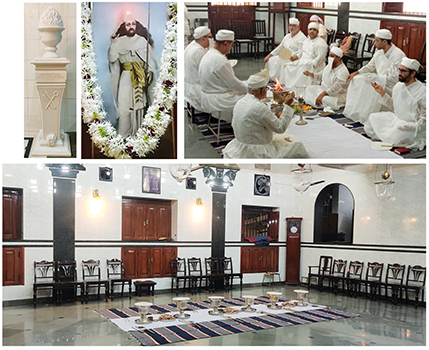
Top, from l: marble pedestal; garlanded frame of the Prophet;
mobeds at jashan ceremony; above: renovated hall
From l, 1st row: restored lamps and prayer area; exterior view during the Banaji Limji Agiary’s 300th salgirah Photo: Homyar Mistry;
2nd row: renovated gumbaj area; Arni (top) and Mani Daruwala; Ervad Hoshedar Panthaki, Jamshed Banaji,
Adi Banajee, Dady Banaji, Hoshang Wania, Bejan Gandhi, Ervad Godrej Panthaki at 300th salgirah Photo: Homyar Mistry
On April 21, 2021, Adar mah Adar roz, the place of worship celebrated its 312th salgirah with a 10-mobed jashan. Agiary panthaky Ervad Hoshedar Panthaki communicated to Parsiana on April 28 that "the priests and non-praying staff are delighted to have our fire enthroned back at its original place…I am extremely thankful to our staff to have gone through inconvenience for a very long period and thank our humdins for standing by us during this time of renovation…We will be able to continue the higher rituals in our own Agiary.” During the pandemic, higher liturgical ceremonies for some behdins were performed at Tardeo’s Sethna Agiary. "I am extremely thankful to the panthaky and staff of Sethna to have allowed my behdins and myself to conduct the same,” noted Panthaki.
On behalf of himself and his three co-trustees Jamshed Banaji, Burjor Banaji and Noshir Mehta, Adi expressed his "deepest gratitude” to the donors and appreciated the services of their panthaky of 14 years "the amiable and supremely accommodating” Panthaki, the Agiary and Trust staff, notably office manager Maneck Mama. The trustees further recalled the services of the late Ervad Godrej, father of Hoshedar, who served as mobed for 55 years including 23 years as panthaky. Likewise the trustees remembered their late colleague Hoshang Wania who had worked with them for 40 years. For the new marble afarganiu, the basic design was created by architect Porus Master and the execution was by artisans in Rajasthan working under the supervision of Jamshed Banaji’s architectural firm.
Built in 1709 by Banaji Limji, a trader from Surat who grew to become a wealthy ship owner, the Agiary was devastated in a fire in 1803. "The holy fire was (temporarily) shifted to Bai Soonaiji Agiary at Gowalia Tank. There is an information hiatus for the period up to 1843 when the Agiary again underwent major repairs over a span of two years. The holy fire, during these two years, was housed in Langrana Agiary in Fort,” explained Adi. Rebuilt by the Banaji family, the fire was re-enthroned in 1845. Subsequently there were periodic repairs and renovations to the edifice until major facelifts were undertaken in 2000 and in 2009, the tercentenary year of the Agiary, noted Adi.