Dr Neville Sanjana’s team of researchers is
focused on genome engineering to gain insights into cancer and autism
Parinaz Gandhi
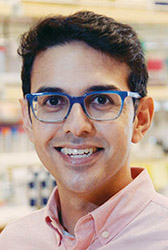
"There is no doubt that many diseases have a strong, underlying genetic component and I am grateful to have the opportunity to work on these important biological problems,” declared Dr Neville Sanjana (pictured), core faculty member at the New York Genome Center (NYGC) and assistant professor of Biology, Neuroscience and Physiology at the New York University (NYU).
"Over the past few years, our lab (SanjanaLab), along with several other groups, has created new tools that make it possible to edit genomes,” added Sanjana in his email response to queries sent by Parsiana.
"The SanjanaLab at NYGC and NYU works at the interface of bioengineering, neuroscience and cancer. Our Lab employs a multi-disciplinary approach… to dissect the inner workings of the human genome and to attack diseases like autism and cancer,” states the website sanjanalab.org
While genes carry only a part of the hereditary material, a genome is the sum total of an organism’s DNA. In Sanjana’s words, "The genome contains the instructions that make us who we are, encoded in the letters of DNA… We are only in very early stages with gene editing technologies but already it is clear that we can ask, and answer, new kinds of scientific questions with these powerful new tools…” After identifying genetic variants that are associated with ailments like cancer or autism, researchers try to understand "the mechanistic basis” of how a disease is caused to help in arriving at a breakthrough in treatment.
"The genome is like a piece of text — if we don’t have Microsoft Word to cut, copy and paste, it’s hard to manipulate the text. Only recently have we had tools like CRISPR (clustered regularly interspaced short palindromic repeats) to write and edit (the genome),” Sanjana was quoted in a report on time.com. From reading DNA, the researchers want to be able to write DNA and thereby stave off disease.
"Although I have not personally worked on the genetics of Parsi or Zoroastrian communities, I am sure that there are certain genetic diseases that are specific to this population that would be great to investigate,” states Sanjana, adding, "This is generally true of any small community that has mostly kept to itself e.g. there are particular genetic diseases that are more common in Ashkenazi Jewish populations than other groups. Right now, the genetics of many smaller groups are understudied but it is my hope that this will not be the case for much longer as the price of genome sequencing falls.”
An alumnus of Torrey Pines High School in San Diego, California, Sanjana graduated from Stanford University with a BS in Symbolic Systems and a BA in English Literature. "Symbolic Systems is a unique program at Stanford that is similar to cognitive science with a healthy dose of artificial intelligence and mathematics,” he states. For his PhD from Massachusetts Institute of Technology (MIT) in Brain and Cognitive Sciences, his thesis work focused on neural development and how neurons in the brain make connections and wire together. After MIT, he spent a few years as a postdoctoral fellow at the Broad Institute of Harvard and MIT, where he worked on developing new tools for genome engineering. A Howard Hughes Medical Institute Predoctoral Fellow, his subsequent work earned him the NIH Pathway to Independence Award and a Simons Center for the Social Brain Postdoctoral Fellowship.
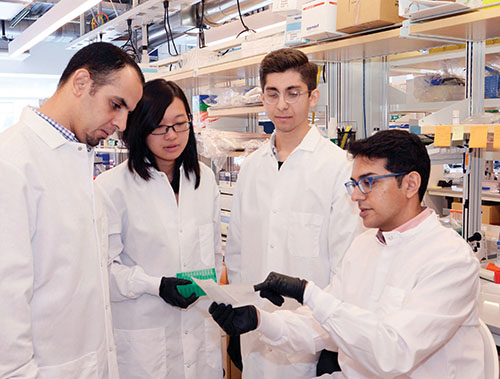
Dr Neville Sanjana (far right) with his team of researchers
When he moved to NYGC, its founding director and CEO Dr Robert Darnell described Sanjana as "an extraordinarily thoughtful, articulate and creative scientist. He has applied his deep expertise in CRISPR technology, bioinformatics and biology to drive new insights in cancer and the brain.” Referring to the work culture at NYGC, Sanjana had commented, "Everybody here is new and that itself provides a lot of raw energy…There are no departments, really, here at the Genome Center. We have core faculty and core labs but none of those traditional boundaries. Everybody works with everybody and that is fantastic…
"In new fields like genome engineering, you don’t need a whole lot of experience but you do need a willingness to try many kinds of experiments, fail, and quickly move on… Being fearless is the hardest thing to do and also the most important… Even as a PhD student or technician in the lab you have the ability to try out new things. If you throw a lot of darts before you pick one direction, you will have many opportunities to hit the bullseye,” Sanjana had stated in an interview featured on the website of the Paul Allen Institute for Brain Science that had also recognized his work with an award.
At Stanford University, he chose to do his BA in English literature when he "stumbled into a class on Charles Dickens and really just enjoyed the enthusiasm of the professor, Christine Alfano, who was an expert on Victorian era literature.” He viewed his BA as "fun…but also very useful as science involves so much writing and critical reasoning.” His interest in cognitive science was aroused from the time he had a school friend whose father was a cognitive scientist at the University of California. Whilst initially he was undecided whether he wanted to pursue cognitive science or neuroscience, he later veered more into neuroscience and particularly molecular and cellular neuroscience.
Having resided in the US since his birth, "Over the years, I’ve taken many trips back to Bombay (where my father Espi Sanjana grew up) and to Jamshedpur (where my mother Veera Sanjana, née Dalal) grew up. My parents raised me in California with a strong connection to the local Zoroastrian community. In San Diego, in the San Francisco Bay Area and also in Boston as a PhD student, I have enjoyed participating in activities of local Zoroastrian associations,” Neville refers to his Zoroastrian bonds.
"At Stanford, I led the Stanford University Zoroastrian group during one of my years as an undergraduate. During my time at MIT, Daryush Mehta, one of my close fellow students and for many years my neighbor in my Cambridge apartment, organized many of the Zoroastrian Students of Boston (ZSB) events that I participated in over the years. Daryush’s grandfather (Dastur Nowrooz Minochehr-Homji) officiated at the wedding of my parents in Bombay and so it was quite a coincidence to encounter him at MIT.” Daryush who currently serves as the chaplain of the Harvard Zoroastrian community is "certainly one of my Boston friends whom I miss since moving to New York last year. As I settle in here in New York, I am hoping to find out more about the Zoroastrian community here,” according to Neville.
Espi has spent the last 20 years leading financial operations at several Northern California art schools. Referring to his father’s "incredible vegetable and flower garden at their home” in California, Neville says, "Every time I visit them, I cannot stop taking pictures of their garden because it is so beautiful.” Veera has taught yoga throughout the Bay Area and also at yearly retreats in the US and internationally. Further, she is part of a US National Institutes of Health-funded study to teach and apply infant massage to prematurely born babies in a local hospital’s neonatal intensive care unit (NICU). Additionally she teaches meditation and cooking. Describing her as "a fantastic cook when it comes to Parsi cuisine,” Neville added, "her dhansak must be eaten to be believed!” The son admires, "I have no idea how my parents, who are both in their 70s, find the time to do everything that they do. They impress me every day and continue to be incredible role models in my life. My parents live in California, but I am very lucky to have a wonderful partner, Ana Gonzalez, here in New York. Ana is a scientist working on cancer immunotherapy and also my best friend.”
Having studied the Zoroastrian texts, Neville writes, "Zoroastrianism has undoubtedly shaped my values. It is a fascinating tradition with connections to so many other old traditions. While I was a PhD student, I took a fantastic class at Harvard on the Zoroastrian texts taught by Prof Prods Oktor Skjærvø, the Aga Khan Professor of Iranian Studies. It was in this class that I first learnt about a world beyond the Khordeh Avesta and was able to delve into translations of the Gathas, Vendidad, Bundahishn and other Zoroastrian texts.
"Even after sampling some of the complexity of the many Zoroastrian religious texts, I feel that one of the greatest things about Zoroastrianism is the simplicity of its core values. I marvel at how many Parsis and other Zoroastrians have been sustained by the simple truth of good words, good thoughts, good deeds. As a scientist and as a human being, I feel lucky to have been influenced by this great tradition and by all the ‘good’ ways it has shaped my life.”