"We could always say ‘This too shall pass’ but we must remember that we never expected in 2020 that the world will stop… but today we are facing this reality… Who knows the calamity may be much worse in future…We need to be prepared,” Udvada High Priest, trustee and president of the Athornan Mandal (AM) Dastur Khurshed Dastoor noted on April 11, 2021 while speaking at an online seminar (pictured) organized by Empowering Mobeds (EM). The event was intended to highlight the experiences during lockdown of the students of the 102-year-old seminary, the Dadar Athornan Institute (DAI), managed by the Mandal. EM is a joint initiative of AM and the World Zoroastrian Organisation Trusts (WZOT) "for mobeds to learn and connect with each other and interact with behdins.”
"Cooperate with parents and teachers…Don’t be too demanding,” the High Priest exhorted. "They are trying their best…if you have to achieve your dream, you have to achieve with your earnings…your mehnat (hard work).” Dastoor recommended that practicing young priests take up part-time work where "you can use your talent…as insurance agents… in the medical insurance field…. Use your time wisely after prayers,” he stated.
For DAI principal Ervad (Dr) Ramiyar Karanjia, the pandemic taught him that "For every obstacle that Ahriman places in your path, you have to make it a stepping stone for success… Resilience is in the Zoroastrian DNA…it should now come to the fore.” The main duties of a mobed — that of a teacher, a performer of rituals, a friend of behdins, a leader — all need good interpersonal skills, he stated, hoping that the students would take advantage of the EM platform ("and the pandemic”) to hone their public speaking skills. DAI joint secretary Ervad Cyrus Darbari stated that the practice of chokkhai (ritual purity) and discipline that is enjoined for a practicing mobed "has stood all of us in good stead” during the pandemic.
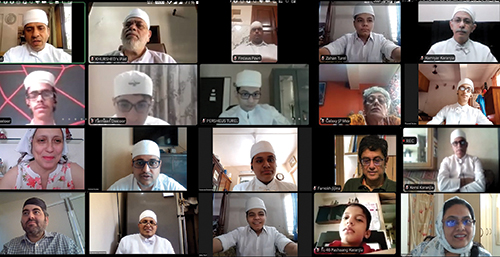
Ervad Perseus Turel narrated how the pandemic transformed him from a "happy-go-lucky child to a responsible teenager” by taking on more family responsibilities alongside his online studies. He indulged his interest in the paranormal, while missing the routine of life in the seminary. Farman Dastoor’s navar schedule was deferred by a year courtesy the pandemic, yet he saw it as a "blessing in disguise” with being able to adapt to online learning. Ervad Varzavand Dadachanji performed a wedding ceremony with his grandfather Ervad Asphandiar Dadachanji and "acquired confidence” to perform higher liturgical ceremonies independently. Ervad Shyamak Sanjana narrated how painting helped "get excitement back” in his life, even while indulging in making malido and cakes with his mother and helping his father with boi ceremonies. "Aapré pandemic ma bov baddhu sikhya ané bov sikhaman lidhi, pan aapré give up nai kidhu (we learnt a lot during the pandemic and took a lot of advice but we never gave up),” stated Ervad Shyamak Dastoor, bringing in a poignant touch by recalling the care and concern of DAI matron Kamal Karanjia while away from the seminary. All the students expressed gratitude to WZOT and the Zoroastrian Charity Funds of Hongkong Canton and Macao for providing laptops to them to ease online learning. The students’ segment was strung together by Ervad Firdaus Pavri, while Ervad Zahan Turel welcomed all present with a short benediction.
Of the 25 online events organized by EM since the pandemic began, many have been focused on students of the DAI. These covered diverse religious and secular topics, Zoroastrian mythology and rituals, and even making malido. "The priests in training are our biggest core constituency,” Ervad Meher Modi, EM core team member told Parsiana.
In response to Parsiana’s follow-up questions, counsellor, therapist and EM program coordinator Binaifer Sahukar stated EM has honed interpersonal skills of the priests-in-training, and even the experienced mobeds, due to their interaction in different programs, with varied demographic segments of the community like XYZ (Xtremely Young Zoroastrians), the teens of HPY (Holiday Programme for Youth) and overseas Zoroastrians in the Return to Roots diaspora.”
Further "Digital communication has increased the participation of the Gujarat contingent, especially Udvada which was unthinkable in the past given their travel restrictions and purity laws… Also, Bombay priests were often unable to participate due to boi duty. Now they can log in from the agiary itself.” F. J.