Jiyo Parsi Care is meant to boost elders
while the 2019 calendar hopes to keep
their message relevant
Text: Parinaz M. Gandhi Photos: Jasmine D. Driver
Three generations of Parsis were in attendance at the Jiyo Parsi function to mark a triple celebration: the launch of Jiyo Parsi Care, Jiyo Parsi Phase III campaign and Jiyo Parsi calendar. "The joy of family is the message of Jiyo Parsi and in 2019 we are looking at making it a part of your daily life,” noted an introduction by Parzor director Dr Shernaz Cama in their newly launched calendar. "Jiyo Parsi is no longer a fertility program but a holistic approach to family life and health.”
An initiative by the Government of India started with financial support of five crore rupees, Jiyo Parsi has helped the community birth figures increase by 172 since its launch in 2013, reminded Cama. As part of its third phase, a new pitch is being made to impress upon young couples that the responsibility towards their parents need not detract from the joys of child rearing and both can be experienced simultaneously with support from Jiyo Parsi. The event was held under the joint auspices of the Parzor Foundation, Madison BMB, Bombay Parsi Punchayet, Tata Institute of Social Sciences and The Federation of the Parsi Zoroastrian Anjumans of India on December 20, 2018 at Sir Ratan Tata Institute on Hughes Road.
"I don’t think Parsis can be critical of the government. The Government did what the Parsis didn’t,” noted Sam Balsara, chairman Madison World, the advertising agency that has been instrumental in keeping the community’s low birth rate in the eye of the media for the last five years. Jiyo Parsi Care "is an amazing scheme… trying to remove all possible impediments” that may come in the way of producing more children, opined Balsara. He was sure though that the "Parsi community will still come up with excuses.” Jiyo Parsi Care will operate three schemes: crèche and child care support of Rs 4,000 per month per child till the child is eight years old for couples whose annual income is less than Rs 15 lakhs; senior citizen honorarium of Rs 3,000 per child for capable seniors undertaking to look after community children up to 10 years of age; support of Rs 4,000 per month for each elderly dependent residing with a couple whose annual income is less than Rs 10 lakhs.
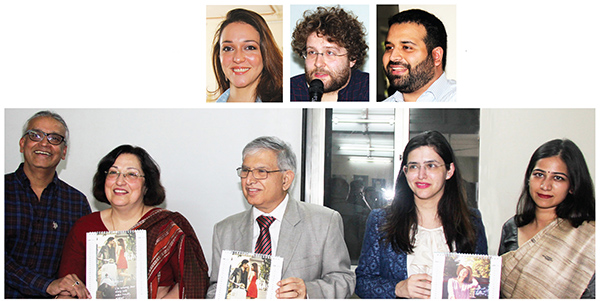
Clockwise from far l: Nauheed Cyrusi Contractor, Anton Zykov, Kaiyan Mistree, Kritika Mudgal,
Lara Balsara, Sam Balsara, Dr Shernaz Cama, Raj Nair
Clockwise from above l: a section of the audience; Pearl Mistry: Jiyo Parsi counselor;
children reciting prayers at the event
Campaign for Jiyo Parsi Care (l): How caring for your children can be invaluable for people in their
second childhood; (r) pick-up line from calendar: "The akuri didn’t agree with me. But by God, you do."
"Parzor and Jiyo Parsi are about culture, not religion. The world suffers every time a culture dies out,” remarked Cama, referring to the "sadness of impending doom and the desire to preserve its identity” that required demographic intervention through Jiyo Parsi. The screening of Not Just Milk and Sugar, a 15-minute film by director Divya Cowasji brought to the fore the ethos and lifestyle of the minuscule community and the many realities confronting its members. Among the clarifications that child actor Rustom Tirandaz seeks from his grandfather played by veteran Boman Irani is whether all Parsis can be considered statues? He earns a tongue-in-cheek response from his granddad who corrects him, "All Parsis are not statues. Only 98% are. The remaining two percent are getting there!”
The ensuing panel discussion anchored by Cama featured Anton Zykov, Oxon, conducting seminar research on Parsi Gujarati under a grant from the European Research Council; Lara Balsara, executive director, Madison World Diversified Communication Group; Kaiyan Mistree, architect who has moved into new technologies and sustainability as head of New Business and Markets, Isprava.
"Maskaa moghu chhè (Gujarati idiom that conveyed he was unduly flattered by the introduction)” stated Zykov who has learnt to speak Gujarati and Hindi. Considering himself fortunate that "there is no baby pressure on me,” he continued on a serious note that in his academic work with the Parsi community he has noticed three things: extreme pluralism that allows "a pagal goriya (mad foreigner) to tell you who you are;” tremendous academic openness; critical attitude which the community has towards burning issues that allows it to come up with an ad campaign like "Be responsible. Don’t use a condom tonight.”
One of the founders of the Return to Roots (RTR) program that since the last five years has been bringing down around 20 overseas youth each year to India to understand the Parsi roots and culture as experienced by the elders in their family, Mistree mentioned that they "wanted to change the narrative” for the youngsters, instead of the frequent portrayal of a dying community. In addition to creating life-long friendships, with the exposure the participants "become ambassadors for us. They are able to educate their parents who didn’t record the intrinsically beautiful traditions and ceremonies… In today’s age, you have to give reasons. You can’t just say ‘that’s how it’s supposed to be done.’” Now a proud father of a little girl, Mistree who met his wife on the first RTR program had advise for young couples: "You have to manage your expectations… Both partners have to be supportive and communicate. Fathers have to pick up the weight of child rearing…Avail of the innate support system of the grandparents… To give back to the community, you must have three children, two to replace the parents and add one more. You must think positive. When you come together, anything is possible.” Before the program ended, the RTR youngsters were brought in to understand the Jiyo Parsi efforts.
The issues that Madison brought up in earlier Jiyo Parsi campaigns are "very, very real,” stressed Lara Balsara referring to the past criticism that the hard-hitting advertisements evoked as "being regressive” or "how dare someone tell me what to do.” Born and brought up in a Parsi baug, she maintained that she well understood what Parsi girls want from life partners. Now a young parent to two children, she admitted, "My work as a mother is not a cakewalk. You need a very, very good support system in the form of grandparents. My mom plays an important role in my children’s lives… Gone are the days when children are only a mother’s responsibility. It is a joy to see my kids interact with their father, a pilot, when he comes back from his flights.” As a working mother, her current three priorities are family, work, fitness, she said, admitting that she has hardly any social life.
Chief guest Nauheed Cyrusi Contractor who has acted in over 100 advertising films and had the courage to walk in and out of Bollywood commented, "You must choose your battlefields where you are comfortable.” Passionate about acting, she began working — in advertisement films — at the age of 14. To appease her parents, she completed her graduation and then did what she wanted. Since a choice of vocation has to be made at a very young age in this country, Cyrusi Contractor observed, "As women, we get married, give up life goals, have children because the future of the community depends on them.” In quest of an identity she frequently asks herself, "Who am I? Men don’t seem to go through it as much as women,” she added.
Conversation starters
"Why have an ad campaign when the target audience is so limited? Can advertising save the Parsi community from extinction?” rhetorically enquired Sam. Although aware that there are barely 5,000 individuals in the child bearing age group in the community who could have been individually approached to give birth to one or more children, Jiyo Parsi chose to rely on advertising campaigns because it believed in "the power of the printed word… Mass media creates a wave, making the message more credible, popular and appear more important and urgent.”
Viewing Jiyo Parsi as the "most satisfying project ad campaign that I have been associated with in my life,” Sam referred to the media awards the campaign won, as also flak from some critical quarters. He expressed his "discomfiture” with the Parsi community that "whenever someone tries to do something positive, there are always 10 guys who will criticize the hell out of you.” The negative feedback though, as pointed out Sam, helped keep the campaigns abuzz. "Jiyo Parsi has a limited objective. It is not trying to solve all the problems of all the Parsis,” Sam tried to forestall critics ready to mount "their own hobbyhorse” at the launch of the third phase of the campaign.
Continuing with its primary aim to reverse the declining trend of the Parsi population, the third campaign works on the premise that "most young Parsis tend to be awkward initiating a conversation on the subject of matrimony.” It has therefore suggested through its visual and printed content some conversation starters like: "The akuri didn’t agree with me. But by God, you do” or "Get out of my dreams. Get into my 1958 Beetle” or "Girl, you’re so precious, you put the dhan into dhansaak.”
Since this campaign also encompasses Jiyo Parsi Care, other creatives reinforce: "Perhaps the best reason yet to become parents: the presence of your parents” or "How caring for your children can be invaluable for people in their second childhood.”
Some of the visuals that have been designed for the advertising campaign feature in the first Jiyo Parsi calendar for 2019 "as a reminder… for 365 days… to our young friends… that we need to act fast,” stressed Sam. And, every page of the calendar carries a footnote: "Don’t stop at starting conversations. If you find that someone, get hitched. Have children. Raise a family. Have fun. Look out for each other. Now and for good. That’s what a good ice-breaker should lead to…”