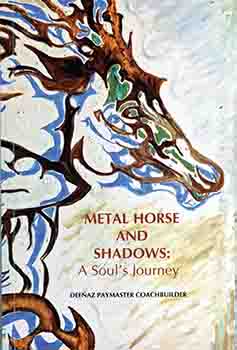
Metal Horse and Shadows: A Soul’s Journey by Deenaz Paymaster Coachbuilder. Published in 2019 by the author, 7429, Breckenridge Drive, Riverside, California 92506, USA. Pp: 149. Price: $ 20.
Deenaz Paymaster Coachbuilder’s (pictured) title of her second volume of poems is intriguing. She explains it at the beginning of the volume: metal is a metaphor for strength and reasoning, while shadows are our ephemeral dreams; we are a product of both,
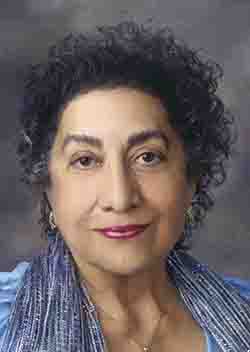
she says, as is poetry, which is a combination of reason and intuition. And this melding of two seemingly contradictory forces is what we see as we read the poems, a gentle, unhurried unravelling of the skeins that make up the tapestry of her life — and poetry.
The reader is drawn into a world seen through the poet’s prism of gentleness, mingled with strength, compassion and warmth. The first section, "Love and Relationships,” explores different aspects of love: romantic, maternal, comradely, filial. The poet loves passionately, with her whole being, "…her eyes/drowned in his presence/like a bee lost among/a lake of lotus flowers.” At times there is a frisson of the erotic, as in Eternal Courtship where the narrator’s fingers lie in the beloved’s lap and "He touches/them/gently.” Being a woman, and experiencing the fullness and complexity of emotion, Coachbuilder also marvels in the innocence of her grandson in Lullaby; the couplets effectively build a magical world for the child: "Come, little Barjor, come hold my hand/we will ride a wild tiger over the sand.” The sense of wonder that grandma and little Barjor share, binds them in "magical music” that allows the poet’s soul to take flight.
Perhaps some of the most moving poems are ones about her parents and brother who died young, aged 22. Even though continents have separated them for decades (Coachbuilder emigrated to the USA from Bombay), memories of her beloved family stay with her: in dreams, in well-loved objects and books, and in the evocation of the senses, when the poet longs "to catch just a faint whiff” of her father’s favorite 4711 cologne, or touches her brother’s face in the fading photograph, or even remembers the feel of her mother’s dark hair.
Coachbuilder’s empathy spans continents and countries and people; she reaches out to victims of war, discrimination and hatred all over the world. There are poems dedicated to soldiers who die for their country, including a decorated American soldier who died in northern Syria, and whose death affects us all, in "the funeral pyre/of/our heart.” Some poems express the grief of the wife of an Indian man killed in a hate attack, or the changing face of America when its borders were closed to immigrants. These tragedies leave such a deep impression on the poet’s heart that she can feel the tears on "Lady Liberty’s face.”
This all-embracing love for humanity also encompasses the poet’s love for nature and all natural things. In the second section, "Mysteries of Nature,” Coachbuilder evokes the prophet of her own religion, Zoroastrianism, who believed in a reverence towards the elements of earth, fire and water, and who has influenced her belief that there is a spirit in every living thing. Whether it is the magnificent redwood trees, a delicate dragonfly, her beloved dog, "a golden autumn leaf,” or a magnificent kite, the poet’s soul reaches out to become one with the subject of her verse. Coachbuilder also experiments with picture poems; in the poem on a dew drop the lines capture the drip drop of dew until it " b u r s t s s h a t t e r i n g” into a myriad rainbow crystals…”
The third section, "Journey of a Soul,” is self-explanatory; here, the poet explores her spiritual beliefs, grounded in Zoroastrianism, but going beyond formal religion. Coachbuilder expresses her gratitude to her past, to the future in the being of her grandson, to the boundless magnificence of nature. These poems are ruminative, luminescent with the idea of the transcendental, images moving from the tactile to regions of the abstract. In Memento Mori, she begins with details of the simple pleasures of coming home to tea and family, and ends with the idea of evening and a gentle death: "the evening sunset to reflect the ends of time/and a sleep with the pleasantest/of dreams.” In Homeward Bound, once again, the idea of home and death are conflated "in a healing of the soul/on its journey/home,” and in I am Lying on my Side, comforting memories of childhood fade into dreams of "bygone night journeys.”
Three longer poems deal specifically with Zoroaster and Zoroastrian rituals and festivals. In Young Zarathushtra, a narrative poem, Coachbuilder traces the events of the prophet’s life, the joy of nature at his birth, attempts by the chieftain Dorasun to kill him, but all of whose attempts are thwarted by "the forces of good,” and leaving home at age 20 to gain divine revelation. Iranshah Atash Behram: Eternal Flame, sees the poet on a personal quest for the divine, as she travels to Sanjan to worship at the earliest fire temple, and her heart "is filled with quietude…;” details of rituals and the essence of the New Year are explained in Navroz Mubarak. While these poems are sincere and emotive especially for a Parsi/Zoroastrian reader, one wonders how a Western reader would respond to the rather protracted and explanatory images of ritual and religious detail. This reviewer’s personal favorite from the ‘religious’ poems is the more compact Messaging Lord Zoroaster, where the poet, listening to the fareshta prayers at the California Zoroastrian Center, thinks of the journey of her own life, and, in images that encapsulate her thoughts, assures the Lord that she will be with him when he calls: "Do not worry about me Lord./When the time is right/O Fareshta O Fravashi, take me by the hand,/For I will fly with you eagerly/to the region of the Chinvat./I am coming.”