TheTaj at Apollo Bunder by Charles Allen and Sharada Dwivedi. Published in 2010 by Pictor Publishing Private Limited, 17 Eruchshaw Building, 3rd Floor, 249 Dr Dadabhai Naoroji Road, Bombay 400001. Pp: 336. Price: Not mentioned.
It has long been both landmark and legend. From its opening in 1903, the Taj Mahal Palace Hotel, known popularly as the Taj, has seen the best of times and the worst of times.Through war and peace, the long march of history has been triumphant and taxing, exhilarating and exhausting! From the happy celebration of its centenary in 2003 to hell and back in 2008 when four terrorists wielding AK-47s and grenades ran amuck for 59 horrendous hours starting on the night of November 26, leaving 31 dead, over 60 seriously injured and scores of survivors scarred, physically, mentally and emotionally. Despite the fires and massive destruction to its heritage and tower wings, the Taj showed remarkable resilience to reopen three weeks later on December 21, 2008, with its tower wing rooms and restaurants — the Zodiac Grill, Souk, Masala Kraft, Shamiana and Starboard bar — back in business. Wasabi, its specialty Japanese restaurant, opened on the top floor of the Taj Tower three days later.
"We will do whatever it takes to get the heritage wing back to its old glory and so renovate it that it will be better than it ever was, so that it will be the glory and icon of the city again. And when we do that, we will have sent a message that resonates strongly among us: that we can be hurt but we cannot be knocked down. The Taj will stand for another hundred years, and will stand as a tribute to the tenacity of our people,” Ratan Tata, Tata Group and Indian Hotels Company Limited (IHC) chairman, is quoted in the book. At the same time, the Taj Public Service Welfare Trust was set up with the backing of the IHC, the Sir Dorab Tata Trust and the Sir Ratan Tata Trust, to provide immediate financial relief to the families of all the victims of the 26/11 attacks, whether they were at the Taj or the Victoria Terminus or elsewhere. The Welfare Trust would also in future aid victims of sudden acts of violence, including natural disasters and other tragedies. The Ratan Tata Awards for Bravery scheme was also announced by the IHC to give recognition to conspicuous acts of bravery in future as well, wherever they may take place within the Taj Group, the book informs us. The entire proceeds from the sale of this painstakingly compiled work will go to the Taj Public Service Welfare Trust.
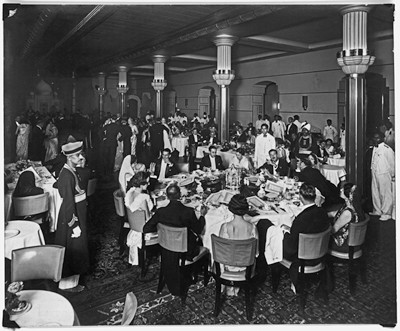
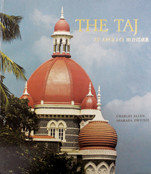
(Top) Book cover; (above) At the ball celebrating King George V’s silver jubilee in 1935, host Sir Nowroji Saklatvala (with bald pate) speaks to J. R. D. Tata with Lord Brabourne (holding cigar) to the right
The Taj at Apollo Bunder was first showcased at a grand party at The Pierre, a Taj Group hotel, in New York on October 17, 2011 where celebrities like actors Michael Douglas and Adrien Brody, authors Salman Rushdie and Paul Theroux and others read excerpts from the book. On December 16, 2011, on the Taj’s 108th birthday, Ratan Tata launched the book in Bombay, along with R. K. Krishna Kumar, IHC vice chairman, and Raymond Bickson, managing director and chief executive officer. Author William Dalrymple, filmmaker Shekhar Kapur, Arvind Singh Mewar of Udaipur and others brought alive the Taj history with their readings.
"Indeed, as the book brings out tellingly, it is emotion and spirit that has largely fuelled the history of the Taj and not reason and logic. The Tata Group founder Jamsetji Tata overreached himself in creating the ‘finest address east of the Suez’ for the wealthy international traveler but, in reality, the Taj struggled for a steady clientele in the initial decades. Indian Hotels, the company that owns the Taj, is the oldest operating Tata company but through much of its early history its finances were so parlous that it became the neglected child in the Tata family…” writes Ratan Tata in his Foreword. In 1962 Leslie (Duggie) Sawhney, an ex-colonel from the Indian Army, was appointed the director-in-charge of Indian Hotels. "…the consequent appointment of people like Ajit Kerkar, Xerxes Desai and Camellia Panjabi into its management team and the efforts of Rodabeh Sawhney and Liz Kerkar, who gracefully modernized the facilities, saw the hotel transform from a rather run down place to one which was classy and eternal, and the proud flagship of what evolved into the Taj group of hotels,” Ratan Tata continues.
The book is heavyweight and not just in terms of kilos! Co-authors Allen and Dwivedi have been meticulous researchers. This is not merely a Taj and Tata story. The journey from cover to cover traverses the growth and development of Bombay, its booms and busts and how it affected the Hotel. Its large canvas encapsulates the colonial and the contemporary. Chronicled are the plebians and patricians, scholars and savants, politicians and pundits who sometimes in unison, at others in disunity, threaded together the destiny of India.
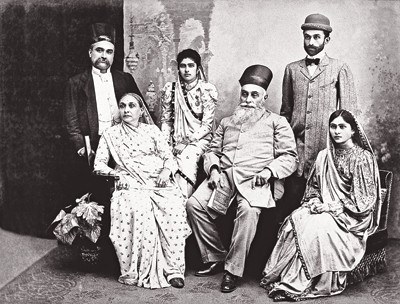
(Left) Tata family portrait,1865: Jamsetji (in white) standsbehind his father Nusserwanji (center), with Dorabji at grandfather’s feet. Seated (middle row) are Manekbai Tata, Jerbai Saklatvala, Rat-tanbai Bamji, Jeevanbai and Hirabai Tata and Virbaiji Saklatvala with children; (Right) R. D. (Ratan Dadabhai) Tata and wife Sooni (both seated) with Meherbai and Dorabji
The beautifully illustrated coffee table book opens with a sweeping photograph by Noshir Gobhai on the Contents page of the Taj’s tall central cupola serenely overlooking the boats dotting the harbor. But what really catches the eye are the magnificent double spread black and white photos of the 19th and early 20th century — of British sahibs and memsahibs enjoying tea and fresh air on the lawns of the then for-whites-only Royal Bombay Yacht Club, with the Chinese Pavilion (later replaced by the Gateway of India) and Custom House in the picture; the aerial 1930s shot of Apollo Bunder with the Gateway of India, the Taj and Greens captured in one frame; the group of Gujarati, Maharashtrian and Parsi women united under the banner of the Indian National Congress… Maharajas and maharanis in turban and tiara, little bejeweled Indian princes with sword and sherwani, the chest ribbons and medals of king and viceroy in uniform; the ramrod lines of the honor guard; the crisp duglas and pugrees, exquisite jewellery and saris of members of the founder’s family provide priceless pictorial remembrances for posterity.
"More than a century ago an English observer wrote that there was no place like Bombay either inside or outside India. ‘The Island City is unique,’ he declared. ‘A well into which the races of Asia have poured themselves. It is full of the wealth of the East and the wealth of the West, and the poverty and vice of both. It has palaces fit for a prince and human kennels unfit for a dog…’ These words were written in the aftermath of the terrible plague that yearly swept the city in the 1890s, taking thousands of lives and which was an indirect consequence of overcrowding and inadequate planning, Today Bombay has reverted to its original name of Mumbai (Bombay or bom bahia, the good bay, was coined by the Portuguese) but is still a victim of its own success as it was then…” the authors observe.
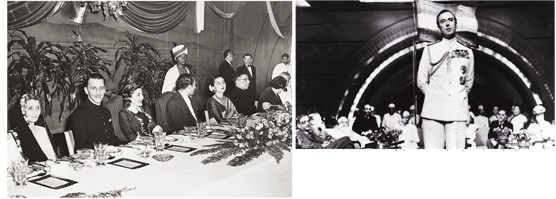
At the banquet for royal visitors: (l to r) Lady Navajbai Tata, J. R. D. Tata, Queen Soraya and the Shah of Iran, Thelma Tata and Harekrishna Mahtab, Governor of Bombay; Lord Louis Mountbatten holds center stage at the Ballroom during celebrations for India’s Independence
The role of the Tatas in the early industrialization of colonial India is extensively narrated. "The little town of Navsari, where Jamsetji was born in 1839, had been a stronghold of the Zoroastrian priesthood ever since the arrival of the first Parsis in Gujarat. In the 19th century it was a place where boys of the priestly families, or dastur, to which the Tatas belonged, grew up in a religious but intellectually stimulating atmosphere, the town being a hotbed of religious disputation within the Parsi faith. The family name, Tata, was said to have been derived from the peppery (tato, hot-headed) temper of an early forbear…”
Young Jamsetji’s father Nusserwanji joined the Parsi migration to Bombay in the early 1850s, apprenticing himself to a Hindu banker and merchant. In time he set up his own business and soon owned a large house in Fort. At 15, Jamsetji was sent to Elphinstone College, renowned for the quality of its education. While still a student, "he followed Parsi custom by marrying a girl several years younger than himself, the shy and self-effacing Hirabai Cursetji, who would bear him two sons: Dorabji in 1859 and Ratanji in 1871,” the book narrates. Jamsetji was sent to Hong Kong and Shanghai to expand his father’s business interests in China and then to England to set up a London agency for his father’s business partner Premchand Roychand. "From China he brought back a rickshaw, complete with Chinese rickshaw pullers, that created quite a sensation in Bombay, and from London a hansom cab (fast, light, low-slung carriage pulled by a single horse) in which he took morning and evening rides along the Back Bay,” the authors describe. This was replaced later by a motor car — the first to be owned by an Indian in Bombay.
Jamsetji developed a political philosophy that was based on economic rather than political action — a bold and original viewpoint considering the circumstances prevailing in India under British rule. Studying the working of the Lancashire mills during his trips to England, Jamsetji opened his Empress Mills in Nagpur, naming it after Queen Victoria who was proclaimed Empress of India on January 1, 1877. "When the other mills had machines that worked at speeds of 6,000 revolutions, Empress Mills attained speeds of 12,000… He (Jamsetji) introduced humidifiers and fire-sprinklers to India, bonus schemes for good attendance and efficiency, pension funds, accident compensation benefits and recreation facilities… These two factors — advanced industrial methods and enlightened labor relations —were the twin foundation stones upon which the future Tata business empire would rise,” the authors state.
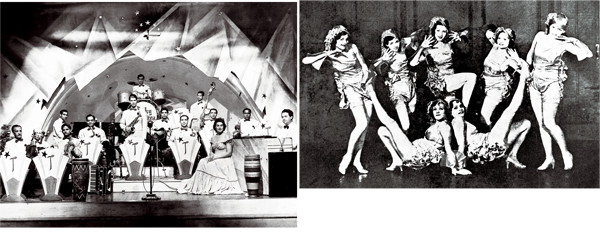
Elegant entertainer Laura Hamilton with Mickey Correa’s band (left); Pompadour and the Follies, 1933
By the early 1890s Swadeshi Mills, set up in Kurla, "nine miles outside Bombay,” was producing high quality cotton cloth for the home and overseas markets and the "name of Tata and Sons — for by now both Dorabji and the young Ratan were closely involved with their father in all his schemes — had become a guarantee of quality throughout Asia.” Jamsetji was also working closely with a cousin Ratan Dadabhai Tata (better known as RD, father of J. R. D. Tata) who was based in Hong Kong for a while. Battling British obstacles at every turn, Jamsetji fought against what he saw as "false imperialism” that gave precedence to the rights of Englishmen over others. He even went to London to put the Indian mill-owners’ case before the Secretary of State for India. He was unsuccessful. The British made a conciliatory offer of a baronetage, which was politely declined!
The offices of Tata and Sons were in the early 1900s located "in a rickety block known as Victoria Buildings, in the heart of the northern Fort area in Parsi Bazaar Street.” In the final years of his life, Jamsetji launched "four grandiose schemes, none of which he lived to see into completion” — the creation of the Indian Institute of Science in Bangalore, the manufacture of pig iron and steel (in Sakchi, later Jamshedpur) from Indian iron ores, the generation of hydro-electric power in the Western Ghats and the construction of the Taj Mahal Palace Hotel. "All sorts of weird and fanciful stories have grown up around the building of the Taj,” the authors write — that it was built back to front, that in horror the architect leaped to his death from the fifth floor, that Jamsetji conceived the idea of the hotel because he was once refused admission to either Watson’s Hotel or Pyrke’s Apollo Hotel. "Such an act of discrimination may well have taken place but it seems far too petty a reason to fire a man of the caliber of J. N. Tata, who in the past had not hesitated to cross swords with governments and powerful commercial combines,” Allen and Dwivedi believe.
In 1902, as the construction neared completion, he "embarked on an overseas buying spree, scouring New York, London, Paris, Dusseldorf and Berlin for the most modern equipment that could be procured.” An electric power plant installed in the garden was to supply electricity for the lights and lifts while a back-up system of gas lights would provide additional lighting in the event of power failures! A carbon dioxide ice-making plant which could make 15 tons of ice per day would service Bombay’s first cold storage cellars and "also provide a cooling system for a number of rooms — almost certainly the first such air-conditioning system in Asia.” A Turkish bath (another first in India), a soda-water bottling factory, an electro-polishing machine, a knife-cleaning and sharpening machine, German lift machinery and American electric fans set the Hotel apart from the rest. "In Paris Tata attended an exhibition at the new Eiffel Tower and saw there the very last word in turn-of-the-century technology in the form of spun steel pillars. He promptly ordered more than a score of such pillars for the ballroom of his hotel and the front porch,” the book notes. Tata’s investment in the hotel was nearly Rs 26,00,000! In return he received 3,600 shares of Rs 500 each, making him thereby IHC’s sole shareholder.
Jamsetji returned to India in time for the great Delhi Durbar of January 1903 organized by the Viceroy Lord Curzon. "As India’s leading industrialist he might reasonably have expected to be present as an honored guest,” but he was not invited! The Taj opened for business (see "The taj of the Tatas,” Parsiana, October 2003) for its first 17 guests on December 16, 1903, "quietly and with little fuss or public announcement.” The board meeting on that day resolved "that no concessions should be allowed to the directors” when they used the Hotel’s facilities! It was the last meeting the founder presided over. Sailing to Europe to seek medical treatment for his health which was fast failing, he passed away in a private clinic in Bad Nauheim in Germany on May19, 1904. His body was brought to England and interred in Brookwood Cemetery to the accompaniment of Parsi rites and prayers.
But times were tough and there were complaints galore at the Hotel! Guests did not like the floors made up of fragments of broken china "which was all very well for ornamental purposes but when one has to tread upon it bare-footed one’s admiration is apt to ooze out of the soles of one’s feet,” wrote an Englishman called Mathews in 1905 in his Diary of an Indian Tour. Bathrooms and lavatories were gathered at strategic points along the corridors. "Right up to the mid-1930s, if guests felt unequal to leaving their rooms they had to make do with chamber pots and ‘thunderboxes,’” the book informs us. The kitchen was located on the top floor — an expensive mistake that was rectified in the 1930s!
One cause for optimism in the early days was the restaurant-cum-lodging house next door known as Greens (where the Taj tower wing now stands), built around the same time as the Taj and owned by an English grocer named W. B. Green. Greens came up for auction on the death of its owner and was bought by the IHC in 1904 for Rs 3,65,000! Greens had gained "a certain notoriety for its racy, honky-tonk atmosphere. Upstairs, however, a very different ambience prevailed. Here were flats occupied mostly by a number of elderly Indian bachelors, and on the fourth floor a private club founded by the Parsi financier and philanthropist Sir Cowasjee Jehangir. A brass nameplate on its door read ‘Asian Club. Not for foreigners,’ but it was to all intents a Parsi millionaires’ club.”
Terrorists wreak death and destruction in 2008; (right) guests and staff clamber out on to the parapet to be rescued by firemen
Gradually the Hotel gained its customers — the lobby would be filled with mountains of trunks and duffle-bags when the P&O liners disgorged their floating population! "Everyone carries his own bedding in India,” noted an American visitor in 1913. He was also surprised to see "little knots of native servants, in groups from two to half-a-dozen, according to the size of their master’s family. At certain hours one saw them eating or sleeping huddled together outside their master’s door.” The maharajas and nawabs brought in the glamor. One of the grandest events took place in 1917 in the form of a ‘durbar’ hosted by Indian royalty and organized by the Jam Saheb of Nawanagar — better known as Ranjit Singhi or Ranji, the cricketing prince. The 10-course banquet saw the raising of toasts and oratory, but "all these worthies were upstaged by the doughty Begum of Bhopal, who having eaten apart from the men as custom dictated, entered the dining room towards the close of proceedings covered from head to toe in her burkha, taking her place between the Governor of Bombay Lord Willingdon and the Maharaja of Bikaner” in whose honor the banquet was being held!
Then came the plot and circumstance of the freedom struggle — the sloganeering and high ideals, the strife and the suffering. The Taj and Greens were among the few places where Indians and Englishmen could meet as equals. "Jawaharlal Nehru, M. A. Jinnah, Sarojini Naidu and Subhas Chandra Bose were among the many political activists who came to speak and listen. In 1931, at a private dinner organized under great secrecy, the speaker was M. K. Gandhi.” Naidu, the nightingale of India, had made the Taj virtually a second home for almost three decades. "A regular caller at Naidu’s suite of rooms was the young and beautiful Rutten Jinnah, daughter of the eminent Parsi industrialist Sir Dinshaw Petit, who had married the much older Jinnah in the mid-1920s. Though a daughter was born, the marriage was not a very happy one and each time there was discord in the Jinnah household, the youthful bride moved into rooms at the Taj — where she finally died in 1928, under tragic and mysterious circumstances,” the book narrates.
The food, fun, frolic and fiesta of a five-star hotel are abundantly chronicled. The cocktails and cabaret, (Rs 15 for a three-course dinner with cabaret in the Ballroom on Saturday nights in the 1930s!), the jazz band performers in bow tie and coattails, the Melody Trio of violinist Mehli Mehta… "The Bombay Chamber Orchestra used to play at the Taj every Sunday morning and this little boy used to stand and conduct behind the conductor. This was Mehli Mehta’s son Zubin who grew up to become one of the great conductors of the age,” the book notes. Well-known painter Jehangir Sabavala, scion of the Cowasjee Jehangir family, used to visit the Hotel almost every day as a child. His father A. P. Sabavala was director-in-charge from 1940 to 1954. "After I joined Elphinstone College, my future wife Shirin and I went regularly with friends to the Palm Court, which was utterly charming with wicker furniture and of course, lots of palms — and they served the most delicious ice cream sundaes,” describes Sabavala. Adorning the lobbies, corridors and suites is an "extraordinarily eclectic collection of art works,” antique and contemporary, the book notes.
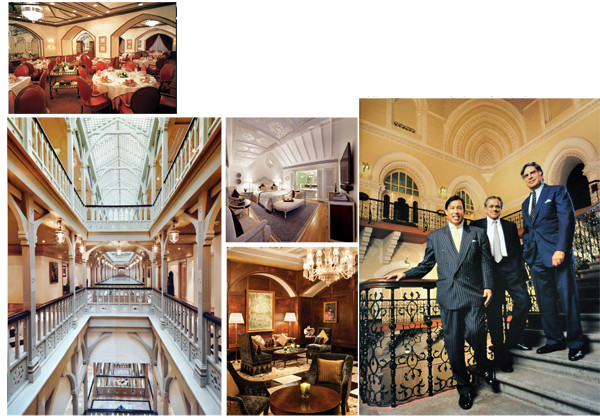
Beauty is back: restored heritage corridors, the Seagull Suite and Palace Lounge; the Zodiac Grill when it first opened; (right) Raymond Bickson, R.K. Krishna Kumar and Ratan Tata
Sir Dorab Tata died in 1932 (his brother Ratan having predeceased him in 1918) and, as he had no children, he left his considerable fortune in the form of a charitable trust. "The Sir Dorab Tata Trust, together with the Lady Tata Memorial Trust and a third trust later set up by Sir Ratan’s widow, Lady Navajbai, before her death in 1965, ultimately came to hold 81.6 percent of IHC’s stockholding. This meant that from this time on the Taj became a funding body for good causes — giving it a unique status among the great hotels of the world,” the historians note.They record the role played by the inheritors and consolidators — Sir Nowroji Saklatvala, Sir Homi Mody, J. R. D. (Jehangir Ratan Dadabhai) Tata, his brother D. R. D. (Dorab RD), Naval Tata and his son Ratan, the present chairman and a host of management and staff who over the decades have taken the one-hotel enterprise to its present position of eminence, with 93 hotels in 55 locations across India and 16 international hotels in the Maldives, Malaysia, Australia, UK, USA, Bhutan, Sri Lanka, Africa and the Middle East, as per their website.
IHC went public in 1970. Three years before that, on December 7, 1967, the Koyna earthquake had hit the city. "The Taj shuddered and rolled like a ship hit by a sudden squall — but held together,” the authors write. In 1969, the interiors of the Taj (heritage structure) "underwent as drastic a renewal as could possibly be done short of actually knocking it down… The chipped mosaic flooring and the wood and steel floor slabs were replaced by reinforced concrete; brick and concrete was substituted for the original partition walls of rice husk and cement… Radical surgery though it was … the patient rose from the operation table, not merely with her health recovered but positively rejuvenated.” The added strengthening was probably one of the reasons why the Hotel survived even the onslaught of RDX almost half a century later, when the avowed aim of the terrorists was to bring the Hotel down, at least the central cupola and dome, if not the whole.
The last two chapters of the book reconstruct in great detail, in word and picture, the events of 26/11 and their aftermath, the valor of hundreds of Taj staffers who put their life on the line to save their colleagues and the guests trapped in the crossfire. Assistant chef Kaizad Kamdin, aged 28, was killed in the kitchen along with many other chefs as they were helping guests to escape; security officer Noshir Sanjana was shot in the knee while leading the police party to safety, but survived despite bleeding heavily. Steward Adil Irani was held hostage, tied up, beaten and kicked but miraculously escaped by climbing on to a gable roof on the fourth floor, then used bed sheets to climb down, urged on by Taj staffers, to the second floor terrace, breaking a rib and cutting his feet on broken glass. Crystal Room steward Noshir Gawadia came under fire but escaped unhurt. Telephone operator Hutoxi Sorabkhan stuck to her post along with her colleagues, continuing to take and make calls all through the night and through the next day, passing on vital information.
The chain of events also brings to the fore what could have been a much earlier end to the horror, when the Taj security staff and the CCTV cameras pinpointed at around 11.30 p.m. on the very first night that all four terrorists were holed up together in one room at the far end of the south wing on the sixth floor, adjacent to the fire staircase door. This presented an opportunity at least to isolate them or confine them to that area. But the police in the CCTV room were ordered by their superiors to wait for back-up, which never came. "Thus a golden opportunity to save lives and property was thrown away. The police may have been inadequately armed but the fact remains that nothing was done to strengthen their hand over the course of the next two hours and 52 minutes,” the authors relate. The MARCOS (marine commandos of the Indian Navy) were "set to move in just after midnight, but remained inactive over the next two-and-a-half hours — apparently awaiting written permission to proceed.” All this while, Ratan Tata and others of the ‘Taj family’ watched in horror from the opposite pavement near the Gateway of India, unable to enter, unable to overcome bureaucratic bungling. The NSG (National Security Guard) commandos arrived much later. The restoration has cost millions; the heritage wing remained closed for over a year and eight months, with consequent loss of business.
The idea of the book had been conceived way back in the late 1970s. British writer Allen and Bombay-based conservationist Dwivedi’s research "encompassed more than 200 interviews and extended over more than two decades.” It is perhaps due to the vast nature of the work in the book that small proofreading errors have crept into the captions and text. Sadly, Dwivedi passed away suddenly in Bombay on February 6, 2012.
"She (the Taj) has stood for 100 years and will stand for 100 more,” the book carries Ratan Tata’s prophecy. The profitability and philanthropy will continue, in keeping with the present chairman’s stated philosophy: "Indian in ownership, at home in the world.”