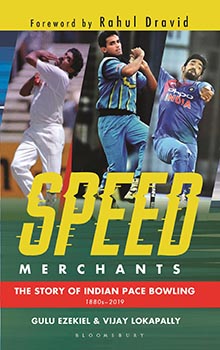
Speed Merchants: The Story of Indian Pace Bowling 1880s-2019 by Gulu Ezekiel and Vijay Lokapally. Published in 2020 by Bloombury Publishing India Private Limited, Second Floor, LSC Building No. 4, DDA Complex, Pocket C-6 & 7, Vasant Kunj, New Delhi 110070. Pp: xviii + 207. Price: Rs 499.
In the years when this reviewer commentated on Test and ODI (One Day International) cricket matches, one of his favorite expressions, a variant of an old aphorism, was: "And once again, India’s opponents make hay while the ball shines!” That was the situation in the late 1960s and early ’70s. This book tells you the Indian fast bowling story from the beginning. Starting with the great Dr Mehellasha Pavri (who toured England with the All Parsees team in 1888 and is regarded in some quarters as this country’s first great fast bowling all-rounder), the book traces the evolution of pace in India thereafter, highlighting along the way the stellar roles played by great fast bowlers like Shaikh Mohammad Nissar and Amar Singh in the baby-step years of Indian Test cricket history (at the first ever Test match at Lord’s in 1932, England were 19 for 3 on the opening day!).
Of particular interest to readers of Parsiana will be the section detailing the early successes of the Parsis who inflicted the first ever defeat on a touring side — George Vernon’s English touring team in 1890, following that up with a win against Lord Martin Hawke’s side in 1892 and completing "a glorious hat-trick” when they beat the third English touring team, the Oxford University Authentics, in 1902.
Pavri was a great personality — a doctor by profession, "his massive physique coupled with an impressive beard giving him a formidable look.” Pavri took over the captaincy from J. M. Framjee Patel and groomed in particular, two fast bowlers, both from the small town of Ajmer: M. D. Bulsara and K. B. Mistry. As co-author Gulu Ezekiel notes, Bulsara was nicknamed "The Demon” after the legendary Australian fast bowler Fred Spofforth.
Mistry was a left arm seamer "who struck terror in the hearts of batsmen across the land” in the early years of the 20th century. Ironic then that it was not until almost five decades later that another Parsi left arm fast bowler emerged, Rusi Surti, who was always a bundle of energy and represented the country with distinction. More’s the pity that except for the blink-and-you-will-miss-it fleeting appearance by Hoshiedar Contractor, back in the 1980s, there has been no Parsi fast bowler at all. Arzan Nagwaswalla of Surat, who has performed creditably for Gujarat in the last two seasons, is perhaps the sole hope for the future.
The authors analyze the later barren years, when only men like Dattu Phadkar and Ramakant Desai toiled virtually single-handedly to continue the fast bowling tradition. They very perceptively look into how the domination of the spin quartet — Erapalli Prasanna, Bhagwat Chandrasekhar, Bishen Singh Bedi and Srinivas Venkatraghavan — in the Mansoor Ali Khan Pataudi-Ajit Wadekar era virtually drove fast bowers to extinction, until the dramatic changes brought about after the advent of the great Kapil Dev in 1978. The fact that today, India’s "pace quartet” — Jasprit Bumrah, Mohammed Shami, Ishant Sharma, Umesh Yadav — is regarded as among the finest attacks ever, is due as much to Dev’s inspiring journey as it is to the sheer hard yards put in by these youngsters on largely unhelpful wickets.
The book is extremely readable and obviously meticulously researched, especially the story of the initial years. Inevitably, there is much in the book that is well-known to every person with even an average interest in Indian cricket history. To this reviewer, the true worth of the book lies in the nuggets of information regarding lesser-known persons and events that did not hit the headlines. The story of Pakistan’s Hanif Mohammad’s travails against Desai’s bouncers in the 1960-61 series is fascinating and Ezekiel tells the story well. Here was one of the world’s leading batsmen, having just scored 337 runs against the West Indies and 499 runs in the domestic competition. Yet, he did not know how to counter ‘Tiny’ Desai’s lethal bouncers and by the end of the series, was actually found "to be retreating to square leg as Desai came charging in to bowl.” Clearly, playing on the psyche of batsmen has always been an integral part of the game.
Another nugget revealed in the book involves Mohammad’s younger brother Sadiq and Dev, decades later. Co-author Vijay Lokapally perceptively notes the incident as marking the arrival of a quickie not to be trifled with. It was 1978, Dev’s first tour. As Lokapally puts it, "Sadiq strode to the pitch in a cap, showing utter disregard for Kapil’s pace. He soon realized his folly and promptly asked for a helmet. It was perhaps the first time that an Indian bowler had compelled a rival batsman to wear a helmet. Kapil won a minor battle when one of his rising deliveries struck Sadiq on the helmet. Kapil had established himself as a genuine ‘quickie.’”
Lokapally also reveals the amazing statistic that Dev and Karsan Ghavri figured as the opening pair in 25 Test matches and did not allow the opposition to register a century stand for the opening wicket even once! Refreshingly, the authors have not focused only on the successful stars. The tales of heartbreak and frustration of many aspiring pacemen in India who toiled manfully on generally placid wickets, are told with considerable sympathy. Consider the case of Maj Gen Joginder Singh Rao who played for the Services in the Ranji Trophy. He had the unique feat of a double hat-trick in the same innings, first dismissing Nos 1, 2 and 3 off successive balls and then returning to get rid of Nos 9, 10 and 11 in the same fashion. Yet, he is hardly heard of.
Or Kailash Gattani, one of the most "cerebral” medium pacers who figured in six Ranji losing finals, whose career unfortunately largely coincided with the spin era, which meant he never played for India. He is still regarded by many as the finest opening bowler never to have represented the country. In a highly evocative chapter titled "The Barren Years” Ezekiel reveals much fascinating stuff about such unsung heroes.
Speed Merchants is a first of its kind in India, no doubt drawing its inspiration from David Frith’s classic The Fast Men. Frith in fact has contributed an Introduction, which along with Rahul Dravid’s Foreward, adds considerably to the merits of this book. There is also a helpful Statistics section by Rajneesh Gupta. It is interesting to note that Mohammed Nissar had the remarkable strike rate of 48.44 — a wicket every eight overs! The Statistics section lists out all the players who have bowled pace for India from 1932 to 2020 — but there is one significant omission: a cricketer who went by the name of Sunil Gavaskar, who loved to turn his arm over when an opportunity presented itself and if memory serves one right, once bowled a "bouncer” in a Test Match at the Wankhede Stadium!
The co-authors are seasoned pensmiths and both have had a long association with cricket in this country. What emerges from their analysis and experiences is that the fast bowling revolution in India, reignited by Dev, has reached its present heights because of the Board of Control for Cricket in India’s efforts to prepare more sporting wickets for domestic competitions. In that regard, one is pleasantly surprised to read that several cricketers regard the pitch at Valsad, a relatively sleepy town in Gujarat, with no great cricketing history, as one of the liveliest of wickets on which pacemen revelled.
The other constant thread found in many of the success stories noted in the book is that in order to be effective, great fast bowlers need the support and backing of their captains and in this regard, Gavaskar, initially, and Saurav Ganguly and Mahinder Singh Dhoni, later, lead all the others; conversely, in the absence of such support, fast bowlers tend to under-perform, as the lessons learnt from the careers of fast men like Subroto Guha and Pandurang Salgaocar, show.
The authors have an interesting theory that the rise of fast bowlers depends also on the quality of the spinners: teams with effective wicket-taking spinners have fewer places for pacemen and vice versa. Happily, the history of successful sides has shown that the best is a combination of both (with the possible exception of the great West Indian pace-domination years under Clive Lloyd, when after Lance Gibbs, there was no spinner worth the name).
Speed Merchants is an easy, delightful read, although for such a prestigious publication, there are annoying typos that could have been avoided. The role of the fast men in India’s iconic 1983 World Cup triumph does not get the space it deserved. The later chapters, interesting as they are, could have done with tighter editing and a little re-arrangement of content, as the remarks on some of the later pacemen — Chetan Sharma, Ashish Nehra, Zaheer Khan, Ajit Agarkar, Atul Wassan and others — appear to be somewhat disjointed.
Whilst the contribution of the MRF Pace Academy in Madras under the great Dennis Lillee is correctly highlighted, the total blanking out of Bombay’s BCA-Mafatlal scheme under the legend, Frank Tyson is surprising, considering the thoroughness with which the subject has been otherwise covered. For the lay reader as also for researchers and serious students of the game, who will no doubt thumb through this book, a subject/name index at the end would have been extremely useful. FREDUN E. DEVITRE
Devitre has been associated with cricket in India for almost 50 years as a commentator and freelance writer.