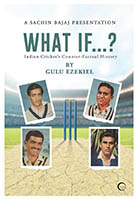
WHAT IF…? Indian Cricket’s Counter-Factual History by Gulu Ezekiel, edited by Sachin Bajaj. Published in 2025 by Global Cricket School, 508, Neelkanth, 98, Marine Drive, Bombay 400002; email: info@globalcricketschool.in. Pp: 212. Price: Rs 490.
WHAT IF….? Indian Cricket’s Counter-Factual History is Gulu Ezekiel’s 16th book on cricket, but it is unlike any of the others that he has penned. In a fascinating survey of Indian cricket from its earliest years (starting with the two visits by the All Parsis team to England in 1886 and 1888), this book presents the story of Indian cricket by posing a series of "counter-factual” scenarios: what would have happened if the numerous quirks or accidents of fate which the author enumerates throughout the narrative, had in fact taken — or not taken — place?
Gulu Ezekiel: surveying Indian cricket
In accounting and legal circles, the "counter-factual” invariably ends in a definitive conclusion of the alternate outcome. But given the "glorious uncertainties” of cricket who is to say definitively how events would have transpired had these accidents of destiny not intervened. Wisely, the author poses numerous "what if…?” questions without answering them, leaving it to the imagination of the reader to work out the consequences.
Take one startling illustration. Everyone knows that India became World T20 Champions in 2007 in South Africa, beating Pakistan in a pulsating, heart-stopping final; the memory of S. Sreesanth taking the catch offered by Misbah-ul-Haq’s injudicious "scoop” shot to end the Pakistan innings is still fresh in people’s minds.
But not many may be aware that India was the only nation that voted against holding a T20 World Cup. India was then dead-set against this newest format of the game. As the author notes, the working committee of the Board of Control for Cricket in India (BCCI) opposed this format and opined that it would adversely affect the game in the long run as youngsters who played it would end up lacking in terms of technique, patience and application!
Lalit Modi, then BCCI vice president, went on record to say that "even if the ICC (International Cricket Council) fines us, we will not play the (T20) World Cup.” Fortunately, no other country in the ICC supported India. But what if India had lobbied more forcefully and had managed to garner support from some of the other members, so that the proposal for holding the inaugural T20 World Cup in 2007 had been shelved? What if India had stuck to its guns and opted out of the World Cup? Unimaginable as it may seem today, it was then a real possibility.
It is these kinds of situations that Ezekiel has explored skillfully.
Take the 1947 India tour to Australia. The team was announced in March 1947, a full seven months before the tour was to commence in October. The events that were to unfold in August of that year were unknown at that time. The three "M”s were part of the team, with Vijay Merchant as captain, Rusi Modi and the young promising fast bowler Fazal Mehmood getting the selectors’ nod.
What happened? Modi dropped out early because of a suspected "nervous breakdown”; by October 1947, Mehmood had decided to shift loyalty to the new state across the border at virtually the eleventh hour; Merchant’s health suffered a setback, ruling him out; the case of the fourth "M,” Mushtaq Ali, was the strangest: he initially declined to travel, having just lost his father, but was persuaded to change his mind — only, the telegram stating that Mushtaq had changed his mind and was willing to travel to Australia reached the Board too late, a day after the team was announced! What if the four premier cricketers of the country had toured? Would the results have been different?
The other major "what if?” scenario of that tour was the decision of the new captain Lala Amarnath to decline Australian captain Don Bradman’s offer that the wickets should be covered for all the Test matches in the event of rain. With his shrewd cricketing nous, Amarnath realized that the best chance for India to win in Australia was if they caught the Australian batsmen on "sticky,” uncovered wickets.
But the tactic backfired badly; as the fates had it, the rain came down invariably when India had to bat. The result: 4-0 to Australia. What if Amarnath had agreed to covered wickets? The Indian batsmen did well when the pitches were dry; the one occasion when Australia were caught on a sticky dog, they managed a very paltry score! Fate played strange hands!
The major charm of the book lies in the simplicity of its language. Each ‘what if’ situation is presented in a logical, easy to read and digest style. The large print adds to the ease of reading. The author presents Indian cricket history in an unconventional, unique format. The initial chapters relate to the early All Parsis tours to England, which almost didn’t happen for a variety of reasons but the revelation in the book is how close a Parsi team came to touring Australia in 1893-94.
England were due to tour Australia that season, recounts Ezekiel, but the wealthy and cricket-mad Lord Sheffield, who had sponsored England’s earlier tours, refused to do so this time, throwing the trip into jeopardy. M. D. Kanga, who happened to be in Australia at the time, contacted the relevant authorities, who were persuaded to accept his proposal that an All Parsis team would play in the absence of the English team.
By then, the Parsis had beaten G. F. Vernon’s team in 1891-92 and Lord Hawke’s team in 1892-93 in India and as the author wryly notes, "they now found themselves in demand.” However, eventually, the Australian Cricket Council decided not to grant its patronage to the Parsi team’s visit, as the MCC (Marylebone Cricket Club) and cricket authorities in Sydney had decided to step in and finance an England tour in 1894-95. That series turned out to be a humdinger. Even Queen Victoria, not renowned for her interest in cricket, demanded to be kept up-to-date on that battle for the Ashes.
The author’s query: What if the late sponsorship had not come through for the Ashes tour and the Parsis had in fact toured Australia as early as in 1893? There really is no answer to what might have been!
Some members of our community may be agitated by the one historical inaccuracy by the author, curiously not relating to cricketing, but to Parsi history in India. Says Ezekiel: "…the community of fire-worshippers from Persia… first landed in Udvada, off the Gujarat coast…” Yes, yes, there will be howls of protest, No sir, it was first at Diu and then in India, the first landing was at Sanjan, on the Gujarat coast. This minor non-cricketing historical inaccuracy does not in any way detract from the obvious scholarship and research evident in the book and will no doubt be corrected in later editions.
There are too many of the counter-factual situations that the author narrates to recount here — the fortuitous circumstances of Nawab Mansoor Ali Khan (Tiger) Pataudi’s elevation to the captaincy in 1961 at the tender age of 21, succeeding Nari Contractor and the even greater quirks of fate that led to the Nawab’s removal by Merchant’s casting vote in favour of Ajit Wadekar in 1971; how the great Sunil Gavaskar (SMG) started his cricketing journey with a bang in 1971, after the timely intervention of the manager of the side, Keki Tarapore, whose insistence that SMG break journey in New York en route to the West Indies to have his troublesome finger attended to medically probably saved both the great batsman’s hand and career.
So too, the contrasting fortunes of Sir Viv Richards and Lawrence Rowe, closely related to their stints in India or against India in the West Indies; Sir Clive Lloyd’s decision to bank exclusively on ferocious pace alone, after the humiliating defeat to India in 1975, at Port of Spain, when India chased down a target of 404 to win against a West Indies attack largely made of spinners who proved ineffective; the Test was not scheduled to be played on the most spin-friendly pitch in the West Indies but stormy conditions ruled out the scheduled Test in Georgetown, Guyana, resulting in the Test being shifted to India’s favorite ground in the Windies. All this and much more.
A word about the publisher, Sachin Bajaj. His passion for the sport is infectious and his recent forays — a crusade, actually — into publishing cricket books has enriched literature on the sport immensely. There are a few minor typos which are irritants but these will no doubt be taken care of in later editions, of which there are sure to be plenty.
This reviewer has a few questions of his own: what if the author had been too lazy or too busy to write this book? What if the author had not done his research so diligently, referencing even some obscure journals and periodicals, presumably from his personal, extremely well-stocked sports collection of cricketing and sporting books, journals?
The answer to these "what ifs” is factual and definite: cricket literature would have been poorer and the reader would have been deprived of a wonderful journey into the many fascinating aspects and nuances of cricket in India over the ages. FREDUN DEVITRE
Devitre has been associated with cricket in India for almost 50 years as a commentator and freelance writer.