Tata vs Mistry: The Battle for India’s Greatest Business Empire by Deepali Gupta. Published in 2019 by Juggernaut Books, KS House, 118 Shahpur Jat, New Delhi 110049. Pp: xvi + 248. Price: Rs 599.
The Brand Custodian: My Years with the Tatas by Mukund Rajan. Published in 2019 by Harper Business, an imprint of HarperCollins Publishers, A-75, Sector 57, Noida 201301. Pp: xxiv + 225. Price: Rs 599.
The Tata Group: From Torchbearers to Trailblazers by Shashank Shah. Published in 2018 by Portfolio, an imprint of Penguin Random House India Private Limited, 7th Floor, Infinity Tower C, DLF Cyber City, Gurgaon 122002. Pp: xiv + 393. Price: Rs 699.
For a business house that has earned a well-deserved reputation for ethical conduct — and stood strikingly apart from its competitors in the probity stakes — it should be a matter of some disappointment that for a little over two decades now the House of Tatas has been at the receiving end of a steady stream of unfavorable media coverage. Among the censorious headlines catching the public eye have been those relating to the controversial departures of long serving Tata stalwarts like Russi Mody, 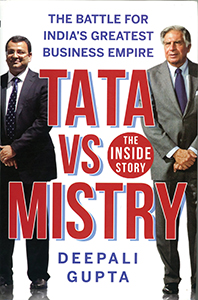 Darbari Seth and Ajit Kerkar (the last-mentioned preceded by unsavory allegations of corruption); serious criminal activity at a flagship non-banking financial enterprise, Tata Capital (which led to a string of cases involving cheating, forgery, criminal conspiracy, misappropriation of funds, criminal breach of trust, and to the suicide of the company’s high-flying managing director); the production of the much hyped "world’s cheapest” Nano car and the project’s early collapse; the ill-judged acquisition of the Anglo-Dutch steel company Corus (described by a Tata veteran as an "aspirational mistake”); the disastrous investment in Tata Teleservices, followed by an indecorous spat with its Japanese partner in that venture, NTT Docomo; the sycophantic letter written by Tata group chairman emeritus Ratan Tata to the former chief minister of Tamil Nadu, M. Karunanidhi; the alleged dalliance of Tata Tea executives with a terrorist outfit in Assam; the unwholesome revelations which followed the publication of the infamous "Niira Radia tapes”; and, most devastating of all, the sordid drama which has unfolded since the brutal sacking of then Tata group chairman Cyrus Mistry in 2016.
Deepali Gupta’s (pictured) offering deals squarely with l’affair Mistry and is the only book-length treatment of the subject so far. It covers the story until around March 2019 (though this is not explicitly stated) and does not therefore bring the reader up-to-date on more recent developments, including a sweeping legal verdict in favor of Mistry from an appellate tribunal which ordered his reinstatement on December 18, 2019, and another important legal order, this time from the Supreme Court, three weeks later, which stayed the appellate tribunal’s verdict.
The author is at pains to assert that the book is "not intended to support one or the other party,” and she has been able, by and large, to make good that assertion. For the most part, the book is reportage or commentary rather than an exercise in evaluation or judgment. Gupta, former assistant editor at The Economic Times, lays out the factual matrix of this messy corporate battle in considerable detail, and explains the twists and turns which has characterized its journey through the media and the courts. On  the rare occasion when a subjective remark rears its head up (eg the litigation between NTT Docomo and the Tatas "brought much disrepute to the Tata Group”), it is well within the bounds of fair comment. Intriguingly, she adds a disclaimer whose value or relevance is unclear: "Any loss, damage or disruption caused by (the book) is unintended.” Loss, damage or disruption to whom? If the idea is to protect her from legal action — eg for defamation or contempt of court — it will be of little avail.
One serious limitation of this book is that the author did not get access to the protagonists in the fight for their views. She says that she "reach(ed) out” (would not "contacted” suffice?) "to the offices of Cyrus Mistry and Ratan Tata” but they declined her overtures. But in an observation that is likely to mislead readers, she says that she had e-mail exchanges with "the parties involved” without specifying who these parties are. The book also suffers from that all too common Indian deficiency of not having a back index, though it does have some skimpy "Notes” and more than a dozen pages of "References” akin to a bibliography in academic works.
The second book, by Mukund Rajan, also deals with the Mistry versus Tata struggle but only peripherally. This book is laid out on a wider canvas and it tries to explain the workings of the Tata empire as seen through the eyes of someone who occupied a range of senior positions in Bombay House (Tata group headquarters) for 23 years before stepping down in 2018. The book analyzes key events and profiles leading personalities who contributed to shaping the group’s destiny over the past quarter century. There is a particular focus on the ethics of the Tata organization — as can be expected from someone who carried the titles of Brand Custodian and Chief Ethics Officer for some years prior to his resignation.
What Jamsetji Tata or J. R. D. Tata would have made of such fancy designations would be an interesting enquiry but that need not detain us for the present; suffice it to note that the author was told by Mistry (who appointed him to those roles) that being Brand Custodian would "entail responsibility for the Tata corporate brand owned by Tata Sons and oversight of corporate communications at the Tata group.” The second part of that definition is easy enough to understand, but the first part begs many questions; everything would depend on what amplitude was given to the word "responsibility” in that phrase. The only other relevant additional information provided is that the author was also asked by Mistry to chair the Tata Global Sustainability Council (TGSC) — a body set up in 2014 to respond to the growing international clamor for action on climate change. Within the TGSC 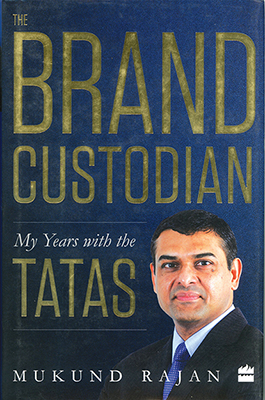 Rajan was charged with oversight of the Tatas’ corporate social responsibility activities.
The book abounds with examples of such activities, the impulse for which many will recognize as an integral part of the DNA of the Tata group going back to its inception more than a century-and-a-half ago. The only difference is that, nowadays, these activities are dressed up in showy monikers such as Tata Engage and Tata Strive and there is a veneer of political correctness attached to them. What also comes through starkly — and, to those of a conservative disposition, jarringly — is the extent to which management-speak has replaced plain language among Tata executives, as well as the proliferation of committees, boards and fora — eg Group Executive Council, Recommendations Committee, Advisory Board, Group Policy and Strategy Forum, Group Innovation Forum and so on. These are all, of course, accompanied by a sea of acronyms in which the book risks drowning.
Turning to more weighty matters, readers will be interested to know where the author, as the custodian of the group’s ethics, stood in relation to the many controversies and scandals that have plagued the Tatas in recent years. For the most part, he steers clear of making any sharp judgments. Even in relation to the Tata Finance scandal — which was egregious by any reasonable standard and which Rajan was personally involved in investigating internally — his verdicts are rather tame. The closest he comes to fixing responsibility on anyone (other than the main culprit, Dilip Pendse, former Tata Finance managing director) is to say that the "board of directors of Tata Finance was also found wanting.” More controversially, he showers gratuitous praise on Ratan under whose watch the scandal had unfolded ("Tata Finance also reflected for me the finest qualities of Ratan Tata during that stage of his own evolution as a leader, and I felt proud to serve him”). Rajan is surprisingly coy about naming an "otherwise respectable director” who had leased his apartment to Tata Finance in circumstances which pointed to questionable conduct.
But the shenanigans at Tata Finance (which led to the eventual closure of the company) proved beneficial to Rajan’s career. In an admission which many will see as a sign of his vaulting ambition, he says that that scandal helped him to become "firmly ensconced at the center of (Ratan Tata’s) power structure.” Is it any surprise, then, that his assessments on Ratan fall quite a way short of what most people might consider critical? At worst, "Tata could,” says Rajan, "sometimes be naïve and trusting of the wrong people.”
What then of his verdict on Mistry? No surprises there either, is the short answer. "I must confess,” he says, "that I was initially lukewarm about the appointment of Mistry as successor to Tata.” This impression "began changing as I began to get to know him better.” Rajan soon landed a new job (as Brand Custodian) under Mistry. "It was becoming clear to me,” says Rajan, "that here was somebody who was well aware of the enormous responsibility he carried on his shoulders for the future success of the Tatas, and who would work very hard to carry his stakeholders with him.”
There are no prizes for guessing Rajan’s stand on the Tata-Mistry spat. "I have emphasized,” says this dutiful employee, "that I owed my loyalty to the institution of the Tatas, not to the individuals concerned. My values were aligned with those of the group, not with specific personalities.” Clear enough, then?
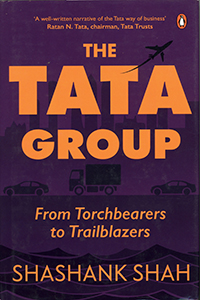 The third book, by Shashank Shah (pictured), despite being significantly bulkier than the other two, is the least satisfactory of the lot. Written by a "thought leader in the fields of stakeholder-centric business strategy…” who is not exactly shy in flaunting his academic credentials, it is cloyingly panegyric in tone and full of management-speak in a way that even Rajan might find a bit over the top.
The book comprises 27 chapters (plus a fatuously titled "Introducing an Institution That Needs No Introduction”) — all arranged under eight "Sections” and written in the style of a poorly put together university dissertation. The prose is riddled with grammatical and other errors ("appeared tad tired,” "reminisced his early years,” "thirteenth day since a person’s death,” "in 1970s,” to name but a few) and shows scant regard for correct spellings (e.g. "A. F. Fergusson” for A. F. Ferguson; "Arthur Anderson” for Arthur Andersen; "loses” for losses). A penchant for jargon ("reaching out” for speaking to; "ecosystem” for environment or landscape; "ideation” for thinking; "shared” for said, and so on) is guaranteed to make the discerning reader tear his hair out in exasperation.
 In substantive terms, too, there is little to commend in this book. The discussion, such as it is, is at best superficial. Key characters involved in the Tata story are either airbrushed out of existence or mentioned only in passing (eg Minoo Masani, Nani Palkhivala); major incidents — such as the Tata Finance scandal — are dealt with perfunctorily or not at all; in the historical section, there is no reference to Jamsetji’s involvement in the opium trade with China; nor is there any discussion, in the chapter dealing with Vistara (co-promoted by the Tatas and Singapore Airlines) of a high-profile legal challenge brought against the grant of the airline’s operating licence by the maverick Bharatiya Janata Party member of parliament Subramanian Swamy (who also, incidentally, challenged the grant of a licence to another Tata joint venture, Air Asia). That said, in relative terms, the chapters dealing with the Tata record in employee relations and the group’s early involvement in aviation somewhat redeem the book.
Shah’s work cannot, by any objective standards, be seen as the "definitive account of the Tata Group” that the author claims he set out to produce. It reads, for the most part, like an authorized, if not commissioned, public relations tract — a conclusion which is reinforced not only by the profusion of encomiums showered on the book by serving and retired Tata executives but also by the fawning manner in which Shah acknowledges the help of Tata officials — including one senior figure who is currently being investigated for money laundering and other alleged offences — in the preparation of the book. No less noteworthy is the fact that the book carries, at the top of its cover, an endorsement from Ratan who is, of course, praised to the skies by Shah.
VENKAT IYER
Iyer is a barrister and legal academic based in Northern Ireland, UK.