Becoming Hafeez Contractor: The Making of an Architect by Harshad Bhatia. Published in 2019 by HarperCollins Publishers, A-75, Sector 57, Noida, Uttar Pradesh, 201301; website: www.harpercollins.co.in. Pp: xii+ 375. Price: Rs 699.
Hafeez Contractor has undoubtedly been one of the most illustrious and forceful characters on the architecture scene in India over the last couple of decades, and surely his biography should have been no less than a thriller. I say this with deep thought because the practice of architecture is indeed a roller-coaster ride maneuvering between the present time, ideas, land politics, political vagaries, economic developments and social changes. Plus, Contractor’s practice and views as an architect have been clear, sharp, and out there in full public view in the shape of his buildings, his design choices, his proposals and arguments for urban development, and the client-patrons he has worked with. For too long have we restricted architecture and design only to a meditative, or monastic, or artistic imagination, which is fine, but to not acknowledge the racy possibilities of an architecture practice would be detrimental to the field and profession.
Harshad Bhatia (pictured), the author of this biographical work on Contractor has himself been an interesting and active persona on the architectural scene in India, especially in Bombay. Often his views have raised arguments and controversies, but have been at the same time most valuable and necessary in many situations and debates on architectural and urban developments. This book is a work of intense research, full of empathy for the subject, setting the tone to smoothen all the criticism Contractor has always attracted, and very detailed and well annotated with stories and events. But I really wish it had been written as a thriller: racy, cheeky at times, controversial in parts, and argumentative at least on occasions.
Contractor’s is a vibrant mind that best expressed itself in his architectural compositions; you could say he took the bull by the horns when times were changing in unpredictable ways in the India of the 1990s and the world of real estate, land development, volatile politics, the promise of globalization, consumerism of a credit economy, and social relationships were drastically transforming. He gave architecture a language and a tongue to speak. You may disagree with the language he chose but you cannot discount the enormous role he played in shaping a period of transition and addressing the needs of real estate, urban developmental politics, as well as changing consumer profile and wants.
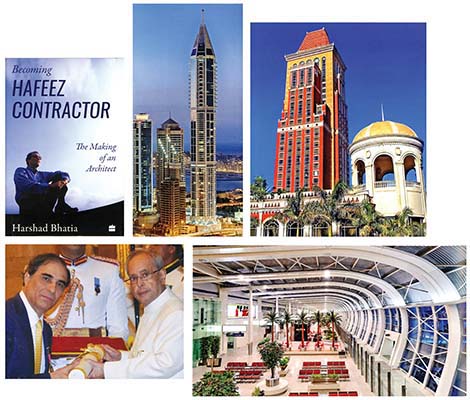
Clockwise from top row (center): residential tower in Dubai; ITC Grand Central, Bombay; Terminal 1C, Bombay
international airport; then President Pranab Mukherjee presenting Padma Bhushan to Hafeez Contractor
The book beautifully locates, through many exhaustive narrations, weaving in many other characters and organizations such as Narayan Murthy and Infosys or the Hiranandani brothers and other such parties and real estate developers, Contractor’s work and practice. However, the author handles the material at hand in too much of a laboratory-kind of manner. The book offers in too sanitized a presentation the stories of friendships and work relationships, as well as the situations and dynamic times all these characters were navigating through.
Contractor need not be a child prodigy, nor be made into an enigma, but he needs to be understood as a human being who trained as an architect like many hundreds around him, and then as an architect made choices. It is these choices — as an architect, designer, professional, citizen, businessman, negotiator of his times and context — that are very important to study. His life and his work, you may agree or disagree with, but it is a case study of immense importance to practitioners and students alike. If his biography is presented in a more matter-of-fact manner, sanitized of controversies, disagreements, criticism and virulent debates, then the learning one can take from it remains severely stunted.

Contractor worked through debates and criticisms against him and shaped an idea of architecture, however controversial it may be. The questions are — how did Contractor do all this, and why an architect should do any of this, or behave and work in a particularly specific manner. The answers to these questions need to be presented as debates and arguments, rather than as the workings of fate or as logical developments. The biography gives all the matter and material that went into making Contractor’s life and practice, including some of the argumentative settings, but does not bring the force of controversies and arguments into the book. Controversies and criticism, along with praise and popular appeal, his simple demeanor along with strong views and convictions — this see-saw of time and life made Contractor the architect of our times.
It is necessary for us to understand what "makes” an architect and what shapes architecture. You can pursue architecture as a meditative and philosophical activity, you could pursue it as an artistic endeavor, or you could pursue it as a set of challenges of the times to be addressed head-on and with full gusto — all positions are valid and it is good to have such variety to learn from and experience. For Contractor it has been the latter, and that is something we have rarely encouraged and included in many educational and professional seminars and platforms, which can be a problem. The problem then is that you either perceive a biography such as Contractor’s as nothing but gusto, nothing but a go-getter attitude, nothing but iconic-architecture-making or simply turn a blind eye and refuse to acknowledge its role and its contribution to the profession and design. Both these approaches are unfair.
The book labors to set the context and explanation for a life and work such as Contractor’s beautifully, and it shows Bhatia’s years of investment in understanding his work and practice. However, the tumultuous times and roller-coaster ride the architect has navigated needed to be advanced and brought out in the book — not in the sense of making it a bestseller, but to give the full and true picture of a life and body of work that has shaped itself in difficult times and braved resistance while being popularly loved — in order to tell readers, especially aspiring students of architecture, what it means to be an architect in our world of changing values, where all kinds of relationships (personal, work, social, economic) are more and more on shaky ground. KAIWAN MEHTA
Managing editor of DOMUS India, Mehta is an architect, academic and researcher and has authored many books.