The silver carriage made by Pestonjee Press for the Maharaja of Bhavnagar is a star attraction of the Victoria and Albert Museum’s exhibition touring North America over two years
Hilla P. Guzder
For Pestonjee Press, making carriages and car bodies was a craft infused with grace and grandeur. In 1915, the heyday of imperial India, Press was commissioned by the Maharaja of Bhavnagar to build for him a carriage that would be both distinguished and distinguishing. Combining the elegance of European design with the artistry of the Indian karigar (artisan), Press created at his Fort Coach Factory a silver landau, elegantly embellished with flowers, enameled birds, swans, greyhounds and lions, crafted in relief and highlighted in gold, at a time when enameling such as this was unknown in locally built carriages.
"Pestonjee was a master coach builder who built carriages for the maharajas and by appointment to successive British governors for over 40 years. He was famous for his technology and for making coaches of silver and gold for the maharajas of Nawanagar (Jamsaheb) and Bhavnagar. Later he manufactured car bodies. In those days carmakers shipped only the chassis and the body was made locally. His old family building still stands in town on Adi Marzban Road, Fort,” his great-grandson Hoshedar Press, who retired recently as vice chairman of Godrej Consumer Products Limited, informs Parsiana. Pestonjee had five sons and five daughters and for the past few years the extended Press family, now scattered all over the globe, has been trying to piece together the life and work of their enterprising ancestor, he adds.
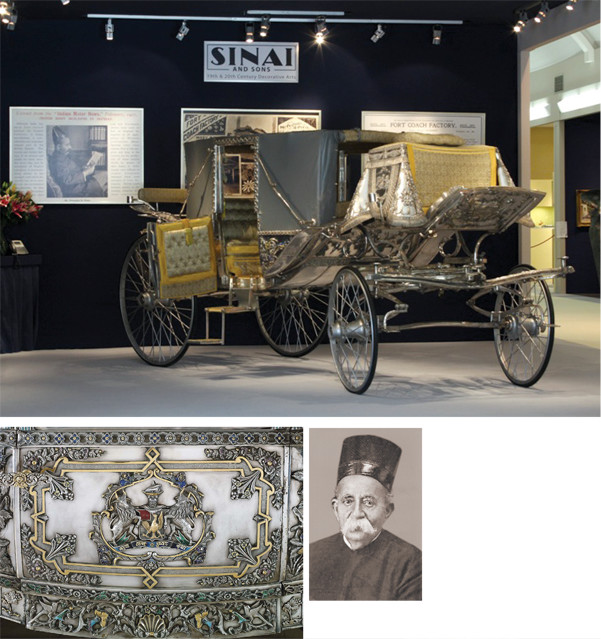
Coach builder Pestonjee Press (above), silver landau at London’s Masterpiece Fair and (bottom) elaborate ornamentation on carriage door Photos: Private Collection, United Kingdom, courtesy of Sinai and Sons Ltd, London
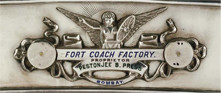
Ninety-five years after it was built for Colonel H. H. Maharaja Raol Sir Bhavsinhji II Takhatsinhji of Bhavnagar, the carriage which now belongs to a private collector in Europe was displayed this year at the inaugural Masterpiece Fair in London by Sinai and Sons Limited, 19th and 20th Century Decorative Arts, at their stand at the Fair. "In every aspect — design, execution, woodwork, upholstery and decoration — this carriage declares the passionate interest and involvement not only of the Maharaja but of Pestonjee Press himself. Unusually for a carriage of Indian origin, it bears the Fort Coach Factory’s own badge, suggesting that Press regarded this as his chef-d’oeuvre,” describe Sinai and Sons in their brochure. "Mounted on iron frame and axles imported from England, the whole structural framework is clad with silver: ironwork, springs, paneling, wings, shafts and even bolts,” the brochure adds.
The landau is also expected to be a star attraction of the Victoria and Albert Museum’s touring exhibition entitled "Maharaja: The Splendour of India’s Royal Courts.” It can be seen at North American venues over the next two years, including the Art Gallery of Ontario, Toronto (November 20, 2010-February 27, 2011), Asian Art Museum, San Francisco (October 21, 2011-April 8, 2012) and Virginia Museum of Fine Arts (May 19-August 19, 2012), states a write-up from Sinai and Sons.
The Imperial Darbar of 1911, which celebrated the coronation of George V as Emperor of India, had seen many a princely potentate in the royal procession which wound its way through the streets of Delhi, silks and satins, the dazzle of diamonds and fiery facets of rubies on public display! In the fleet of carriages was the gold and silver one Pestonjee had built in 1911 for the Maharaja of Nawanagar. The sight of this landau at the Darbar may well have inspired the Maharaja of Bhavnagar to commission his own from the same maker, bypassing many European makers that had long been established in India, the brochure gives the background to the making of the masterpiece.
But polo-playing princes were not Press’ only customers. British colonial gentry also required carriages that were both functional and fashionable. From the days of Lord Harris who was governor of Bombay from 1890-1895, the coaches of Government House had been entrusted to his care and Press was later appointed the official coach builder. The Times of India, February 20, 1899 noted: "His Excellency Lord Sandhurst (the governor of Bombay) has been pleased to confer his special appointment on Press as a mark of his approval of the work turned out at the factory.” Press retained that appointment through the tenures of seven successive governors of Bombay!
Pestonjee was born on February 17, 1854. His family came from the village of Sumli in Surat area, states an article in the Jam-e-Jamshed written on the occasion of his death on July 28, 1931. His grandfather Jeevanjee Behramjee made his way to Bombay and took up a job at a factory that pressed cotton, which is probably when the family took on the surname Press. Jeevanjee had four sons — Manekjee, Framjee, Hormazdjee and Behramjee. Pestonjee was Behramji’s son. At 17, he started work in a mill as a fitter at a salary of Rs 10, the article states. At 19, he joined J. J. School of Art to study woodcarving and later joined his father’s carriage-making workshop at Girgaum.
His enterprising spirit prompted him to set up in a small way his own coach-building unit called the Fort Coach Factory at Modi Bay (Frere Road, now P. D’Mello Road) in 1879 when he was 25 years old. In 1887 he introduced rubber wheels for carriages, similar to the ones built in England. Forging his own opportunities, he developed a spring-loaded quick disconnect between the pull and the carriage to replace the traditional nut and bolt connection (an easy self-acting arrangement for escaping carriage accidents, which could also be used if the horses were restive and hard to handle). For this he received a patent from England, the Jamé notes. The Times of India of June 27, 1898 described the factory as having "a large smithy fitted with seven fires, a painting, varnishing and drying house, a carriage storing department complete with lift!”
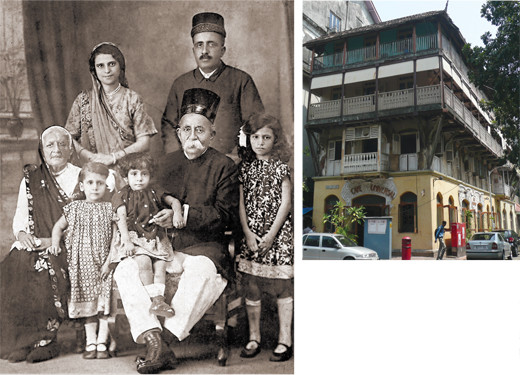
Pestonjee Press (seated) with three generations of the family, old building still standing at Fort (Photo: Jasmine D. Driver) and (top) Fort Coach Factory badge
For his riveting inventions, Press received accolades aplenty. In 1893, he built a mail carriage with rubber wheels for Khan Bahadur Meherjibhai Cooverji Taraporewalla, the Divan of Kolhapur for which he received the first prize at an exhibition in the village of Chinchli. At the Bombay Horse and Carriage Show in 1895, Press received at the hands of Sandhurst a silver medal for his patent as well as two diplomas — one for "design and finish,” the other for "lamps and mirrors for proper illumination of carriage.” With the cart not coming before the horse, at the Bombay Horse Show of 1896, Sir Jamsetjee Jejeebhoy, Cawasjee Dadi Limji and Dinshaw Nussarwanji Vakil received awards for a fine display of horses and pony, while Press was awarded a gold medal for the display of fine, reliable carriages and a silver medal for making fashionable carriage mirrors!
At the Bombay Horse Show two years later, it was Bomanji D. Petit who won the second prize for his splendid steed Neapolitan; Press received a gold medal for the display of four fine carriages. The following year it was a gold medal for a four-wheel dog cart with a provision for electric illumination! Press received 18 gold medals from different places in India, the Jamé records all the details. A booklet in the possession of the Press family contains testimonials from a variety of citizens who doffed their hat to his skills — M. C. Marzban and Sorabjee S. Bengallee, the collector of Ratnagiri, the Divan of Baroda, the military secretary to the governor, assistant superintendent of police, secretary and treasurer, Bank of Bombay and others.
A car body made by P. B. Press and Sons
Press traveled extensively overseas and among his trophies of enterprise was an ‘Honorable Mention’ at the Paris International Exhibition of 1900 for excellent workmanship in carriage building. B. J. Rose, secretary, Indian and Ceylon Committee, Royal Commission, Paris Exhibition noted in his testimonial of October 3, 1900: "Your carriage had to be judged with those of all other parts of the world. Had your carriage been judged against those from the east only, no doubt it would have secured a much higher award.” The Coach Builders’ and Wheelwrights’ Art Journal of London published his photograph in its issue of November 1, 1900 along with pictures and a description of the different departments of his workshop. The Coach Builders’, Harness Makers and Saddlers’ Art Journal, a magazine for the horse carriage and related equipment manufacturing industry, also recognized Press as one of India’s leading coach builders.
The turn of the century saw the arrival of the motor car into India. For Press, the transmission from carriage to car was smooth! "In about 1901 three Curved Dash Oldsmobile models were brought into the country and sold to Jamshetji Tata, founder of the Tata group, Rustam Cama, an attorney, and Kavasji Wadia of Bombay Garage, notes www.carhistory4you.com Press’ son Jehangir studied motor manufacturing with various companies, including the British Daimler Company and the French Brazier Motor Car Company, the website states. By 1906, P. B. Press and Sons, automobile engineers, motor body and carriage builders (as their signboard proudly proclaimed) had "installed the newest machinery and plant for the making and repairing of any style of motor body works.” The workshop also specialized in rebuilding accident and burnt out cars.
Press handed over the reins to his sons in 1925 when he was 71 years old. The enterprise however seemed to roll downhill thereafter. The master coach builder died in 1931 at the age of 77 and after the passing away of his wife Khorshedbai a few years later, the ignition was switched off and the properties were sold, as per the details forwarded by the family.