Refuelling the aircraft and procuring flight maps
posed a major problem in the Middle East
Rusi Sorabji
Ninety-one years ago on March 21, Navroz day, Aspy Engineer, a young Parsi lad of 17 years, three months and six days, arrived in England from Karachi, flying his own plane, a tiny Gypsy Moth, accompanied by his friend Ram Nath Chawla. Engineer was to take part in the Aga Khan Race which offered a prize of pound sterling 500 to any Indian flying solo between England and India in the fastest time, provided the flight be completed within 30 days. This serialized account pertains only to how the two adventurous friends made it to England. Engineer then flew back to India solo to win the first prize. In the first instalment they had just departed from Karachi.
"Taking off from Karachi and heading into strong head winds we meandered along the coast to Gwadar for the first refueling stop and then reached Jask at 4.30 p.m. from where we flew to our first stopover at Lingeh in Iran,” wrote Aspy Engineer.
"It was beautiful flying at 2,000 ft and watching the large turtles and shoals of fish swimming in the bays below. Our arrival at
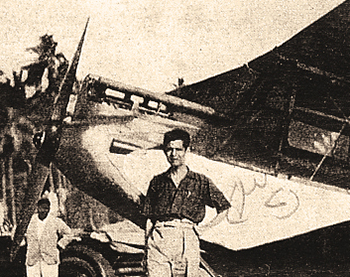
Lingeh was delayed because we could not identify the landing ground as the markings on the strip had been washed away by rain. The only living creature to receive us was the local dog who first sniffed us and then certified us as OK.
"This is where (my flying companion Ram Nath) Chawla and I had our first argument. When at first we could not find the landing strip Chawla wanted to make his customary forced landing in a field. Chawla had twice force landed in India. At that time I had apprised him of the critical damage that could occur to the plane; even a small stone hitting a wheel could break the main wooden longerons of the fuselage or perhaps the fabric of the plane. That would really cook our goose and be the end of the flight.”
At Lingeh, and exactly north of Dubai, while making friends with the local dog Engineer carried out minor checks on the plane and cleaned the filters while Chawla went to town in search of fuel. The local agent for Burmah Shell was enjoying his Middle Eastern afternoon siesta and would not sell Chawla the fuel. Language was a problem as well. Chawla and the local agent arrived with the fuel several hours later.
The aircraft was refueled from half-filled cans, but they were charged for two gallons of petrol. The shortage in the cans was explained away as due to evaporation.
It was getting late for the next long hop to Basra in Iraq so testing the engine after the refueling Engineer took off easily saying, "Despite strong winds, we made it to the Royal Air Force (RAF) base at Basra just as officers there were getting into their mess kits for dinner night. With an early start the next morning we were winging our way over the Tigris and the Euphrates basin on our way to Baghdad. I got to enjoy flying over this area which was so green and with the aircraft barely crawling along. I had a grandstand view of the river and other traffic as well. We hardly seemed to move and it became exceedingly bumpy but I thought of what fun it would be being pushed at thrice the ground speed on the return flight. Arriving at Baghdad we decided to stay the night there instead of as originally planned at Rurbah Wells spending the night under the plane. We had a most enjoyable dinner of kababs, nan, another meat dish and my (then) favorite, Tennents beer, which I can’t get now. Sitting at a riverside table at a not so posh but interesting café, we were able to see the traffic of cars, carts, camels, human beings and other objects crossing the famous boat bridge at Baghdad.
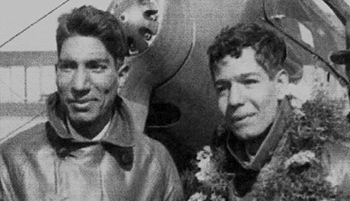
Ram Nath Chawla (left) and Aspy Engineer
"We left early the next morning and after skirting south of the RAF base at Lake Habanniyah we hit the oil pipeline and followed it to Rurbah Wells. This was a prudent step as many aviators who had to refuel their short range aircraft at the desert half-way house and had decided to repose more confidence in their compasses and not follow the pipelines ended up in a Bedouin’s tent drinking goat’s milk till such time they could requisition a few camels to bring in some fuel!
"After refueling at Rurbah Wells, we reached the RAF air field at Amman, spending the night in a comfortable hotel. Leaving Amman and upon crossing the Dead Sea the well behaved and placid Cirrus engine went into convulsions of heavy coughing and the revolution counter nosedived each time the engine coughed. As we were flying over the Holy Land, both of us went into our respective prayer mode and sure enough the engine responded and kept us airborne. We soon reached the Mediterranean coast and landed at Gaza. I had a good dekho (look) at the aircraft and after cleaning up of the float chamber, fuel lines and the engine, we gave it a good run with me on the ground and Chawla at the controls. Since the plane had no brakes, I had to hold the aircraft at the tail end to prevent it from taking off and was blasted by the mini sand storm created by the propellers.
"Airborne from Gaza we passed over the Suez Canal and not long after that the great Pyramids. Looking down I could have sworn that the Sphinx winked at us in a fond welcome.
"On landing at Cairo, we had our first experience of those quite unnecessary (or so it seemed to us) bureaucrats, the customs and immigration officials. Up to now it had been a very friendly world with no questions asked. However, I must say the Egyptian officials were a fairly friendly lot, but our hitherto fond dream of a utopian one world had been rudely shattered.
"At Cairo we got our first big shock. The maps we wanted to purchase for the rest of our trip were not available despite wandering from shop to shop for an entire day. In the process we collected the best of what we could lay our hands on, falling back on our splendid motto, ‘What cannot be cured must be endured.’ We could not find the maps but were able to buy some warm clothing and leather coats for the European part of our flight.”
To be continued