We have to act against those ills that beset our planet and community
Ava Damri
Today is about celebrating our great religion and culture… about realizing the need for our community to uplift and empower each other, about accepting that love is love no matter who it is that we love…about realizing that we as a community are stronger when our women lead… Finally… today is also about recognizing that it is our religious and moral duty to leave our communities better than we found them. This means we cannot stand still while our environment…is destroyed by climate change, that we cannot stay silent when…our fellow Zoroastrians from around the world cannot be…here with us because of the actions of a
President who fails to see that we are stronger when our country welcomes…immigrants,” passionately stated Parshan Khosravi, chair of the Seventh World Zoroastrian Youth Congress (7WZYC) in his opening remarks.
Held at Pacific Palms Hotel in the suburbs of Los Angeles, California from July 1 to 6, 2019, the 7WZYC attracted close to 400 delegates in the 18-35 age group representing 12 countries: Australia, Canada, Hong Kong (HK), India, Iran, Kenya, New Zealand (NZ), Pakistan, Singapore, United Arab Emirates (UAE), United Kingdom (UK), and the United States (USA). A group of Zoroastrians from Iran was denied visas to enter the country due to current travel restrictions imposed by the United States. Key sponsors of 7WZYC included: Dariush Irani, Zoroastrian Charity Funds of Hongkong, Canton and Macao, Bomi Patel and B. B. Travel Experts.
The 7WZYC was an innovative congress with many firsts to its acclaim: an entirely paperless registration process, online streaming through the FEZANA (Federation of Zoroastrian Associations of North America) Facebook page, the highest number of female delegates and female speakers. In aggregate, 64 speakers representing nine countries, spoke on at least 33 topics. The six-day event would not have been possible without the herculean efforts of FEZANA, the eight-member Congress executive committee and the 80 volunteers across three local Zoroastrian communities — Zoroastrian Association of California, California Zoroastrian Center and the San Diego Zoroastrian Group. Besides Khosravi, the committee included Adil Minocherhomjee (vice chair — revenue), Anahita Hormozdyari (vice chair — operations), Khodarahm Partovi (treasurer), Arzan Wadia (program chair), Hanoz Santoke (webmaster), Roxanne Unwalla (secretary) and Ashkan Garshasbi (program co-chair).
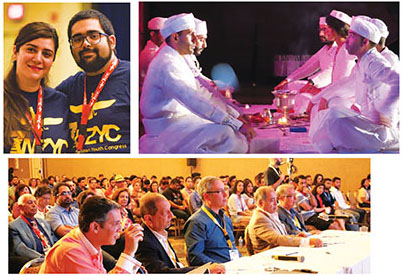
From l: top row: Anahita Hormozdyari, Parshan Khosravi; mobeds and mobedyar perform inaugural jashan;
2nd row: Zoroastrian ‘Sharks’ Cyrus Mistry, Feroze Bhandara, Xerxes Wania, Mehrfar Khosro, Alayar Dabestani;
3rd row: Jehaan Kotwal, Khosravi, Hormozdyari, Meher Bharucha, Meher Pavri, Natashah Torki,
Shernaz Pavri, Pearl Mistry, Cyrus Cama, Faridun Dadachanji
Shayda Sales, Ervads Karl Desai, Soli Dastur, Zerkxis Bhandara, Tehemton Mirza,
Arda-E-Viraf Minocherhomjee, Sheherazad Pavri, Adil Minocherhomjee and Jimmy Madon, Meher Pavri
Congress photos: Parenda Foroghi, Shayda Sales, Ana Verahrami
Just over 25 years ago, the First World Zoroastrian Youth Congress took place in California, and this year the 7WZYC returned to California. To highlight the importance, a retrospective panel, "The Congress Comes A Full Circle” was moderated by Meher Amalsad, the founding chair of the North American Zoroastrian Congress and WZYC. A representative from each of the prior congresses reflected on the Zoroastrian ideas and issues of the day: Ervad Zarrir Bhandara on the first congress held in 1993, in California, USA; Sheherazad Kapadia on the second congress held in 1997, London, UK; Behnaz Nanavatti on the third congress held in 2003, Poona, India; Shirin Mistry (via video) on the fourth congress held in 2007, Victoria, Australia; Kayras Irani on the fifth congress held in 2011, Vancouver, Canada; Tinaz Karbhari on the sixth congress held in 2016, Auckland, New Zealand.
The theme of the 7WZYC being "A Global Zarathushti,” the sessions covered the ABCs: Academics, Business, Community. The Academic programs explored our understanding of the religious and historical literature regarding Zoroastrianism over the last 25 years. The Business sessions analyzed opportunities to thrive across the world. The focus on Community studied the measures required to reignite the flame as Zoroastrians spread across the world. The organizers selected topics and speakers that reflected current global trends as seen through a Zoroastrian lens.
Academic
For the first time in congress history, Pablo Vazquez who is currently working on a dissertation on Kurdish Zoroastrianism at the University of London’s School of Oriental and African Studies, and a recent convert, spoke about the evolution of Kurdish Zoroastrianism and the rise in the number of Kurds who have recently converted to Zoroastrianism as they believe their ancestors were Zoroastrians before Muslim occupation. He provided detailed information on the distinct Kurdish elements in their practice of the faith such as their use of a woolen thread thicker than the kusti but not the sudreh, and the existence of male and female pirs (priests, although there is no clear hierarchy within their ranks). The Kurdistan region overlaps multiple countries fraught in political upheaval — Iraq, Syria, Turkey and Iran, and religious liberties vary based on the land. The only Kurdish Zoroastrian place of worship is in Sulaymaniyah, a city in Iraqi Kurdistan.
The first Iranian female mobedyar in North America, Mahshad Khosraviani spoke about the importance of balancing blind faith with an intellectual understanding so that the community evolves with the times and ensures the survival of the faith. Her talk began with a film by Tanya Hoshi, a 7WZYC speaker, and filmmaker from Toronto, Canada, capturing Khosraviani’s journey. Overcoming the roadblocks placed in her way, Khosraviani continues to forge her path. In her own words: "There (were) certain (things) that I was not allowed to do and that... made me question everything…I … couldn’t understand how could this be when our teachings and our religion say we are all equal and the same… And yes, I was obviously going against all these laws that were set by men, to benefit men.” Despite pushback from some family, friends and members of the community at large, she received the support and mentorship of Mobeds Kerman Katrak and Jehan Bagli (Zoroastrian scholar and researcher) in Ontario, Canada, who realized she wanted "to take that further step for her religion.”
From l: Homi Gandhi, Khosravi with UK delegation that will host the 8WZYC
Congress supporters Khodadad Kaviani, Arman Ariane, Shida Anoshiravani, Dariush Irani, Daryush Bastani
Business
7WZYC partnered with the World Zarathushti Chamber of Congress (WZCC) Youth Wing to provide a day’s programing focused on professional development and networking. This day culminated in the first Zoroastrian Shark Tank (ZST) competition. ZST’s goal is to connect budding Zoroastrian entrepreneurs with angel investors looking to invest in early to mid-stage businesses. ZST was hosted by Rashna Sanjana, a leader in the WZCC Youth Wing in Bombay and the founder of StichMyFit.com. The all-male sharks included Xerxes Wania (serial entrepreneur and angel investor, Toronto Canada), Cyrus Mistry (Google product manager, Michigan, USA), Alayar Dabestani (Dabestani Group, Washington, USA), Feroze Bhandara (entrepreneur, Texas, USA) and Mehrfar Khosro (Mehr Solar, California, USA).
Six brave entrepreneurs from five industries made pitches to the ‘Sharks’ in front of a packed audience, while the competition was live streamed on the FEZANA Facebook page. The firms included a Parsi themed apparel start-up, Dhansak Company (Hoshi and Anaheez Karbhari, Canada) that had not sold any products but they brought models wearing samples. A bartering mobile app, Let’s Swapp (Jehangir Irani, UAE) was in the ideation phase. TRiBE (Arius Iri, Costa Rica), a boutique hotel, was not yet open for business but already had investors and purchased property. CityFalcon (Ruzbeh Bacha, UK), a financial news engine and an eco-friendly grocery bag manufacturer, Lotus Trolley Bags (Farzan Dehmoubed, USA) were established companies seeking additional capital to expand operations. Ultimately, four of the five businesses sufficiently hooked the ‘Sharks’ who offered investment on a variety of terms.
Community
Laws across the world are making slow progress in increasing the rights of Lesbian, Gay, Bisexual, Transgender, Queer+ (LGBTQ+). On the heels of the unanimous decision by the Indian Supreme Court (September 2018) to decriminalize gay sex, Zoroastrian youth conducted their first open discussion about LGBTQ+ members in the community. This panel was moderated by Feresteh Bulsara (founder of the Zoroastrian LGBTQ-Straight Alliance group, Canada) with Nadia Jam (Canada), Nasha Katrak (USA) and Farhad Cooper (UK) as the three panelists. Cooper participated via a pre-recorded video. Katrak, a mental health therapist, set the stage by defining terminology. This discussion reflected the personal, vulnerable stories of the panelists and a recognition that Zoroastrianism does not have a clear view on this topic.
Jam mentioned that she spoke to orthodox and reformist Zoroastrian academics who would only quote a line from the Vendidad that could be interpreted as condemning same-sex relations. However, as Ervad Tehemton Mirza [vice president of the North American Mobeds Council (NAMC)] pointed out, this religious text "was written for a (different) time, and now that we have knowledge, we have to use (that) knowledge …with the principles ... of (a) free mind and apply that to what we know. And if you combine those two… (with) science today …and society… moving in that direction, it is time (for acceptance).” While the NAMC has no official stance on same-sex marriages, Mirza said he finds it acceptable and does not pass judgment on another’s sexual orientation. When he said, "You are first and foremost a human being,” the audience erupted in applause. To encourage audience participation while allowing for anonymity, the organizers created a forum for anonymous questions. Although this was a panel held towards the end of the Congress week, it was well-attended and received significant audience support.
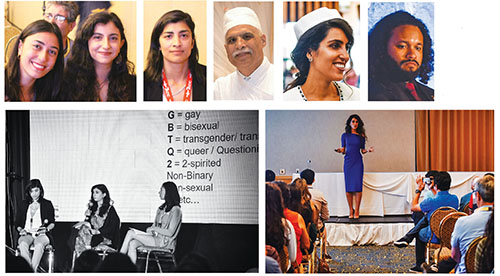
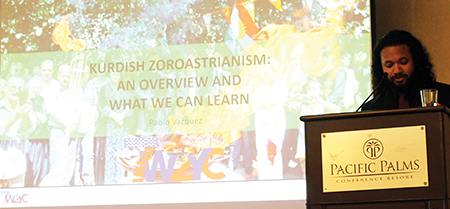
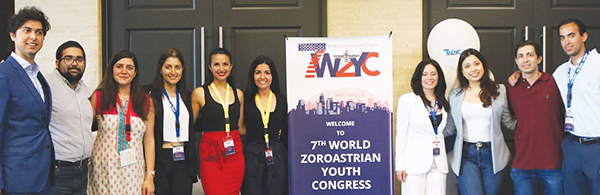
From l, 1st row: Nadia Jam, Nasha Katrak, Feresteh Bulsara, Mirza; Mobedyar Mahshad Khosraviani; Pablo Vazquez;
2nd row: LGBTQ panel; Khosraviani and Vazquez
Global Women’s panel Negin Forouzesh, Dr Rashna Virji, Shazneen Munshi, Sanaya Sabavala,
Benafsha Shroff, Alisha Shroff, Rashna Sanjana, Tinaz Karbhari, Hormozdyari
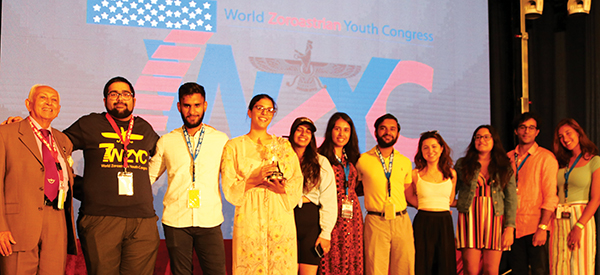
Top: 7WZYC organizers and volunteers;
above: executive committee (clockwise from center row, far l) Khosravi,
Adil Minocherhomjee, Hormozdyari, Khodarahm Partovi, Ashkan Garshasbi,
Roxanne Unwalla; Hanoz Santoke, Arzan Wadia
Principal panels
The 7WZYC created another precedent by having two key panels: Global Stories: How Women Will Modernize the World’s Oldest Religion; and Global Mobeds Panel. Both panels drew from history to discuss the future of the religion, Parsi and Iranian cultures, and the role of youth.
The Global Women’s panel featured eight highly accomplished women from a variety of careers and backgrounds who spoke about their family history, how local customs across the diaspora affect religious practices, and the Zoroastrian communities in their home countries.
Negin Forouzesh, an immigrant from Iran now living in the State of Virginia in the USA, spoke about what it is like to be a Zoroastrian in her birth country of Iran. She mentioned there are several organizations in Iran for Zoroastrians who live in the big cities, including Zoroastrian women’s organizations which run classes and workshops for women to pass the religion down to the next generation. However, they cannot invite non-Zoroastrians to such events or advertise about the faith. Zoroastrians in Iran are allowed to practice the faith but within boundaries. Forouzesh and her husband who are now pursuing PhDs at Virginia Tech University appreciate the freedom to celebrate their faith openly in the United States.
Dr Rashna Virji, a medical practitioner in Pakistan, explained how it is easy to take for granted the freedoms that Zoroastrian woman in Pakistan enjoy when compared to their female peers in a majority-Muslim nation. Zoroastrian families value the education, health, and happiness of their female children, just as equally as the male children. In her medical practice, she often comes across emaciated young and old women from sister communities who have had to sacrifice food and education for the well-being of their male relatives. Zoroastrian women in Pakistan have two strong pillars in the community that benefit them: the century-old Mama Parsi Girls School which has nurtured many Parsi women’s education and the Karachi Zarthosti Banu Mandal, established in 1912 for the betterment of Zoroastrian women. Virji credits these organizations for their incredible lineage and hoped they continue to be preserved for the future.
Sanaya Sabavala from Australia spoke about her grandmother, Katayun Amaria, from the Mirza family of Udvada priests whose parents gave her educational opportunities equal to that of her brothers in the early 20th century. This is a testament to the fact that the literacy rate for Zoroastrian women is closer to 100% when compared to women in many other faiths.
The moderator Benafsha Shroff of USA and all the other speakers — Karbhari, Sanjana, Alisha Shroff (HK), Shazneen Munshi (UK) and Hormozdyari (Iran/USA) — appreciated Zoroastrianism’s importance on gender equality. There is a long way to go, and it is up to this generation and the next to continue this dialog to make a lasting change.
The Global Mobeds panel included a mix of young mobeds with orthodox and reformist views: Ervads Sheherazad Pavri (India), Karl Desai (Australia), Zerkxis Bhandara (USA), Adil Minocherhomjee (USA) and Jimmy Madon (UK/India) and their elder mentors: Ervads Soli Dastur (USA), Mirza (Canada) and Arda-E-Viraf Minocherhomjee (NAMC president, USA). It was enlightening to see how many people stood in line to ask thought-provoking questions to the young mobeds. The audience engaged the panel on substantial topics such as marriage outside of the faith, conversion, women being barred from attending key religious ceremonies while menstruating, female mobedyars, and how practices and views can evolve with the times while maintaining traditions. While no consensus was reached on these topics, the fact that youth with differing views are willing to engage in an open dialog is an essential component to the longevity of the religion.
The other sessions and social activities will be covered in the next issue of Parsiana.