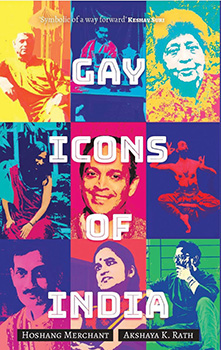
 In Gay Icons of India, authors Hoshang Merchant, poet and former professor at Hyderabad University and Akshaya K. Rath, assistant professor of English at the National Institute of Technology, Rourkela, celebrate the lives of 19 extraordinary men and women who have courageously withstood censure and injustice in the face of prejudice to take up cudgels with society and fight for the LGBTQIA (lesbian, gay, bisexual, transsexual, queer, and/or questioning, intersex and asexual and/or allied) movement through their art, poetry, dance and writing.
The book is evenly divided into three sections: "Forerunners," "Contemporaries" and "A Future Past." In the section "Forerunners," the authors deal with a few individuals who may not be familiar to the present day reader and whose contribution has been forgotten. They start with Ram Gopal, a dancer born in Bangalore in 1912. If Uday Shankar is remembered today for his masculinity, the fragile and feminine Gopal has been more or less forgotten. Equally famous, he performed successfully and to critical acclaim in 1939 to packed houses at the Aldwych and Vaudeville theaters in London. In 1960, he performed a Radha-Krishna duet he had himself choreographed with a famous ballerina, Alicia Markova. A search on the internet throws up page after page on Ram Gopal Verma, Indian film director, screenwriter and producer, known for his work in Telugu cinema, Bollywood, and television, but hardly anything about this dancer who did so much to popularize Indian dance in the West.
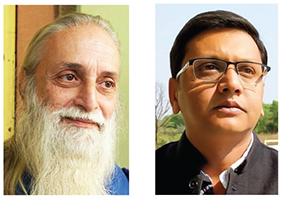
Hoshang Merchant (l) and Akshaya Rath: fighting for LGBTQIA rights
It is not a blatant act of self-indulgence that Merchant himself is included as a gay icon in his own book. He has not only been ridiculed for being an effeminate gay and called "hijra (eunuch)" but also tortured: college going boys would throw stones at him while he was on his way to teach at the university. In spite of the cruel society in which he lived, Merchant’s spirit was never cowed. He has published over 20 books of poetry. He has written fearlessly about his own life. It is appropriate that he should have been presented with the Gay Rainbow Warrior award at a recent film festival in Bombay.
Similar essays have been written about Bhupen Khakhar whose courageous and provocative paintings of male nudes and frank depiction of sex have been praised. Giti Thadani dropped out of the conventional system of education and educated herself to become involved with feminist, lesbian and cultural movements. She visited the temples of India and unearthed lesbian iconographies and manuscripts. She created a lesbian organization called Sakhi in 1989 and was "instrumental in the creation of a lesbian space for unrestricted knowledge and mystical energy." Ashok Rao Kavi, another crusader, started a gay magazine in the 1970s called Bombay Dost. He was the man behind the Humsafar Trust, an organization which dealt with the AIDS epidemic and which in 28 years helped 85,000 people to fight AIDS and its stigma.
The authors present a sympathetic portrait of Prince Manvendra Singh Gohil of Rajpipla, Gujarat, who decided to come out to his parents. His father took him to several doctors to "cure" him of this distressing ailment, his mother disowned him publicly, his wife divorced him and the people of Rajpipla burnt his effigies. He established an NGO (nongovernmental organization), the Lakshya Trust, to assist the gay community by supporting them and educating them on matters of health, HIV and safe sex.
The chapter on Adil Jussawalla is more or less identical to the chapter in Merchant’s earlier book All My Masters with a few changes: the name of Jussawalla’s wife and the college he was supposed to attend have been corrected. However, the misstatement that Jussawalla’s father was behind the Vajreshwari hot springs still persists. On one hand, the authors assert that Jussawalla could not "come out of the closet" in his poetry till he was middle aged; on the other hand, gay cruising is read into one of the early poems which Jussawalla wrote as a young man, when he was a language teacher in London. The two assertions seem to contradict each other. Merchant’s review of Jussawalla’s I Dreamt a Horse Fell from the Sky, is rather dismissive and does not bring out the variety of his poems, fiction and non-fiction in an extremely impressive collection.
The book, which is a valuable contribution to the history of the gay movement, is marred by a few errors which I’m sure the authors will correct in their next edition. In the chapter on Sultan Padamsee, the authors make a reference to Kamal Wood who started a clandestine radio station broadcasting against the British. Her husband was Evelyn Wood and not James Wood as mentioned in the chapter. In the same chapter, they mention that Padamsee’s family helped to make Nissim Ezekiel an English poet. However, in R. Raj Rao’s biography of Ezekiel, it is clearly mentioned that "Ebrahim Alkazi took him away to England." It was Alkazi who bought him a steamer ticket which cost Rs 620 as well as warm, secondhand clothes. Whereas it is true that Alkazi was married to Padamsee’s sister, it seems clear that the financial assistance came not from the Padamsee family but from Alkazi.
In the chapter on Bhupen Khakhar, the authors claim that "Don Giavainni (sic) in Mozart’s opera…is killed defending his daughter’s honor…" Whereas, in fact, it is Don Pedro, Il Commendatore, who is killed by Don Giovanni, while the former is defending his daughter’s honor following Giovanni’s attempted rape of her.
Barring these few errors, the book provides valuable information on people who have not been given their true importance and who have remained in the background, possibly because of their sexuality. Each of the chosen icons has certainly made a very valuable contribution to the gay movement in India and they have been presented in an endearing, flamboyant and lively (though occasionally malicious) manner which makes every chapter an interesting read.