The 112-year-old social welfare organization
Seva Sadan Society perpetrates its founders’ cosmopolitan views
Farrokh Jijina
A year after the Malabari Hall of the Seva Sadan Society (SSS) was inaugurated after a 11-month refurbishment and restoration project, the building was recognized on December 16, 2020 with a United Nations Educational, Scientific and Cultural Organization’s (UNESCO) Asia-Pacific Merit Award for Cultural Heritage Conservation. The Hall is part of the complex of four buildings that comprise Seva Sadan, the women’s empowerment organization started by social reformers Behramji Malabari and Diwan Dayaram Gidumal in 1908.
A small foyer with staircases leading to the auditorium greets visitors as soon as they enter the Hall. The building houses the airconditioned, high-vaulted, 200-seater auditorium on the first floor, with a balcony on the mezzanine. Rooms at the rear of the building house a computer laboratory and other meeting areas. Previously known as the Malabari Memorial Hall, it was inaugurated for use in 1924 by governor Sir Leslie Wilson. The Sadan has sheltered over 10,000 destitute girls in their residential home over the years, and educated over 40,000 students in their Marathi and English medium schools and teachers’ training college, estimates their website.
Joint honorary secretary of the Sadan Umaima Mulla-Feroze told Parsiana on January 3, 2021 that "it is vital that such culturally significant sites in history and time must be preserved…People need to be made aware of how important the heritage of our Society is… one that offers them a sense of belonging, sense of place, and source of inspiration that we pass on to our future generations.” The founders of SSS believed it was not enough to provide refuge to destitute women. They thought "it was imperative to educate them and equip them with skills to make them economically independent. The pioneers "envisioned that there needed to be a space for the residents of the home and the students of the training college for multicultural activities… a school for underprivileged girls in the future… who would need a hall for their activities as well.”
The UNESCO citation commends the "careful conservation” that "supports the important mission of the Society in protecting, nurturing, and empowering women… Saving the structure from further weathering and deterioration, the project upgraded and refurbished spaces in the building to meet modern-day standards.” The commendation also appreciates the "extensive research on the building’s sociocultural, architectural, and historical significance as well as its urban context… Overcoming the constraints of limited resources, this initiative serves as an inspiration for India and beyond.”
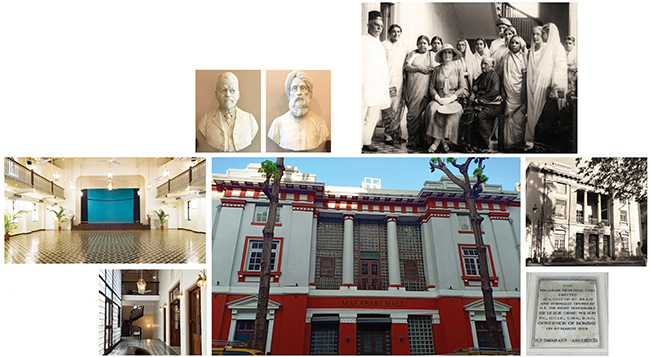
Clockwise from top: busts of Behramji Malabari (l) and Diwan Dayaram Gidumal; members of the
Seva Sadan Society with patron Lady Wilson (seated, with hat), 1924; vintage image of façade of Malabari Hall;
plaque memorializing the inauguration of the Hall; façade after renovation
Photo: Somaya and Kalappa Consultants; entrance foyer; auditorium of Hall Photos: Neelu Singh
Above left: a computer class in progress, prior to the pandemic;
erstwhile cafe Aahaar in the foyer of the Hall
The major problem with the Hall was "water ingress from the walls and leakages from the roof which was weakening the structure, had ruined the interiors and the wood panelled roof had rotted and needed replacement,” noted Mulla-Feroze. Extensive repairs of the buildings in the complex, including the Malabari Hall was last done in 2008, to celebrate their centenary. "We were fortunate to have (then) received a major grant from the Basque government for the repairs…If we were to provide safe living, studying and working conditions for the girls staying here, we considered it imperative to preserve and maintain this institution in good repair so that the cause for which it was envisioned could continue for posterity,” she communicated.
Parul Sheth, architect from Somaya and Kalappa (SNK) Consultants who carried out the refurbishment project stated in response to Parsiana’s queries that the first phase of the project involving major structural and lime plaster repair works, water proofing, repairs to the roof, addressing internal and external cracks in the structure and painting of the façade was executed between December 2018 and April 2019. The next phase lasted six months and involved internal painting, lighting, design and external signage. "The paint work… has been carried out in subtle shades to complement the decorative lighting fixtures and the pitched roof… External signage has been redone in steel finish. The addition of a pelmet to the stage has been made to house Seva Sadan Society’s logo that is a lotus in brass finish,” Sheth wrote.
"She loved the place as soon as she saw it, gave us her professional report… the rest is history,” noted Mulla-Feroze of principal architect Brinda Somaya, who started SNK in 1978. "In order to get funding, we had to make a presentation to our potential donor, Jones Day Foundation and give them a project report that would make a compelling case,” noted the joint honorary secretary. Somaya communicated to Parsiana that an "architect’s role is that of a guardian, he or she is the conscience of the built and the unbuilt environment.” The principal architects’s daughter Nandini Sampat who worked with her on the restoration project told mid-day on December 20 that "being of a certain period, we had to maintain the integrity and authenticity of the structure by employing the original construction techniques, sourcing similar materials and skilled labor.”
Satisfied that the Hall has been "restored authentically to its original elegance and the facilities enhanced and upgraded keeping in mind our future needs,” Mulla-Feroze communicated that their beneficiaries who live in the home and the students of the schools will "now feel a sense of pride and belonging when they use Malabari Hall for their different activities.
"We hope to draw more attention to this little-known gem of a place, which is an ideal venue for music recitals, dance programs, seminars, meetings, workshops, book launches, exhibitions, and social gatherings. It’s already widely used for dance and ballet classes, yoga and karate classes, as well as for meditation meetings. We also promote it as a beautiful colonial setting for photography or film location.”
Other locations recognized by UNESCO this year include the Amar Singh College, Srinagar, Koothambalam at Guruvayoor Temple and Sunder Nursery, Delhi.
The constitution of the Sadan requires that all office bearers be women. Besides Mulla-Feroze, the others who serve SSS are Guddi Advani (president), Khurshed Pavri (vice president), Sunishi Gabhawala (honorary secretary), Vidya Srikanth (honorary treasurer) and Kashmira Dajee (joint honorary treasurer).
Mulla-Feroze pointed out that the Sadan’s longest serving honorary secretary was Bhicaiji Engineer (1913-1963). Past Parsi women presidents include Ms M. Cama (1924-1935), M. S. Captain (1942-1945), Lady Masani (1949-1951), Dr Gulbai Doctor (1955-1956), S. J. Pavri (1967-1970) and Jerbanu Chinoy (1977-1994). The Sadan’s teacher training college established in 1914 was renamed Ramabai Navrange College of Teacher Training in 1954, after their first president who served from 1908-1922.
"We will continue to evolve and meet the needs of our beneficiaries in step with the times. Our goal is to maximize the girls’ potential, educate them, develop their personality and self-confidence; instil moral values; provide opportunities and expose them to technology, visual and performing arts, sports etc so that when they leave Seva Sadan they are skilled and equipped to meet the challenges of the ever-changing world,” noted Mulla-Feroze.
As had noted then longstanding committee member of SSS Amy Pavri, the foundation for the journey of the Sadan was based on the simple concept: "Don’t give money. Give service. Put the women on their feet (see "The Spirit of Seva Sadan,” Parsiana, October 1990).”
Malabari’s muse
When Parsiana visited the Award-winning Malabari Hall on January 6, about 15 girls from the home of SSS were practicing their computer skills. A smaller group was diligently working at their books. Five were in yet another room in the complex, listening in to their audio lessons, all masked, supervised by a masked teacher. "The others are in various other rooms within the complex,” administrator Herzel Simon told us. It seemed to be in the fitness of things that a Bene Israel Jew administered a Society started by a Parsi and Hindu, sheltering mainly Hindu girls, a tribute of sorts to the cosmopolitan spirit of the founders.
Perhaps social reformer and journalist Malabari (1853-1912) was inspired in his outlook by his redoubtable mother Bhikhibai. Both his early biographers, Gidumal and R. P. Karkaria stress that Malabari owes a great deal to her influence than to either his father
Dhanjibhai Mehta, whom he barely knew, or his stepfather Merwanji Malabari (see "How can a mother die,” Parsiana, September 7, 2019). The anecdotes in the initial chapters of both biographies stand testament to his mother’s strength and nature; how she routinely went out of her way to help those less fortunate. Gidumal says, "She was often to be seen in the sick room of her neighbors, Hindu or Parsi, with little Behram toddling behind her, or holding onto the skirts of her simple sari.” Bhikhibai once found a wailing, sickly infant deposited at her doorstep, with no explanation. Noticing that it was near-starved to death, she immediately suckled it, without a thought as to whose child it was, or what its caste or creed were. What followed was a veritable scandal, for it turned out to be the child of the local street scavenger. Bhikhibai was severely chastised for this by her Parsi neighbors, who were appalled by her lack of class-consciousness, "still, few could (but) help loving this utterly unselfish woman.”
Malabari’s most important work remains his struggle against infant marriages and enforced widowhood. He published widely against this practice and finally, his famous "Notes” resulted in the passing of the Age of Consent Bill in 1891 which raised the age of consummation for Hindu girls from 10 to 12 years. His later biographer Harmony Siganporia draws our attention to the fact that around 4,000 copies of these Notes were circulated and one was even presented to Lord Ripon in 1884 (see "Reformer rediscovered,” Books, Parsiana, February 21, 2019). He did not ask for the British to ban child marriage but, in his words, "show its disapproval of this practice indirectly.” He was hopeful that the government which had already taken steps in the right direction in the areas of compulsory vaccination, sati and infanticide would support his cause.
In The Parsis, Piloo Jungalwalla noted that Malabari meticulously documented then prevalent evils of child marriage and enforced widowhood. He "lectured throughout India and met viceroys, governors, Indian princes and prominent Hindus and newspapermen” to garner public opinion. Yet another biographer Sirdar Jogendra Singh in B. M. Malabari, Rambles with the Pilgrim Reformer wrote of how difficult Malabari’s work would have been. "In India the spirit of reform is regarded with great mistrust. Hindus, Muslim and Parsis alike are apprehensive of reformers and ready to pronounce all reformers, heretics,” he stated.
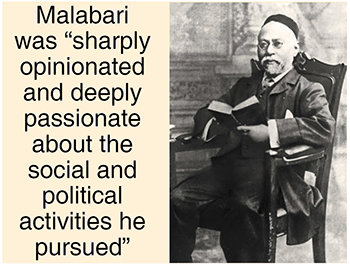
Assistant professor of history at the S. P. Jain Institute of Management and Research Dinyar Patel told Parsiana on January 5 that Malabari "had little formal education yet was widely read and had a natural political antenna: he provided Congress leaders in the late 1880s with detailed analysis of British party politics in spite of not having the chance, as yet, of visiting the country.” He was "sharply opinionated and deeply passionate about the social and political activities he pursued… Malabari was also the editor of what was widely considered the most respected English-language journal in India in the late 19th century, the Indian Spectator. In spite of leaving the Congress in 1886, he played an invaluable behind-the-scenes role in Congress activities and Indian political development. He was in touch with some of the most prominent people across India, Great Britain, and the British Empire, and he was happy to use these contacts to advance India’s political demands.”