The new president of the two-century-old Asiatic Society of Mumbai
shares plans to complete ongoing projects and take up new ones
Farrokh Jijina
It feels great to be the first woman president of The Asiatic Society (of Mumbai),” educator and former vice principal of Jai Hind College Vispi Balaporia stated in an email to Parsiana on September 22, 2019. "But this acclaim is also indicative of the fact that we still live in a male dominated society. It is being looked upon as an achievement, simply because I am a woman! Having said that, I do have a sense of having accomplished something that had not happened in the 215-year-old Asiatic Society,” she stated.
Having served previously as secretary and vice president of the Society, 78-year-old Balaporia was elected its 50th president on August 31. She won 107 of the 178 votes cast. Reportedly, her opponent, former principal of Siddharth College Dr Surendra Dhaktode garnered 31 votes. Former Supreme Court Justice Sujata Manohar had reportedly withdrawn her candidature when she came to know the office was an elective one. Four vice presidents, one honorary secretary and five members of the managing committee were also elected.
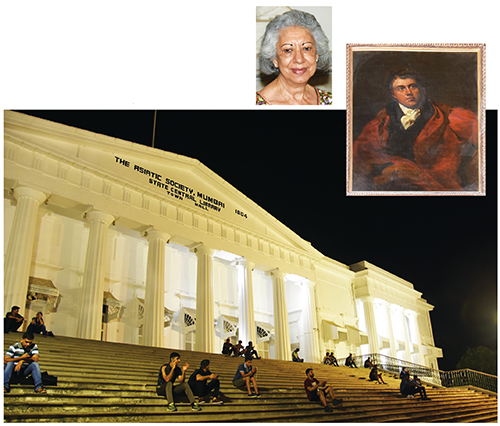
Top: Vispi Balaporia; above: Town Hall housing The Asiatic Society of Mumbai; inset, Sir James Mackintosh
Clockwise from top left: the Society’s reading room, library and Durbar Hall
"Some men still feel uncomfortable to see a woman taking charge. But I am confident that I can deal with that, provided I have the support of the other women on the managing committee. Generally speaking, one has seen many instances of women failing to support women. I would like to ensure that we work as a well-coordinated team on the managing committee, with only one goal: that we work together for the benefit of the Society, setting aside personal equations,” wrote Balaporia. Reportedly, until recently there was not a single portrait of a woman in their Gallery of Excellence. "After some members suggested it, we added a portrait of Indian scholar Durga Bhagwat to the Gallery,” she stated in an interview with Parsiana on September 26.
Of the 2,442 members of the Society eligible to vote, 178 voted, according to Balaporia. "This reveals that many of our members could fall into the category of dormant members, barring a small number who are regular users of the library, but who may not be interested in its other activities… Care is taken to reach out to all our members (via email), with information pertaining to all our activities, particularly the several public lectures we hold under the Endowment Scheme and the Literary Club.”
The Society’s total membership comprising life members, annual members, reader members and student members is 3,089 as per their annual report. Everyone "who demonstrate(s) a sustained interest in (its) aims and objects,” can avail of membership, which provides access to "its vast and cumulative body of information, learning and knowledge,” according to their website.
Lectures are held out of interest earned from about 13 endowments received by the Society over the years. Topics for last year were diverse: labor studies, Indian secularism and heritage, and urban architecture. Their portrait lined Durbar Hall is the venue of these lectures and that of their Literary Club which conducted 13 lectures in the last year on yoga, gardens, political thinkers and cultural history, among other topics, according to the Society’s annual report. Nine scholarships were awarded in 2018-19 to researchers in fields like mythology, social customs among Kolis in Alibaug and portrayal of the Maratha navy in Dutch print media.
Balaporia outlined to Parsiana the ongoing projects that she would like to see completed during her term. "Instead of trying to bring in revolutionary changes, I believe in bringing in change gradually, with a healthy exchange of innovative ideas,” she stated. "I would want to ensure that the Asiatic Society of Mumbai, like its counterpart in Calcutta, is given recognition as an Institute of National Importance by the Government… Previous president Sharad Kale had made efforts to enhance the grant the Society receives from the Ministry of Culture in Delhi so that we do not have to look continuously for the generosity of donors to complete our ongoing projects and take up new ones… I would continue with the efforts,” she stated.
During a 2014 visit to the Society, vice president of India Hamid Ansari was "specifically taken up with a gold coin with inscriptions from the reign of Mughal emperor Akbar,” narrated Balaporia. When he went back to Delhi, he recommended the setting up of a review committee to see how the Society could be assisted. The committee report recommended a grant of Rs 50 crores, with Rs 30 crores coming from the union government and 20 from the state government. "We have only received five crore rupees so far,” explained Balaporia. The Society is taking steps to revive its previously lapsed permissions under the Foreign Contribution Regulation Act to be able to avail of the largesse of overseas donors.
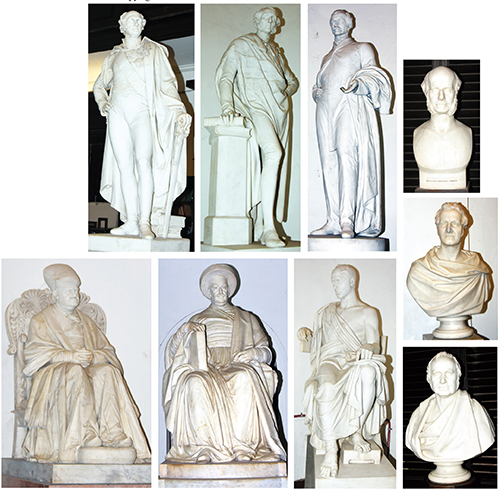
Clockwise from top: Statues at the Society/Town Hall of Sir John Malcolm; John, Lord Elphinstone,
Sir Henry Bartle Frere, William Frere, Sir James Rivett Carnac, William Erskine; Charles Norris;
Jagannath Shankarseth; Sir Jamsetjee Jejeebhoy
Thanks to another one-time grant of five crore rupees from the Maharashtra government, the Society was able to complete the first phase of a web portal, Granth Sanjeevani, in January 2018. "It was a suo motu (voluntary) grant. We had not applied for it. We got to know about it from the Press,” Balaporia told us. With the hope that "thoda thoda kar ké miléga [we will get it (the grant) in instalments],” the Society set up scanners in their basement area and started work prior to the full amount being received. The portal currently provides global access to a portion of the Society’s resources of newspapers, manuscripts, government publications, journals and books which are free from copyright restrictions. So far the Society has reportedly digitized 25,800 books, 2,462 manuscripts and 1,600 maps during the first phase.
Their website notes that "It is envisaged that (the portal) will eventually host all the unique collections of the Society.” "Much remains to be done... We need to widen its scope, so that we can attract researchers and scholars worldwide,” Balaporia told us. A recent donation of Rs 35 lakhs from a fashion house across the road from the Town Hall has enabled the Society to start work on cataloging its collection of maps, revealed the president. "But corporate houses do not (generally) give (funds) freely,” she stated.
Sheetal Gandhi, the Society’s conservation architect has prepared a blueprint for infrastructural improvements to the Society’s library taking into account the needs of the library staff. This is another project that Balaporia would like to carry through, she explained.
"We do not weed out older books as a matter of policy” as some libraries do, the president told us as she walked us through the library, reading room and the researchers’ room. The reading room with its large chairs and footstools, reminiscent of an age gone by, with balconies holding more glass fronted bookcases sees "only a handful of visitors besides the regulars.” Researchers can ask for and refer to up to 15 books at a time and work at about a dozen desks with lockable drawers that can be allotted to them, if informed in advance. Wifi, though, is unavailable, as of now. The library accepts books as donations if the donor gives them a list of volumes that they believe would be relevant.
According to the Society’s annual report for March 2019, they have 2,58,952 books and periodicals. Their rare and valuable collection includes first editions of antiquarian books in Indian and European languages. Subjects include Indology and Oriental scholarship, biography, genealogy, politics and economics among others. Balaporia told Parsiana that the Society has books dating back to 15th and16th century including an original manuscript of Dante’s Divine Comedy and manuscripts written on palm leaves in Sanskrit. Their coin collection includes a fifth century gold coin of Emperor Kumaragupta Maurya and coins issued by Shivaji, warrior prince of the Bhonsale Maratha clan, besides others.
Old issues of newspapers and periodicals in the Society’s collection date from up to nearly two centuries ago, records their website. Their "Sopara relics” (artefacts from an archeological expedition in Nalla Sopara near Bombay in 1882) include eight Buddhist bronze statues from the eighth and ninth century, caskets of copper, silver, stone, crystal and gold, numerous gold flowers and fragments of a begging bowl believed to have been originally used by Gautam Buddha, Balaporia shared with Parsiana.
The Society has sought the state government’s approval to power its heritage building with solar energy. Balaporia told Parsiana that "besides looking for funding for this, several permissions have to be sought. Since the Town Hall in which the Society is located falls under the purview of the Collector of Bombay, the Public Works Department has to carry out a structural audit to ensure that the roof can take the additional load of the solar panels. We must also seek the permission of the municipality’s heritage committee. Letters have been sent to the various authorities, and responses are awaited.”
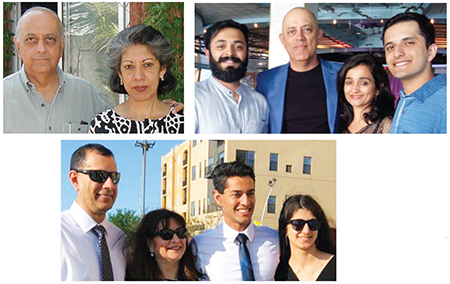
Top (from l): Russ and Vispi, at Regimental Cinema, Nasik, circa 2004;
Rehan, Zubin, Tanu and Farhan; above (from l): Zahir, Meherrnaz, Zarvaan and Myah
Carrying the legacy
Recipient of the Best Teacher Award from Bombay University in 1999, the academician has spoken of the need "to attract young members who will carry the legacy of the Society forward.” Balaporia continues her interest in academics as visiting faculty member for the bachelor’s degree course in mass media at Jai Hind College. She serves as trustee of the Sir Jamsetjee Jejeebhoy Parsee Benevolent Institution and advisor to the Byramjee Jeejeebhoy Parsi Charitable Institution. "I got involved with the Society post my retirement from Jai Hind College” in 2001, narrated Balaporia. Being a secretary of the Society involved long hours. "Now as president I am not expected to work late,” she quipped.
Balaporia recalled that as a child growing up in Delhi while her father Shavax Lal was secretary to Dr Rajendra Prasad, India’s first President, she would constantly be told "bahar hava ma rammva jaa (go play outdoors).” But she was happier doing her homework and pretending to teach a class, she smiled. After a short stint as lecturer and tutor at her alma mater Wilson College, Balaporia joined Jai Hind, teaching English and French in the early 1960s. (She had schooled at La Châtelaine in Neuchatel, Switzerland and studied French at both the graduate and postgraduate level in Bombay.) The College "proved to be a very happy choice. I was able to make many good friends, Russ (her future husband) being one of them. I had some excellent teachers, and during the two years of post-graduate study I was also given training as a tutor and lecturer, which set me off on a teaching career,” the academician reminisced.
A previous Bombay University senate member, Balaporia’s bio data notes that her Masters of Philosophy (M. Phil) dissertation was on "Designing a writing course for undergraduate students with a low level of proficiency in English.”
The septuagenarian is positive about Parsi youth. "They are making efforts,” she disclosed, basing her opinion on her interaction with members of the World Zarathushti Chamber of Commerce.
"I am certainly not a traditionalist... I occasionally go to the fire temple, but do not consider it mandatory…But I do believe in a super power, call it Ahura Mazda for ease of belief…I believe very strongly in the tenets of good thoughts, good words, good deeds, and believe in giving thanks for the relative ease and comforts that surround me,” revealed Balaporia. Although to her the practice of dakhmenashini "sounds archaic and outdated,” she stated that she "would like to be traditional in this respect. Doongerwadi still retains its peaceful ambience and old-world character.
"My elder son Zubin is married to a woman from the Bohra community,” she noted. "We get on extremely well with members of her family, and have on several occasions gone on planned holidays together... I am also of the opinion that we should move out of old beliefs and be more accepting of the other faith marriage partners, including them in the faith as well, without proselytizing.” Zubin and Tanu have two sons, Rehan and Farhan. Balaporia’s younger son Zahir has a master’s degree in industrial engineering. His wife Meherrnaz and children Zarvaan and Myah live in the US.
The president says she was "fortunate in having had a truly happy married life from 1963 to 2010,” when her husband passed away. "I was fortunate to have been able to continue with my career and still raise a family... there was always someone to mind the boys when they were growing up.” Russ, being the only son, "was almost compelled” to join his father Framroze in the business the senior gent had set up from scratch, having started off with the Regimental Cinema in Nasik, she revealed. "Balaporia Theatres had become a well-reputed firm, controlling a chain of cinema houses in Maharashtra and Gujarat. After his father passed away, Russ controlled the business singlehandedly... Unfortunately, the rise of multiplex cinemas dealt a death blow to single screen theaters. Russ read the writing on the wall, and was able to gradually water down the business, selling off the properties that they owned,” she narrated. Since neither of their sons were inclined to join the business, "it was prudent to take the steps he did... It also left lesser problems for us to deal with when he died so suddenly.”
The Parsi members and researchers at the Asiatic are "not a large number,” Balaporia bemoans. "It is the same in academics... a result of dwindling numbers and better opportunities in the commercial world.”
"Taste and munificence”
Housed in the 1833-built Town Hall, a heritage structure overlooking the Horniman Circle garden, the Hall’s facade and its sweeping flight of 30 steps leading to a portico with eight Doric columns is a must see venue for many tourists to Bombay, in addition to being a popular venue for film and fashion shoots. Access to the Asiatic Society of Mumbai is available from the side of the Hall, past a wrought iron divided Regency staircase with ornate banisters, leading to a vestibule adorned with statues and busts of administrators, scholars and philanthropists, including Sir Jamsetjee Jejeebhoy, who contributed to Bombay and to the Society.
.jpg)
Founded in 1804 by jurist and Recorder or the "King’s Judge for Bombay,” Sir James Mackintosh (pictured) as the Literary Society of Bombay, their aim was "promoting useful knowledge, particularly such as is now immediately connected with India.” The Literary Society purchased the collections of the Medical and Literary Library (founded 1789). This formed the nucleus of their library, notes the Society’s website. After its 1826 merger with the Royal Society of Great Britain and Ireland, the Literary Society was renamed the Bombay Branch of the Royal Asiatic Society (BBRAS). In 1830, the Society moved into the Town Hall, contributing Rs 10,000 towards its construction. A researcher and former managing committee member told Parsiana that "they moved in before (the building) was formally completed” in 1833. Former Bombay governor Sir John Malcolm, whose statue stands in the vestibule at the head of the stairs, called the building "the most magnificent structure that taste and munificence combined have as yet erected in India,” according to the Society’s website.
The last three decades of the 19th century saw mergers of the Geographical Society of Bombay and the Anthropological Society of Bombay with BBRAS, thereby expanding its collection of books and manuscripts. In 1954, the Society was renamed the Asiatic Society of Bombay, and in 2002, The Asiatic Society of Mumbai.
The Society’s first Indian president was Justice K. T. Telang (1893-1894). The first Parsi to head the organization was Sir Jivanji Jamshedji Modi (1929-1931). Lawyer B. J. Wadia served as president from 1943 to 1947. Prof P. A. Wadia was appointed as acting president in 1958 for one year, while lawyer Soli Sorabjee headed the Society from 1977to 1985. The current board of six trustees of the Society include advocate Navroz Seervai and businessman Cyrus Guzder. Their 15 elected committee members include archeologist Dr Kurush Dalal, academician Dr Shehernaz Nalwalla and researcher Rusheed Wadia.