The new Jiyo Parsi advertising campaign adopts a more introspective tone
Parinaz Gandhi Photos: Arish J. Patel
Baby babble seasoned with shrieks and squeals continued for over an hour during the launch of the second publicity campaign for the Jiyo Parsi initiative at the Sir J. J. Modi Hall of The K. R. Cama Oriental Institute on July 29, 2017. They were undoubtedly a disturbance to the minister of minority affairs Mukhtar Abbas Naqvi, his gun toting security, the consul general of Iran, Masood Khaleghi, the press corps from the print medium and television channels who had come to cover the proceedings, Dastur Khurshed Dastoor who recited prayers at the start of the program and other invitees. But no one dared to oust the restless toddlers who featured in the new advertising campaign. They were as cherished as the 104 prized additions to the community since the Jiyo Parsi campaign was launched in 2014. They were a living proof that the Government of India’s (GOI) financial commitment of Rs 10 crores through the ministry of minority affairs (MOMA) to increase the strength of the Parsi population had resulted in birth rates improving by 18%.
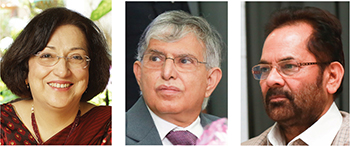
From left: Dr Shernaz Cama Photo: Anay Mann, Sam Balsara, Mukhtar Abbas Naqvi
Some of the new advertisements
(From left, 1st row) Masood Khaleghi, Dastur Khurshed Dastoor, Niva Singh,
Parizad Kolah Marshall, Yazdi Desai, Armaity Tirandaz; (2nd row) Dr Katy Gandevia,
Pearl Tirandaz, Dr Niloufer Shroff, Pearl Mistry
A section of the audience
Saluting the enthusiasm of the Jiyo Parsi team, Naqvi assured the organizers that MOMA and joint secretary Niva Singh who was seated on the dais could be counted on for further financial and moral support. In his talk in Hindi he mentioned that while other minority communities like the Muslims, Christians, Buddhists, Jains have witnessed a 10-20% increase, Zoroastrians have shown a continuous decline in numbers with the 2011 GOI census showing a count of 57,264. To further increase the respect and admiration that the community has earned over the years, he recommended that more publicity material be created and presented through the print and audiovisual medium in the form of story books and films. Pledging MOMA’s commitment to the safety and security of the community, he announced that he would speak to the chief ministers and home ministers of the concerned states such that the property of this peace loving community is protected by keeping antisocial forces at bay.
Commending the government that is making a "sincere effort for the distinguished community in India,” Khaleghi who was the chief guest at the 2014 Jiyo Parsi launch (see "Creatively coupling,” Parsiana, November 21, 2014) remarked that the major responsibility continues to fall "on the shoulders of the community.” He felt incentives from Parsi founded industrial houses like Tatas, Godrej and Shapoorji Pallonji would go a long way in encouraging the community to procreate. In a faith that stresses on good thoughts, words and deeds, "what deed is more important than the continuation of the community?” he asked rhetorically. To those parents who feel they need to send their child to the best school, Khaleghi reminded, "Best schools may not produce the best children.”
The program being co-hosted by Parzor Foundation, Bombay Parsi Punchayet (BPP), Tata Institute of Social Sciences and The Federation of the Parsi Zoroastrian Anjumans of India, the message of Parzor founder director Dr Shernaz Cama who could not attend the function due to ill health, was read by Jiyo Parsi program coordinator Dr Katy Gandevia. Cama lauded MOMA that has "stood by this tiny community” and Madison that under Sam Balsara’s stewardship "agreed to help us spread the message pro bono.” Pointing out that the Parsi community "for too long has focused on only one type of success,” she hoped the new advertising campaign would remind them to balance professional accomplishments with personal life so that they are not "cut off from the joys of living with the family.” Others in attendance from the Jiyo Parsi core team were cousellor Pearl Mistry who served as the anchor for the program, public relations officer Pearl Tirandaz, nodal person and BPP trustee Armaity Tirandaz and Dr Niloufer Shroff from Parzor Foundation. Sharing the dais was Federation president and BPP chairman Yazdi Desai.
Vivacious and charming, model and television actress Parizad Kolah Marshall was specially invited as "an inspiration for our community on how to balance a successful career with children.” Being one of three children who knew the "importance of family,” she said she was able to continue as anchor for the Great Laughter Challenge show thanks to the support she received from director Pankaj Saraswat and the celebrity judges. Working well into her pregnancy and resuming within six months of her first delivery, she recalled how she had "to run between shoots… As hard as it will be,” there’s an incomparable "joy to come home to a husband and children… There’s a time for everything. Take a chance, trust God and the universe will support you.” Having realized that "children don’t want a perfect mom, they want a happy mom,” she concluded with the maxim, "Never get so busy making a living that you forget to make a life.”
Referring to the success of Madison’s first advertising campaign for Jiyo Parsi that "helped create awareness and let Parsis accept that ‘yes we have a problem,’” chairman and managing director of Madison World Sam Balsara appreciated that the "intentionally controversial” campaign went viral and was able to earn "media attention and become the subject of family dinner table conversations in Parsi and non-Parsi homes… To give it more gravitas, the second campaign treats the subject a little more seriously.” It specifically highlights "the importance of getting married and starting a family from an individual, and not a community’s perspective… To make an individual reflect seriously on his/her future and hopefully take him a step closer towards the action the community desires.” Since procreation is "a delicate subject, generally considered a private matter, it has been dealt with a certain sensitivity but the campaign is yet hard-hitting to drive home the point.”
He was happy that his daughter Lara Vajifdar who had played a stellar role at the launch of the first campaign and had delivered her second baby just two days prior to the launch of the second campaign "has imbibed the spirit of Jiyo Parsi.” She delivered her first child within 15 months of marriage and the second one within 18 months of the first baby. Hoping that more Parsi daughters will do the same, Balsara impressed on Parsi parents not to adopt the attitude of "éné gamé té karva dé (let the child do what he/she wishes).”
To make it "a credible campaign,” real life situations faced by Parsis have been projected through 12 black and white advertisements. Balsara particularly dwelt on a few of them: one, showing a man on a bike bonding with his son on a bicycle with the accompanying text stating, "We can’t have children. They cost money.” "Hey, what if your parents had said that?” continues the message. Another advertisement depicted a lovely young girl who is hoping to find an affluent match owning a Honda sedan, one lakh salary per month, two-bedroom-hall-kitchen flat on Napean Sea Road. The tag line states, "Wait to check all boxes and you may check into an old-age home. Alone.”
Happy to use his "professional skills in the service of the community,” Balsara was keen the campaign should "give singles and childless couples something to think about… such that having babies can be brought back in fashion.”