A one day seminar under the auspices of the National Commission for Minorities highlights the community's demographic decline and the steps to counter the falling numbers
Arnavaz S.Mama
"To do nothing is to do something wrong.” Dr Ashish Bose, population studies expert and chairman of the Society for Applied Research in the Humanities, quoted a German aphorism. "We’ve taken 50 years doing nothing,” added Dr Armaity Desai, former director of the Tata Institute of Social Sciences (TISS).
The strong statements of the sociologists were made in the context of the Parsi community’s depleting numbers as demonstrated by the Government of India census 2001 which has pegged the all-India community membership at 69,601. In the face of a globally low fertility profile (0.9 percent), of the world’s highest geriatric population (31 percent are over the age of 60), of women outnumbering men in all age-groups, more specifically during their childbearing years, the experts were of the view that the community needed its fertility clinic, but it needed policy intervention even more. And they were not referring to the male chauvinist panacea of multiple wives.
Their intervention in the debate (there are people who still question the veracity of the idea that community numbers are declining, even though the decadal growth rate is -8.88 percent) came at the full-day symposium organized by the National Commission for Minorities (NCM) at Sahyadri, the guest house of the State of Maharashtra, on December 5, 2004. Hosted by Sardar Tarlochan Singh, Member of Parliament and chairman of the NCM and conducted by Lt Gen (Retd) Adi Sethna, president of the Delhi Parsi Anjuman in his avatar as Zoroastrian member of the NCM, the event proceeded with a presentation by Bose and his team of experts headed by Prof T. K. Roy, former director of the Indian Institute of Population Studies. Desai and her TISS professors who are probing the community to profile the attitudes, problems and preconceptions of the youth as well as the health hazards that ail its middle aged and elderly on behalf of the UNESCO sponsored PARZOR project, shared their findings with the audience.
A panel of discussants drew from their experience to paint in details of the community portrait. Dr Anahita Pandole who is heading the Bombay Parsi Punchayet’s (BPP) Fertility Clinic, spoke about the technical aspects of fertility patterns. Much respected physician Dr Farokh Udwadia addressed the socio-economic and medical aspects of the community whose patients he has tended for over 45 years. Drawing on legal history, Parsiana editor Jehangir Patel examined the exclusivist mindset and its repercussions over the past century. Noted solicitor and columnist Berjis Desai read the writing on the wall as etched by the community’s marital patterns. The BPP’s school counselor Pareecheher Daviervala recounted the aspirations and apprehensions of the youth. Dr Homi Dhalla proffered practical suggestions from the viewpoint of a religious scholar. A sumptuous repast, courtesy the Taj Group of Hotels, primed the experts and the audience for some heated debate.
This was the second presentation by Bose’s expert committee which had been appointed by the NCM to examine and present census data and help each minority community to understand the findings and take measures to ensure its welfare and prosperity, said Singh, remarking that the first had been held a month earlier for the benefit of the Sikh community. "The role of the Parsis in India is well known...India needs you and we are proud of you...”
Presenting a gist of analysis of the data on the Parsi population, currently .0069 percent of India’s total of over one billion, Bose, who described himself as "basically an economist who has strayed into demography,” said the Parsis are "India’s most talented community (with) no hang-ups, complaints or ill will.” Hence he justified the demographers’ legitimate concern at the decreasing numbers. He contrasted the Parsis’ 60+ age group, now 31 percent of the whole with the all-India figure of seven percent; of the low 3.2 percent of children, "not to pressurize but to awaken the community to an unpleasant truth.” He contrasted the Parsis’ complacency with the anxiety of Japanese policy makers who are worried that there will not be a single Japanese left in the world at the end of 300 years even though their population is about a hundred million today.
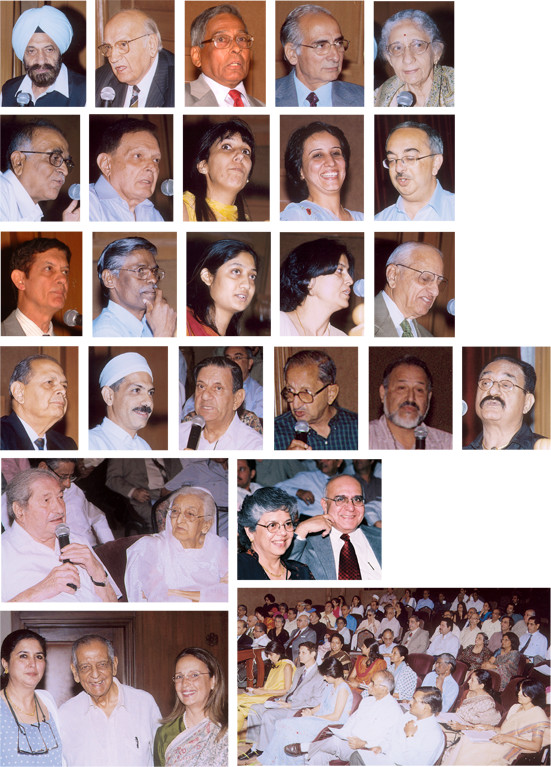
1st row : From left: Singh, Sethna, Bose, Dev Swarup, Desai; 2nd row : Roy,Udwadia, Pandole, Daviervala, Desai ; 3rd row : Dhalla, Sivaraju, Bharat, Narayanan, Shroff; 4th row : Row above from left: Modi, Karanjia, Kanga, Moddie, Mistree, Irani Left: BPP chairman emeritus Jamshed Guzder and Silloo Kavarana.(Alongside) Bachi and Dinshaw Tamboly. (Bottom) Firoza Mistree, Kekoo Gandhy and Pheroza Godrej.; Section of the audience;
Bose noted that there were cases of deliberate underestimating of minorities in some countries of the world, but that was not the case in India in 2001, especially with the Parsis for whom census commissioner J. K. Banthia went out of his way to collect data, though he felt that there was an inadvertent undercount in 1981. Former Indian Administrative Service (IAS) officer Jamsheed Kanga had played an outstanding role in the enumeration plan this time, Bose added. "When people don’t get married, when they produce an average 1.2 children per couple, the community numbers decline. If Parsis are migrating, to which countries are they going in such large numbers?...Out-migration cannot explain the consistent decline in the Parsi population for the last four decades...In all age-groups there are more women than men...In the 20-30 age-group there are 2,060 women and 2,031 men, in the 30-40 age-group there are 1,940 women and 1,937 men... The women remain unmarried or marry outside. But if you marry out you are not considered Parsis...This is a real threat... unless intercaste marriages are sanctioned by Parsi priests...” stated Bose.
Bose pointed to the anomaly in the Indian constitution which has one reserved seat in Parliament for an Anglo-Indian nominated by the President of India even though that community has largely migrated out of India. "The Parsis should also have a member (in the Lok Sabha). We owe it to the Parsis to ensure some seats from the donor kitty in educational institutions,” he added, acknowledging the community’s role in the spread of educational facilities in the country. "There is nothing wrong in talented Parsis joining the world mainstream...but there is no great merit in being a bus conductor in Canada.”
If the fertility rate remains unchanged at the present level there will be 34,000 Parsis in India by the year 2051
"Up to 1941 Parsi fertility was high and the mortality level was lower than the all-India level; but from 1961 the sex ratio began to change with females outnumbering men. The age structure of the Parsi population also became older,” said Roy adding that at ages upward of 60 females generally outnumber men all over the world. He was particularly concerned with the dip in 1981 (population declined from 91,378 in 1971 to 71,630 in 1981 according to the census figures). Though heavy emigration was a possibility, he felt it was more probably due to some problem in the enumeration of Parsis. "If there had been such a big emigration between 1971-81 we might have known.” Projecting backward from the 2001 data he estimated the population in 1981 at 86,013. Examining the fertility and mortality rates, the age structure and probable migration, Roy noted, "If fertility is high, the proportion of the population below the age of 14 would be high. Children account for only 10.4 percent of the total in the 0-14 age-group.” Also, the child-woman ratio (which provides the fertility rate) is less affected by emigration because the child will migrate with the mother, he added. But the total fertility rate for Parsis was 1.12 in 1991 and 0.94 in 2001 when the corresponding rates for the Indian population were 5.2 and 3.2. "Fertility is higher among Parsis in states other than Maharashtra,” he added.
Though childlessness among married women (45-49 years) has reduced from 16.7 in 1982 to 11.7 in 1999, it contrasted sharply with the all-India incidence at two-three percent, he told the audience. Moreover, in 1961 there were 3.2 percent of never married males, a figure that rose to 20.6 percent in 1999 in contrast to 0.6 percent in India as a whole. Over nine percent of women remained unmarried, Roy provided the figures.
Life expectancy among Parsis is very high but the death rate is also high because of the peculiar age structure, noted Roy. He explained that 69,601 in 2001 = 76,382 (in 1991) less 8,630 deaths plus 1,849 immigrants. "It indicates that in 1991-2001 there is no evidence of substantial out-migration.”
Working on projections for the year 2051, the demographers use the current as well as higher and lower fertility rates to estimate the figures. If the fertility rate remains unchanged at the present level there will be 34,000 Parsis in India by the year 2051. If the fertility rate falls to 0.75 from the present 0.9, the total numbers will decline by 7,000 per year to 32,000. If fertility increases, the population may register 47,000 individuals. However, the total figure will continue to decline because of the skewed age structure, noted Roy.
The community "built houses all over the place, thinking housing is the problem”
Several communities in India — small groups among Hindus and Muslims — face similar fertility and health problems, noted A. Desai. "Crucial to our survival” are 17 percent youths (aged 20-35). Using quantitative and qualitative methods, the PARZOR team is interviewing in depth a random sample of 10 percent of the total number (11,868) across India. Laboratory based studies are concentrating on the genetic factors, examining the effect of consanguineous marriages on fertility and health. Three-generation family genealogies with information on education, occupation, age at marriage, age of mother at birth, age at death, causes of death, fetus loss, are some of the areas under the scanner, said A. Desai who made a strong pitch for space for an archival center where all the data can be stored including medical data like X-rays, slides, blood samples, etc.
TISS Prof Lata Narayanan observed that the youths had been subdivided into three groups 20-25, 25-30 and 30-35. So far 137 of the projected 1,200 had been interviewed. Once convinced of the purpose of the interviews and their confidentiality, there has been no dearth of cooperation, she noted. However, exam and work schedules impinge on the time available for the long, in-depth interviews.
A similar research on the 60+ segment hopes to lay bare the family background, reasons for non-marriage where applicable, present living conditions, expectations from the family, neighborhood, government and NGOs. It may result in policy guidelines for an action plan to help them, said Prof Sivaraju. Being conducted in 12 cities as also rural areas, they have so far chalked up 30 case studies.
A team of researchers under Dr Katy Gundevia is identifying research publications on Parsis as well as interviewing medical specialists who treat Parsis. They hope to identify health problems, cases for early intervention, the patients’ adherence to treatment, etc. Dr Shalini Bharat is closely scrutinizing families to understand the psychosocial dimensions of the Parsi population decline. Family and kinship patterns, interdependence and bonding, arranged marriages, age at marriage, preferred family size, goals of marriage and whether these differ by gender, are some aspects under the scanner. She is also trying to ascertain the impact of the higher age at marriage on the family as well as the community in terms of reproductive health problems and behavior. These projects have certain common themes to ensure a large set of data, explained Bharat. Questions based on these in-depth interviews would then aid the quantitative analysis projected in Bombay and Baroda among the urban areas, Gandevi and Bardoli among the rural ones. "The census gives the problem in wide perspective. These studies are in micro perspective,” noted A. Desai, bemoaning the time wasted as the community "built houses all over the place, thinking housing is the problem.”
Noting that worldwide 10-14 percent of couples are incapable of conceiving, Pandole noted that 90 percent of infertility is treatable, adding that 48 of the over 50 couples who had come to her in the past six months were following up with treatment.
Acknowledging that the community’s demographic pattern was best illustrated by an inverted triangle with too many elderly on the top, too few children at the bottom, Udwadia spoke about the medical and socioeconomic problems afflicting the community. Recalling how the B. D. Petit Parsee General Hospital used to be crowded with young, middle-aged and old patients in the earlier part of his 45-year association with the institution, he noted that it is now half empty, quoting the Hospital registrar’s figures for the day: four patients under 30, six in the 40-50 age-group, 30 patients in the 50-70 age-group and 77 patients over 70 years of age — "Proof enough what an aging population we are.” Hypertension, strokes, degenerative diseases like diabetes, arthritis are diseases of midlle age and older people. There is no way of saying how many such may be in the community. Ischemic heart disease among Parsis was significantly greater than in other communities even in the 1970s, said Udwadia.
"Old age plus sickness plus loneliness plus poverty is a lethal combination. Decrepitude and loss of dignity is difficult to fight”
Alluding to the current study of genes and its clinical impact which Udwadia anticipated will take a long time to come, the physician noted that though the Parsis’ health troubles were frequently genetic in origin, it is "not a single gene which is responsible for the transfer of a disease. It is a complicated mechanism. There are other genes, helper genes, suppressor genes...Moreover, it is not just the gene which conditions disease. Environmental factors are intermixed. They determine the presentation of these diseases. In old age, apoptosis is a cell which has an inbuilt mechanism for slow withering away of the body after a spell of time. Alzheimer’s has a large part to play in the terminal stages. All aspects of living are interlinked. ...Philosophy, religion, politics, national disasters and calamities, all impact us. There are people who are lonely, uncared for and sick. They are generally poor. Old age plus sickness plus loneliness plus poverty is a lethal combination. Decrepitude and loss of dignity is very difficult to fight. (We must) address it at the level of the family, baug, local authority. It is our moral duty to look after the old and infirm, make them more comfortable.”
More worrisome was Udwadia’s statement that these diseases are creeping into younger age-groups: "In a small community everyone is related to each other. Recessive genes become dominant. Coming to the fore by getting mixed in unfortunate ways, they manifest in illness. Behavior patterns are also governed by them. Good people are also produced by good genes coming together. So there is polarization between the good and the not-so-good. There is an increase of nervous diseases, psychosis, psychotic behavior, mother fixation, multiple sclerosis, tremors.” Referring to the social mores of the young which results in late marriages with no children or few children, the Parsis’ fondness for comfortable living, "they wouldn’t want children they can’t support and educate,” Udwadia asked for a census of Parsis in North America, New Zealand, Australia to establish what is happening there. "Are we talking of symptoms? What is the cause?” he asked. "This community is a bit fossilized. We live in a time warp, shackled to customs and traditions which is good to a point but only to a point. There are blinkers on our eyes, we have tunnel vision, we can’t see to our sides. We don’t want to change when the world has changed incredibly.” Quoting famous historian Arnold Toynbee Udwadia said, "Civilizations and societies have to respond to challenge. Those that fail to respond, stagnate, decay and die. I only hope this community can meet the challenge.” A standing ovation to Udwadia demonstrated that at least among the small audience at the Sahyadri his words had hit home.
In his presentation titled "Twilight and dawn of Zoroastrianism,” Patel quoted extensively from the Parsi Punchayet Case judgment of 1908 to establish his view that "the Parsi caste is a relatively recent development.” Justice Dinshaw Daver had held that the properties and institutions founded by community philanthropists were for the use of the "Zoroastrian community of Bombay.” Justice Frank Beaman had similarly noted, "In not one (trust document) do we find the word Parsi. In their own solemn religious utterances, the Indian Zoroastrians had not... thought of designating themselves or their religious communion, by the popular caste appellation of Parsi. Such a term in such a connection would probably have had no meaning for them.” Patel pointed out that Beaman stated Parsis favored conversion if it was of the well placed and not the lowly castes. During the guests answer session Tannaz Parekh referred to Justice Dinshaw Daver statement that conversion would be suicidal. To which Dr Armaity Desai retorted the community was anyway committing not only "suicide” but "genocide”on account of its falling numbers.
"The census board should be the census. It cannot comment on religious acceptance, etc”
Patel referred to the case of Bella, the orphan child of a Parsi mother and a Goanese father who was reared from early infancy in a Parsi home in Rangoon and her navjote performed. When she was taken to the Rangoon agiary by her adoptive father however, three members of the community there complained of wounded feelings and desecration of the agiary. The matter went in appeal all the way to the Privy Council which, on the basis of the Daver-Beaman judgment, declared that Bella was not entitled as of right to use the agiary but that it was within the prerogative of the trustees of the agiary to permit her to do so, as her attendance, being a Zoroastrian, would not interfere with the devotions of other worshippers. As per the research of PhD student Mitra Sharafi, Bella continued to frequent the agiary as long as her uncle, the trustee, lived. After his death she was debarred, became bitter, and gradually dropped out of the community fold. "How many more Bellas do we wish to create without realizing we are losing out on numbers and assets?” asked Patel.
B. Desai began by noting that one-third of marriages in Bombay were intercommunal. Outside Bombay they range between 60 and 95 percent, he added. "It is undisputed, even by the traditionalists that these trends are irreversible, in the sense that it is not possible to reduce the number of intermarriages either by propaganda or exhorting campaigns or by measures such as increasing community housing. Therefore one can safely conclude that these patterns will accelerate, possibly exponentially.” As laws governing the definition of Parsis date back to the Parsi Punchayet Case and the Bella Case, both in the pre-Independence era, and as the Indian constitution recognizes no gender based disparity, B. Desai advocated a test case in the court seeking the legal right for the children of Parsi mothers to be considered Parsis on par with the children of Parsi fathers, though he admitted that the issue would be "divisive, controversial and bitterly contested” and of uncertain outcome. In the absence of a legislative correction which would be most unlikely in the face of the highly vocal orthodox, he advocated the court option, advising the conservatives that it is in their interest to prevent any loss of the Parsi population. The liberals, he reminded them, were content so long as there is a revival of Zoroastrianism.
The youth want to break free, replace old traditions with materialistic values, a trend stronger among females, noted Daviervala who was unhappy at the lack of youths in the audience. They dream of creating a record of sorts, secure admission to premier educational institutions abroad, relocate, find the perfect mate, etc. Much of this is without a corresponding desire for serious application, hard work. But apprehensions begin where aspirations end. Fears, loss of tradition, culture and religion follow the inability to secure the desired admissions. Nearly 40 percent end up in a bachelor existence or in late marriages that increase the generation gap and the corresponding unease between parents and children, Davierwalla traced the generality of community existence.
Dhalla advocated a "paradigm shift in thinking:” the acceptance of the children of Parsi women in recognition of their human rights and the setting up of a survival fund by shifting consecrated fires together on the lines of the Lonavala Agiary (which also houses the fire brought back from Aden) and disposing of the premises. Advising a change in the mindset, Dhalla sought a new vision. "Pride in the community’s history is not enough. To live in the shadow of the past is not enough. We need better, higher education, businesses in other parts of India, trustees over 65 giving the youth a chance. Involve the World Zoroastrian Chamber of Commerce, establish exchange programs with Zoroastrian communities settled abroad. The highly educated will opt for only one or two kids. Therefore enhance provision for the third child...”
In the open forum Barrister Kaikhushru Lam urged restructuring of the community’s "rules for eligibility... The child of a Parsi man and a non-Parsi woman is considered a Parsi but the wife can’t enter the agiary. A mother’s influence is much greater. Which lady, herself excommunicated, will want her children to join the community? An intermarriage loses the entire next generation. A little loosening of ties there might help.” Lam also sought a welcome for adopted children and, if Parsis need to marry within the community, to "educate them before they fall in love.”
Commodore Jehangir Bhada noted the absence of religious leaders. He was critical of major decisions being taken without their knowledge. (In fact, there were no decisions on the anvil as the event was of an informative/educational character.) Sethna replied that all the high priests had been invited and that Dastur Kaikhusroo JamaspAsa had agreed to come but hadn’t. Ervad (Dr) Ramiyar Karanjia, principal of the Dadar Athornan Madressa, was present and later joined the discussion.
Zoroastrian Studies founder Khojeste Mistree protested Roy’s dismissal of out-migration of Parsis from India, stating that 20,000 Parsis had joined the western diaspora in the past 10 years (he later changed it to last 20 years). He also called the birth rate figure erroneous. As for the experts’ suggestion of a need for change in religious perceptions, Mistree commented, "The census board should be the census. It cannot comment on religious acceptance, etc.”
The statistics are based on the civil registration data in Bombay, responded Roy. It is corroborated by the child-woman ratio. There is a shortfall (between births and deaths) of 500-600 per year. This has been extrapolated for the country. He reiterated that there is no significant out-migration. Bose added that the calculations and assumptions made by the census were based on the data available, noting, "Our projections are less pessimistic than those of the community. If the fertility rate rises, the community may not vanish...The census commissioner has made no comment on the religion.”
Kanga agreed that Mistree had a valid point regarding emigration, that important data had been left out. "Let us have a proper analysis if proper figures can be produced. If not, forget about it. Don’t throw dust in the eyes of the community,” he advised. Firoza Mistree pointed out that the directory of the Federation of Zoroastrian Associations of North America (FEZANA) reports 15,300 plus Zoroastrians in North America. "Over how many years? Over 50 years?” retorted Bombay Parsi Punchayet Chief Executive Officer Behram Dastur. And how many of the migrants to North America were from India? What about the Iran? And Parsis from Africa, Pakistan etc? he queried.
According to former IAS officer Aspi Moddie, who had been involved in independent India’s first census operation in 1951, Mistree had "put his finger on the nub of the problem.” He nevertheless argued that the census authority is responsible only for those residing in the country, not those who have shifted elsewhere. He faulted the Parsi leadership for not updating the records of the Fifth World Zoroastrian Congress when the topic had been addressed in substantial detail. The debate which had begun to generate more heat than light led Singh to refer to the response of the Sikh community to the census figures: "Sikh leaders went to the newspapers alleging that lakhs had been killed, lakhs had migrated. We called each one of them to the NCM office (to help them understand the figures). Please don’t confuse your community. Our duty is to create awareness. Dr Roy and Dr Bose are here only to help...doing the job voluntarily, not charged a penny. And they are not from the minority communities.” Added Bose, "We are here with concern about the Parsi population in India diminishing.” Referring to the BPP scheme of assistance to the third and fourth child, Bose stated, "We congratulate you for going in the face of the Government of India policy (which is now said to preclude assistance and privileges to more than two children per family).”
Karanjia faulted the census, averring that "the situation is not so alarming” though numbers are going down. "In 1891 there were 89,000 Parsis. So in 120 years the decline is 20,000. Go by the history of centuries, not by decades. Intermarriage, the children of intermarriage, conversion, are religious issues. We should not tamper with time honored traditions.”
Noted legal counsel and vice president of the Athornan Mandal Ervad Nadir Modi raised the issue of adoption which has had a controversial past. He spoke of the recent judgment of a single judge of the Bombay High Court who upheld the adoption of a child by a Christian couple even though Christians, like the Parsis and the Muslims, do not have a valid law of adoption. Justice Rebello argued in favor of the child’s right to a name and a nationality under Articles 14 and 21 of the Indian constitution which guarantee the right to life. If the decision is not overturned by higher courts, it could well become applicable to all the minority communities in India. "Adopting a child into the family without causing controversy adds to the numbers of the community. It would be beneficial. We should avoid confrontation in our small community,” Modi advised, suggesting quiet discussions and a convergence of views.
Merwan Irani, producer of the film Percy, suggested better use of the media to galvanize the community: "Where is the youth today? Give them the message through drama, films. One picture is equal to 1,000 words.”
"The trend has been with us for some time,” noted BPP chairman Minoo Shroff welcoming non-controversial suggestions and referring to the Punchayet’s "multi-pronged approach” which provides housing to half the community (though unfortunately the occupation density is only three per flat), grants for education, sports and medical treatment, the fertility clinic where 40 percent of the cases may require invitro fertilization (IVF). He was concerned about the employability of those between youth and middle-age, as most are not computer savvy. Also that Parsi boys get left out of higher educational institutions once financed by Parsis. "Females don’t take no for an answer. That gives them a higher leverage in life. We need a change in the mindset.”
"The Parsi Zoroastrian community and its culture has flourished in India because of the multicultural policy of the state. Bear in mind what is happening elsewhere,” advised Sethna adding that the media and intelligentsia of the country were taking interest in the Parsis because of their "predicaments of progress. Our studies will apply to the country as a whole.” A new national committee on minority education is being set up, he noted. "We are not after 50, 100, 200 seats in educational institutions, but some.” He was happy that technology is working toward getting age groups together. Also medical technology as exemplified by the fertility clinic could help and sought financial aid from the government for research into community health. He also sought exemption for Parsis from the Government of India’s embargo on government help to the third and subsequent child in a family.
"NCM can take the initiative. Give us a list of institutions founded/funded by Parsis. We can see that some seats are reserved for you,” responded Singh. "If you need anything with government for education, for health, come to us.”