Mr and Mrs Jinnah: The Marriage That Shook India by Sheela Reddy. Published in 2017 by Penguin Viking, Penguin Random House India Private Limited, 7th Floor, Infinity Tower C, DLF Cyber City, Gurgaon 122 002. Pp: viii + 421. Price: Rs 699.
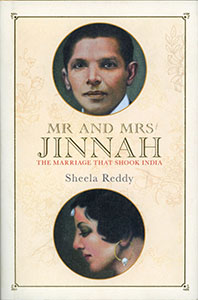
A healthy dose of scepticism would not be out of place when approaching books that carry dramatic titles. This one claims to offer hitherto unrevealed insights into a marriage that ‘Shook India.’ Whether such claims are justified depends, to some extent at least, on the reader’s credulity. Few will deny that the union, in 1918, of Mohammed Ali Jinnah, then a 42-year-old lawyer and rising star in the pre-Independence politics of the sub-continent, and Rattanbai (‘Ruttie’) Petit, the 18-year-old daughter of Sir Dinshaw Petit, one of the pillars of the business community in Bombay, scandalized a section of Indian society and became grist for the gossip mill of the day. The back story to that marriage, and the twists-and-turns of what was clearly a fascinating love story by any standard, forms the basis of this volume.
Sheela Reddy (pictured on pg 39) has had access to a rich treasure trove of private papers which she has put to good use. The nearly 50 pages of references to source material appended to the book reveal a breadth of documentation which will do credit to any serious researcher. They include: Ruttie Petit’s letters and poems; published works on Jinnah; monographs detailing the ancestry of, and goings-on in, the Petit family; reminiscences of friends and acquaintances; Jinnah’s diaries; his speeches; accounts from newspapers of the time; proceedings of important political meetings in the lead-up to Indian Independence; reports of key court cases; deliberations of the Bombay Parsi Punchayet; oral history transcripts; letters of viceroys and other colonial masters and their wives; and accounts provided by Jinnah’s inner circle (including his personal secretary). The research was buttressed by a month-long visit that the author undertook to Pakistan where she was able to meet valuable contacts and access more papers.
.jpg)
In some respects, the Jinnah-Ruttie story has elements to it which are recognizable in today’s India as much as they were in the more conservative society of a hundred years ago. How uncommon is it, for example, to come across contemporary examples of Parsi parents throwing a fit over their son — or even more so, their daughter — announcing his or her decision to contract an interfaith marriage, particularly where the object of his or affections happens to be a member of the Muslim faith? Little wonder, then, that Sir Dinshaw who, as Reddy points out, "had something of a reputation as a staunch champion of intercommunity marriages” was "taken aback” when his friend Jinnah, who was only three years younger than him, expressed his intention to marry the baronet’s beloved daughter. Reddy’s retelling of the way in which Jinnah sprang his surprise, using his lawyerly cunning, deserves reproduction: "He began by asking Sir Dinshaw innocently what his views were on intercommunity marriages. The unwary Sir Dinshaw walked right into the trap by giving the stock answer that all modern Indians felt was expected of them: intercommunity marriages would, he said glibly, ‘considerably help national integration and might ultimately prove to be the final solution to inter-communal antagonism.’ Thereupon, we are informed, Jinnah calmly told him that he wanted to marry his daughter.”
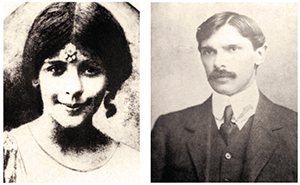
Ruttie Petit as a teenage wife (l) Photo courtesy: National Archives, Pakistan
and Mohammed Ali Jinnah before marriage
Clockwise from above: Ruttie (center) with brothers Fali (left) and Manek,
mother Lady Dinbai Petit and father Sir Dinshaw Petit
Jinnah (suited) with his sister Fatima (l) and daughter Dina; far r: Jinnah’s father Jinnahbhai Poonja
Photos courtesy: National Archives, Pakistan
Sir Dinshaw would, of course, have none of it. Then began a period of great grief and anguish for all concerned. The baronet forbade his daughter from seeing her suitor, but that instruction was disobeyed. He thereupon took the somewhat startling step of going to court to obtain an injunction against Jinnah on the grounds that Jinnah had been planning to abduct Ruttie (who was still a minor but of marriageable age under the law). The unwise nature of this move draws the following comment from Reddy: "[T]o go to court against one of the country’s top lawyers who had a well-deserved reputation for getting his clients out of the most slippery situations was a foolishness of such mind-boggling dimensions that Bombay could hardly stop itself from talking about it, even if the newspapers kept a discreet silence on the subject.”
Litigation, however, had become a pastime with Sir Dinshaw, and he persisted in this unwise course of action, securing the injunction that he sought. Jinnah, to his credit, abided by the court order, content in the knowledge that he only had to wait for a year and a half for Ruttie to reach the age of majority, at which point the injunction would cease to apply. As soon as that day came, Jinnah sprang another, bigger surprise, on Sir Dinshaw. On April 20, 1918 he put out an advertisement in the Bombay Chronicle informing its readers, of whom the baronet was one, that his marriage with Ruttie had been solemnized the previous evening. Sir Dinshaw, we are told, literally choked on his breakfast on reading the news [in Reddy’s words, he "collapsed on his own dining table, bringing the meal to a halt mid-course perhaps for the first time in Petit Hall’s (his grand residence) proud history of sumptuous dining”]. The chaos that ensued in the Petit household was immense: one guest, the poetess Sarojini Naidu, was quoted as saying that "The old man has gone off his head and the house is upside down” — a report which, Reddy notes, is probably apocryphal because Naidu was scheduled to be in northern India on a lecture tour for the whole of that week.
The marriage ceremony itself was by no means a straightforward affair, and Reddy’s treatment of it — as well as the drama which preceded the ceremony — would be of interest to many readers of this journal, not least because of the religious complexities of this union. Fortunately for Jinnah, explains Reddy, "Ruttie could not possibly have demanded that (Jinnah) convert to her religion instead of the other way around. As both were aware, under Parsi custom and law, it was prohibited for an outsider born of a non-Parsi father to convert to Zoroastrianism, let alone marry under Parsi rites.” In the circumstances, Ruttie was left with no choice except to undergo conversion to Islam, which she did quietly at Bombay’s Jama Masjid under the guidance of the presiding imam who, conveniently, was a loyal foot-soldier of Jinnah’s Muslim League. Ironically, the conversion took place on the day of a Parsi festival...
As for the nuptials, they were a low-key affair. Both bride and bridegroom went through the motions in an hour long ceremony, neither understanding any of the rituals (which were conducted according to Shiite traditions). "The only memorable moment,” says Reddy, "was when the bridegroom had to place a ring on his bride’s finger and discovered that, with so much on his mind, he had forgotten to buy one.” The lapse was made good by one of the distinguished guests, the Raja of Mahmudabad, offering his own ring, which Jinnah gratefully accepted and slipped on his bride’s finger.
What came next is far from cheering or uplifting. After spending their honeymoon in Nainital, the couple had to return home to Bombay and begin to face certain hard realities, among them the prospect, for Ruttie, of meeting her parents. The reunion did not happen as planned because, by then, Sir Dinshaw had filed another legal action against Jinnah, this time for abduction of his daughter. The three of them had to face each other in court, under circumstances which were particularly trying for the baronet. Ruttie launched a spirited defence of her husband, claiming that, if anything, she had abducted Jinnah. The case collapsed, and Sir Dinshaw was both humiliated and heartbroken.
Worse was to come. The Parsi establishment turned their wrath on him, arguing that too many Anglicized members of the community (the Petits were not mentioned by name but the message was clear) were bringing up their daughters with no mooring in the tenets of the Zoroastrian religion. Among the condemnatory resolutions proposed by the orthodox was one which sought to excommunicate any priests who were implicated in inter-communal marriages (plus ça change, one might be forgiven for saying). Ruttie was, unsurprisingly, excommunicated and banned from Parsi "weddings, navjotes and social occasions...Never before in the history of the Parsis,” avers the author of this book, "had there been such a savage witch-hunt.”
What about the marriage itself? The news on that front was no less bleak. For all Ruttie’s love and passion for Jinnah, his increasing preoccupation with politics meant that he was unable to devote the time or the attention to her that she had expected as a newly married wife. Ruttie also missed the social life that she was accustomed to (Jinnah’s aversion to the theater, clubs and parties was well known). To add to her woes, the looming presence of Jinnah’s unmarried sister, Fatima, was an irritant which did little to help. Even the birth of a daughter, Dina, failed to rekindle any romance or companionship. Quarrels soon followed. All this began, inevitably, to take a toll on Ruttie’s health and, wracked by depression, she died on the day of her 29th birthday, February 20, 1929 (although there appears to be no medical record of her death, a close family friend who used to attend to her at the time "unequivocally declared that Ruttie had killed herself by taking sleeping pills,” according to Reddy’s researches).
This book is clearly a valuable contribution to modern Indian history, but it suffers from many imperfections. For a start, the writing is unacceptably long-winded in places. A good editor could have pared down the text by at least a third of its current length without detracting from the instructiveness of the work. The narration is meandering and disjointed, which many readers will find irritating as they will the lack of a back index (a serious failing that most Indian publishers do not seem to worry about). More attention could have been given to fact-checking (an example of sloppiness which stood out for this reviewer is the description of M. C. Chagla as a former chief justice of India — a position which, of course, he never occupied). Readers with close familiarity with the doctrines and customs of Zoroastrianism, especially as practised in India, will cavil at some of the statements in the book (e.g. that Ruttie was ‘excommunicated’ which, the editor of this journal informs the reviewer, is not possible – ‘shunned’ would have been a more appropriate usage — or that Ruttie was ‘banned’ from attending events such as navjotes and weddings which, apparently, can only be true when applied to events held in fire temples, not more generally).
Dr VENKAT IYER
Iyer is a UK-based barrister and legal academic.