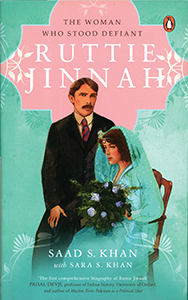
RUTTIE JINNAH by Saad S. Khan with Sara S. Khan. Published in 2020 by Ebury Press, an imprint of Penguin Random House India Pvt Ltd, 7th Floor, Infinity Tower C, DLF Cyber City, Gurgaon 122002. Pp: xxxvi + 307. Price: Rs 599.
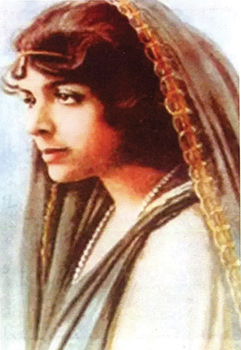
This book begins with a long — and instructive — explanation of the various challenges that its author Saad Khan faced in the course of writing it. Not only was, he says, source material on the subject scant, but "there had been a deliberate attempt to wash away [Rattanbai (Ruttie) Jinnah’s] memory” (he cites, in particular, the alleged destruction of many photographs relating to her as well as attempts to circulate fake photographs of her — though he doesn’t quite say by whom or at whose behest). More worryingly, he hints at external pressure being applied on him towards influencing the contents of the work ("directions that came from quarters that wanted to ensure a particular line being taken, not exactly on our subject of study but on figures incidental to her”).
To add to his woes, the author, a historian and political scientist, also had to "walk a tightrope in (ensuring that) the book does not get banned in one country or the other.” The reference here is, clearly, to the widely prevalent practice in both India and Pakistan of governments succumbing to threats from extremists of one hue or another and engaging in censorship of a kind which, in more tolerant countries, would be considered completely unacceptable. The finger here points more towards Pakistan because, suggests Khan, any writer would have to be extraordinarily brave, while attempting to reflect the truth, to depart from "the national narrative on the personality (by which he almost definitely means Mohammad Ali Jinnah, the country’s founder and Ruttie’s husband, though he doesn’t state it explicitly).”
Those sobering realities notwithstanding, Khan has, it would be fair to say, done a creditable job of his project which is aimed, he declares, "to revive and restore the memory of a remarkable lady, who had a seminal influence on the shaping of modern history — and geography — of contemporary South Asia.” He — and his co-author, Sara S. Khan, who gets secondary billing on the cover of the book — also has another "imperative” in writing the book, which is "to set to rest many of the distortions, intentionally at times and inadvertently at others, injected into past accounts of the Jinnah family.” For example: "Had (M. A.) Jinnah been married before? No, Rattanbai was his first and only wife. Was she a Muslim? Yes, she was, till her death. Did the Jinnahs get divorced? No, they were man and wife till Mrs Jinnah’s last breath — and the former never remarried. Was she known to (Mahatma) Gandhi and the Nehrus? Yes, and very well so.”
Top row, from l: Ruttie as a child flanked by her brothers Framji (r) and Jamshetji Petit;
Mohammad Ali Jinnah (circa 1920s); Dina Jinnah;
second row, from l: Jinnah with Dina; Ruttie’s parents Sir Dinshaw Petit, 2nd Baronet, Lady Dinabai Petit;
Ruttie’s tombstone Photo: Saad and Sara Khan
On the equation between Ruttie and Gandhi, Khan reveals that the promulgation of the Rowlatt Act (which sought to curtail dissent in India against the British Government) and the Jallianwala Bagh incident (in which some 300-odd protestors against that law were gunned down) in 1919, sparked off a series of formal communications between the two. Among other things, Gandhi "wanted to impress upon her the need for her husband to come to grips with the Congress’s viewpoint on self-rule.” It also included an exhortation to her to "coax (Jinnah) to learn Hindi or Gujarati” and to get Jinnah to support the boycott of foreign goods. The latter exhortation was rebuffed, with Ruttie arguing that a boycott was "neither politically wise nor practisable” (earlier, Gandhi had tried to persuade Ruttie to wear white cotton, but without success because she "could not accept the logic of drab dressing”).
Khan does not buy the argument, advanced by another historian, that Gandhi’s communications with Ruttie were "aimed at weaning her off Jinnah’s thoughts and ideas and subsequently destroying their married life.” She was, he maintains, a person of independent thought, possessive and sensitive about her husband, and someone who, moreover, saw eye to eye with him on most political issues.
As for Nehru, the situation was more complex. Ruttie had maintained good relations with Jawaharlal’s father, Motilal, so much so that she was described by one of Motilal’s daughters as being "a favorite of my father’s.” But Ruttie died — in 1929, at age 29 — just when Jawaharlal began achieving political prominence (he become leader of the Congress party the same year), and the equation between the two families changed dramatically. "All three of Motilal’s children,” notes Khan, "mostly talked ill of the Jinnah family in their writings.” Sarup Kumari (who later became Vijaya Lakshmi Pandit) was particularly unkind about Ruttie in her autobiography: "She describes her as ‘spoiled, very beautiful and used to having her way.’ She points out that her marriage with Jinnah ‘caused a nine-day stir in India.’ But then she tries to prove that it was Jinnah’s political stature, his big name at the bar and his being ‘very much in the news’ that made Ruttie fall for him. It was ‘certainly not a love match,’ Vijaya gives her conclusive judgment.”
There is a certain irony in the fact that Vijaya herself fell for a prominent Muslim, converted to Islam, and eloped with him — only to give in to family and community pressure within weeks, repudiating her new religion and jettisoning her husband to marry someone chosen by her family. By contrast, says Khan cuttingly, Ruttie had "withstood the adverse pressures of being Jinnah’s wife, not leaving her husband’s side or forsaking her new religion till she died.”
There is much else, besides, in Khan’s telling of the Ruttie story, including the circumstances under which she married Jinnah ("the marriage that shook India”), the substantial motivation and encouragement that Jinnah derived from her, the troubled relationship that Ruttie had with her own family, the chronic ill-health that plagued her for most of her life, and the turbulence which marred the Ruttie-Jinnah marriage towards the end of her life.
There is an interesting — if somewhat cursory — section in the book where Khan poses the question "Was Mrs Jinnah the real creator of Pakistan?” He thinks not: "The factors that decisively contributed to the creation of Pakistan — the toxic mixing of religion and politics by Gandhi through the Khilafat Movement in the 1920s, the arrogance of Jawaharlal Nehru in the 1930s, and stubbornness of Sardar Patel in the 1940s — took place regardless of Mrs Jinnah’s life or death. Scholars on both sides of the divide… seem to agree that this divisive mindset was not Jinnah’s — or, at least, not his alone.”
Whether or not Khan’s further assessment that "Mrs Jinnah must have been smiling in her grave when history vindicated her viewpoint, expressed through her husband’s political struggle” will be widely shared remains a moot point.
VENKAT IYER
Iyer is a UK-based barrister.