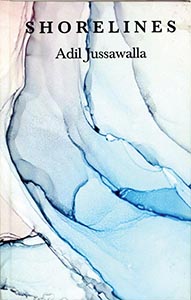
Shorelines by Adil Jussawalla. Published in 2019 by Poetrywala, an imprint of Paperwall Media and Publishing Private Limited, 1201/D-Octacrest, Lokhandwala Township, Kandivali (East), Bombay 400101; website: www.paperwall.in; email: info@paperwall.in Pp: 57. Price: Rs 250.
Adil Jussawalla has just published a collection of wonderful and moving poems, Shorelines. He uses an extract from a very famous and moving Breton fisherman’s prayer for protection, as an epigraph to this collection: "The sea is so big / And my craft so small.” Significantly, he omits the first line of the prayer, "Dear God, be good to me.” He says, "I did not want to stress on the metaphysical aspect, but wanted to highlight the need for protection in a more concrete sense.” Thus, he highlights the daily fears and the visceral perception of the sea as well as the terrors the sailor has to face — an overwhelming, scary, hard to navigate sea along with the challenges which await him. Jussawalla has also changed the "boat” or "vessel” to "craft,” cleverly punning on the word.
 Several of the poems deal with the destruction of Bombay shorelines and particularly the ports. The first poem Shorelines, starts with dismal images of rain and a "shore buttressed with shanties.” Further in the poem, Jussawalla speaks of another dwelling place which is equally bleak: "It’s stark, its doorways and windows vanished. / Its winds have nothing to rattle so they howl.” In The Days, we are startled by a vivid image, "Black rocks run their wounds.” When the tide comes in and flows out again, it seems as if the wounds of the rocks themselves are bleeding. When Jussawalla went to England, he visited his cousins, Sammi and Rita, in Liverpool in the 1960s. He took photographs of "cranes behind a line of homes,” and now in India he reminisces and recreates the visit in this poem. But welded in the nostalgia and the memories loom the distress that ports in England, like those in India, have also lost their glory: "Merseyside stilled in one blow, / the turned tide unreturning” and "the bleeding rusts of hulls.”
But the damage is not restricted to the ports and the shorelines. "Man marks the earth with ruin – his control / Stops with the shore,” says Lord George Gordon Byron in his poem, Childe Harold’s Pilgrimage. Jussawalla, however, has another point of view. In his poem You, Lord Byron and You Too, Churchill, he declares that the ravages of war have not been restricted to the land but "On sea creatures too has war been declared.” Jussawalla uses violent imagery to convey that the trawlers are now fishing in deep-water and the damage is far from superficial "their rollers crush / our more ancient floors.”
We encounter kites in two poems but both with differing significance. The poem Kite is dedicated to Tenzin Tsundue, a Tibetan who has always been involved in Tibet’s independence movement and whom Jussawalla has known for several years. Jussawalla sees him as a kite caught in a fight, has been cut and now descends slowly moving towards and away from flats "as though wanting to see if someone will let it in.” But the fact that the kite is rescued by a "boy” seems to imply a bit of hope that the struggle will carry on.
From a Manual of Maritime Signals is a cleverly constructed poem of one line, sometimes one-word messages from a captain to a harbor master and vice versa. Says Jussawalla, "I found the lines actually in a manual; I did not invent them though I may have repeated some and changed their order.”
Many of the poems are nostalgic and have an elegiac note. In Reply to a Postcard from Overseas, a cousin who has migrated questions him whether we still have kite fights in India. Jussawalla describes the kites which hang from balconies or from trees or even balance "like nervous divers on the rims of wells.” But some, like his cousin, seem to be cut free "swimming in air, / swimming for air, away, floating away.”
A moving poem is Old Men on a Bench who seem to be walking on "slippery ground” not in beautiful gardens but at a fishing dock with "smells more uplifting than yoga.” They chat about their children in foreign cities and various other subjects and their comments are overheard by a young passerby. One of the men tells him that though their words may seem insignificant and shallow and "skip over surfaces, / like the day’s last dragonfly before it’s absorbed by shadow,” he will realize the significance and the importance of their conversation when he is much older.
Many of the poems have a wistful tone and Jussawalla pays homage to his relatives who have all passed away. In Janu, he remembers his aunt who was like "live ammunition…shooting her mouth off” at parties. He also remembers her suffering both the loss of a child and later on a stroke of paralysis. In Her DKW, he communicates the close relationship between the sisters — Janu and his mother (Mehera) — as the only happiness left for them is to go on a shopping spree.
Shapur Mehta, the subject of Downcast was his mother’s brother. He was a flight instructor and was known for his "flights of fancy” as well as his "schizoid (suspected)” personality. Jussawalla remembers him as mysterious and extremely likeable. "He wrote poetry and painted and had a great sense of drama. He flew to his wedding dressed up like an Indian prince,” he says.
One of the most moving poems is Alang. Alang, a town in Gujarat has, during the last 30 years, become a major worldwide center for ship demolition. Seawise Giant, the longest ship ever to have been constructed, sailed from Alang and returned there for destruction. The images Jussawalla uses in this poem are violent and striking: "Perennial scrapyard, magnet for the remaindered,/burning ground for ships that outlive their terms of service.”
Once "buoyant” — Jussawalla is probably punning on the word, they are now subject to destruction by "crushers, claws.” The scene suddenly shifts to hospitals where patients, like his mother, who have lived happy and peaceful lives, are now destined to be subjected to "probes and instruments.” The poem ends with a fervent plea that when the end comes and we are destined to face "the sudden bright arc of the lighthouse” we witness: "the passing of ships with all their lights on, the music at sea/others are joyously dancing to...”
In 2015, Indian poet K. Srilata and Irish poet Fióna Bolger were concerned about the nature of writing, that it was a solitary and lonely affair, where poets sat alone composing their poems, not connecting with poets in other countries and continents. They wanted to see if writers could find some common ground and started an experiment to bring together poets from India, Ireland and other countries. Jussawalla was matched with Sue Butler who lives on the east coast of England near woods and a salt marsh. "We got on quite well,” he admits. "We did a sort of jugalbandi (competition) and I would take lines from her poems and make poems of my own. Her own poems are very raw and strong and she also lives by the sea, and not in a flat in a tall building.”
In one of her letters to Jussawalla, Butler described her cottage as "weatherbeaten.” It: "looks like a/shipwrecked boat and feels alive,/because in the sun the wood shrinks and/in the rain it swells.”
As a result of these lines Jussawalla wrote about Bombay where, in comparison, life seems not only to have become unliveable but also dangerous. In From the 61st Floor, the lady who once dreamt of a home without walls, now finds herself walled in by the skyscrapers which "house nouveau riche upstarts” completely destroying any possibility of a view. In addition, the city has become dangerous and she is protected by guards who are instructed as to who has the right to visit her.
The collection of poems is a delight to read. They remain etched on the mind long after you have closed the book and some lines will continue to haunt you. Some of the poems may require re-reading and careful scrutiny, but the effort is certainly worth it. FIRDAUS GANDAVIA
Gandavia holds a doctorate in English literature and is a retired chartered accountant. He is a compulsive reader of fiction.