The family she learned cooking for encouraged Perzen Patel to take up the art professionally
Text: Farrokh Jijina Photos: Jasmine D. Driver
A display of ginger-soda and raspberry bottles in blue crates at the entrance to the JW Café just off the chic lobby of the new JW Marriott Hotel, Bombay Sahar told us we had reached the right location. "A 10-day food festival to usher in the Parsi New Year in collaboration with the Bawi Bride Kitchen,” the invitation to Parsiana had stated. Referring to "authentic Parsi creations by the one and only Perzen Patel,” and calling her a connoisseur of Parsi food, the invitation quoted Vivek Bhatt, executive chef of the Hotel that "Parsi culture is an integral part of the city of Bombay, food being the center of traditions.”
Perzen Patel at the buffet at JW Café, Marriott Bombay
Speaking to Parsiana at the venue, Patel informs that she developed four different menus of eight dishes each for the fiesta. "I have tried to include my family’s favorites in the menus,” she says. Citing her (paternal) Grandpa’s Kheema Kabab and Mamaiji’s Red Prawn Curry as her personal favorites, the chef explains that her involvement in the fest covers all aspects of the preparation and cooking, not just in sharing her recipes with the hotel kitchen. The festival which attracts about 120 patrons daily is giving Patel a firsthand look at how a large kitchen in a luxury hotel functions, she reveals, and states "it took me a while to digest the fact that the staff was calling me Chef.” She is all praise for the help she received from all levels of staff in the kitchens.
Pointing to a section of the capacious café decorated with glass jars holding batasas and nankhatais, and Irani restaurant style blackboards, Patel invites, "Do have the dahi gosht (mutton in a yogurt based gravy).” She adds that it is based on a recipe from an Australian-Parsi friend of her mother Shernaz Darukhanawala. We taste what appears to be mutton in a dahi ni kadhi. The peppery flavor sits well on the tongue, and the tender mutton virtually melts in the mouth, though the dish may not find favor with those who like their gravies thick. The handsdown winner is the Anjeer ma marghi (chicken cooked with figs, see recipe on pg 33). The dish, cooked with cashewnuts, figs, red chillies and cinnamon, is a popular one as we see a few patrons lining up at the buffet for seconds. Ahead of the mains are three starters – chicken and cheese balls, the ubiquitous sali par eedu and patra ni machhi. The chicken filling in the patties is generous and tastes just like ‘mamma would have made them.’ The chutney on the fish could have been spicier but the tanginess hit the right notes. The sali par eedu has a unique twist: the sali was on the eggs, instead of under, the base being tomato and onion. The prawn pulao that follows is delicately flavored, not spicy, not bland. Desserts include a custard choc-a-bloc with charoli, and two kinds of koprapak, the mango flavored variety charmingly mislabeled as ‘coconut koprapak.’
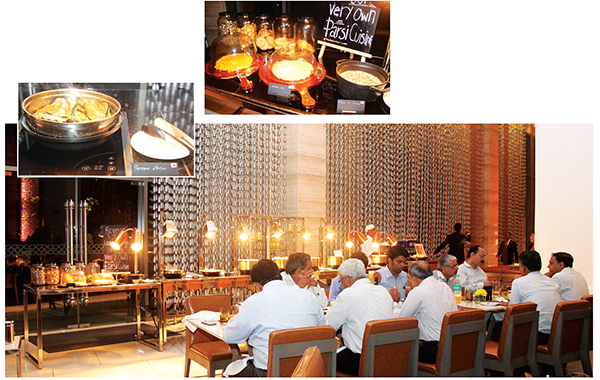
Clockwise from top: Patra ni machhi; the desserts; patrons at the food festival
Within a month of having started her blog ‘Bawi Bride’ in mid 2013, where she posted her experiences with cooking and food as a newly married woman, Bombay based Patel started receiving inquiries from potential buyers for her products. "What started as a personal quest to keep my husband and in-laws happy and well fed with Parsi food, soon grew to a catering service from my home,” she says. The encouragement of friends and family led to the formation of the Bawi Bride Kitchen, which is now a business with three major streams — catering for parties and meetings, regular meal services and pop-ups serving Parsi food. The 28-year-old graduate in hospitality management also conducts cooking classes on request and hosts at-homes in a Bombay Parsi colony where she showcases her cooking.
Paternal grandpa Homi loved his kababs crunchy on the outside, narrates Patel, and insisted that the egg should be used in the binding, rather than have the kabab dipped in beaten eggs before frying. Reminiscing about making kababs jointly with the senior gentleman for Sunday lunch, Patel ensured that the dish featured on the menu on the very first day of the Marriott festival. The caterer narrates that when she was a girl, her maternal grandmother Dolly Irani had laughingly asked her what Patel would remember her for. The adolescent Patel quickly retorted with "Leave me a big tapélu (vessel) of kolmi ni curry,” but rues that the lady is no more, to partake of her successes.
A graduate of Auckland University of Technology where she majored in hospitality in 2009, Patel talks wistfully of the family’s early days in New Zealand (NZ) and says that they sold a batch of cutlets or patties to purchase a new microwave. Or the mother-daughter duo would cater for parties, to buy another kitchen gadget. "Times were not hard, but we had to struggle a little, as do most immigrants,” she says of her family’s move from India to NZ in 2002. Father Yezdi is now back in Bombay to help Patel grow her business while Shernaz continues to work as an administrative assistant in NZ.
While on a project assignment from college in Canada, succumbing to the mutual prodding of seniors in both families, Patel flew out to meet her future husband Rushad who was then training to be a pilot, in Florida. "The transcontinental romance” culminated in marriage in November 2012. Rushad, called Bawa Groom on Patel’s blog, "is her worst critic” as Patel says she can do no wrong in Rushad’s eyes. "I ask for a critical evaluation and all I get is: ‘It is super, babe, since you have made it,’” she says of the man who now runs a jewelry business. "But I know he just loves my lagan nu custard,” she admits coyly.
Among the Parsis in the food business, she reveres Tanaz Godiwala for the sheer volume of work that she does. Another name she holds in high esteem is Kurush Dalal, and laughingly states that his mother Katy Dalal’s cookbook Jamva Chaloji "was part of her dowry.” There is nothing like a secret recipe, and one should not keep a good thing unshared, she smiles. "I have the first mover advantage over other Parsi caterers,” she freely admits, "as none of the others have a presence on the social media with the same force as I do.”
Having contributed her Parsi recipes to a crowd-sourced e-book on regional cuisines called Best Kept Secrets last year, Patel is proud of the second edition titled Best Kept Secrets – The Eedu Edition, which has her recipes "for those who want to eat eggs all day.”
Though her blog does have a small section on "International Favorites, Bawa-fied” and features an interesting Sali Boti Pizza and Choi Fudina Chicken Wings, among others, Patel feels it is best to stick to the tried and tested. A fan of Meherbai Wadia’s Vividh Vani, the Bible of Parsi cooking written 120 years ago, high on her to-do list is to try out the boomla per eedu (egg on bombay duck) from that tome. An admirer of American chef and author Julia Child, her blog prominently displays Child’s now famous line, "People who love to eat are always the best people.” Future plans for this Parsi include "learn to make popatji and varadhwara.” She dreams of a YouTube channel to host her Julie and Julia style cookery show, based on the Hollywood movie that juxtaposed the story of a girl with cookery dreams, with that of Julia Child. "Or maybe I should just select 300 of the best recipes from Vividh Vani and contemporize them,” she muses. Also on the cards are, perhaps, food trucks that would go around from locality to locality selling Parsi delicacies, "if only I can figure out the complicated licensing requirements.” The year 2020 will see her catering at Parsi weddings for sure, she emphasizes.
Patel says that her Zoroastrian beliefs ingrained in her by her parents and grandparents keep her rooted. "The traditionalist in me believes interfaith marriages are not kosher, and the practical feminist in me says why not,” she affirms. Giving her own example of growing up in NZ with only a handful of potential Parsi grooms, she says she is "lucky to have met Rushad, otherwise I would have been compelled to marry a non-Parsi.”
I want to make Parsi food accessible to all, states the vivacious caterer. "After all, regional cooking is the next big wave in the cookery world,” she sums up.
ANJEER MA MARGHI
Dry figs (20)
Onions (3 – chopped)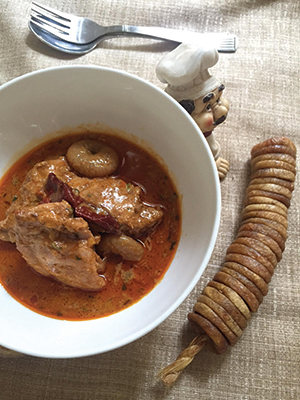
Kashmiri chillies (6 – whole)
Ghee (4 tbsp)
Shahjeera (2 tsp)
Cinnamon sticks (2)
Saffron (10-15 strands)
Salt (to taste)
For the marination
Ginger garlic paste (1 tbsp)
Green chilli jeera paste (1 tbsp)
Ghee (2 tbsp)
For the paste
Yogurt (200 g)
Cashewnuts (75 g)
Red chili powder (2 tsp)
Garam masala (2 tsp)
Dhana-jeera powder (2 tsp)
Salt (to taste)
Make the paste and mix with marinade. Coat chicken with this mix and marinade, preferably overnight. Soak figs in hot water for two hours. Heat ghee in a pan, add the shahjeera, whole red chillies and cinnamon. When they begin to crackle, add the chopped onions and fry till golden brown.
Add the marinated chicken and figs. Mix lightly and cook on high heat for about three minutes. Add the water in which the anjeer were soaked along with the saffron. Stir and cook on high heat for 5-7 mins or till a thick gravy is formed and the chicken is tender.
Serve with jeera rice or rotis.