Despite frigid weather and other privations, with its wild and sere beauty the Bryce Canyon National Park remains an astonishing legacy for future generations
Farok J. Contractor
It was May 10, when most Americans are in their shirtsleeves and the temperature rises above 30°C in the southern states. But here I was, staring at our camping group leader Laura, her padded form partially obscured by falling snow. At least the Sierra Club had provided us with a covering, like a shamiana, so that the 12 of us could stomp around under the canopy and keep the snowflakes off our heads. At least, that is, those of us not engaged in cooking and cleaning duty, which was done completely in the open.
For Laura, Melinda our assistant leader, and the cook crew, a woolen cap, a parka and whatever other layers underneath, were all that stood between them and the elements. For a week, all I saw of the women in our hiking group was their faces, the rest of their forms resembling padded balls of insulation and wool. Imagine washing the utensils and dishes to then find that the waste water has coagulated in a frozen sheet of ice underneath. At night, with temperatures plunging way below zero, even with seven layers of clothing, a parka and sleeping bag, sleep was elusive. Visions of sunny Haji Ali Bay and Marve Beach caroused through my thoughts as I lay shivering in my cocoon inside a small tent.
(Top) Crossing a snow field in Agua Canyon and (below) hiking below the rim;
"Did I pay money for this trip?” I asked myself. Yes. The wild and sere beauty of Bryce Canyon National Park cannot be accessed without some discomfort. Lying between 8,000 and 9,000 feet this magnificent part of the Utah-Colorado Plateau has non-freezing days in only two months of the year, mid-June to mid-August. But then it is difficult to get a dozen campsites reserved in advance for a week, which is what the Sierra Club camping trip needed for our group. The plan was to set up our tents and supplies in the campground, and venture every day down into the multicolored canyons surrounding the plateau for hikes of 15 to 18 kilometers, returning for a cooked dinner at 5 p.m. to then crawl into our tents around 6.45 p.m. for around 10-and-a-half hours of sleeping, reading, shivering or whatever — until 6 a.m. the next morning. From all walks of life (our group had a doctor, nurses, lawyers, professors, an art photographer, teachers, a real estate developer, as well as a couple of retired persons), millions of Americans relish the outdoors and will seek solace from their computers and their daily grind, in sacred contemplation of the natural world. Except in this case, contemplation of more than a few minutes was out of the question, since we were either marching, or shivering if we stood stationary for too long.
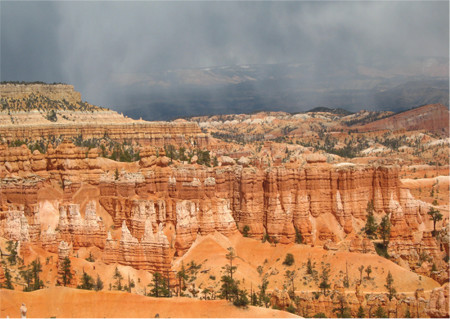
Snow falling on mesas and cliffs
America is blessed with more than its share of natural beauty. A continental size nation, spanning 4,700 kilometers from sea to shining sea, it contains great depths (like the Grand Canyon), searing deserts (such as Death Valley) and snowy heights (such as Mount Denali at over 20,000 feet). India has, or had, similar beauty. But in every nation it is a race between population pressure and development; between despoliation and the rise of a preservation ethos; between the rise of conservation societies like the Sierra Club that wish to save the land and the profit motive that wishes to exploit it. In India the race is partially lost or abandoned. The US and Canada were fortunate in having very few people. (Even today, much of the US Midwest and Canada are virtually unpopulated). The US Federal government, having purchased one-third of the country from Napoleon in 1803 (for a mere $ 15 million), and winning California and Texas by ousting poor Mexico in the 1840s, suddenly found itself with nearly 1,249 million acres of uncharted territory that then contained fewer than 8,00,000 souls. This was a territory that was later found to include some of the wildest beauty on the planet.
America could not help but win the race. Since almost no one occupied the over one billion acres of federal government-owned land, conservation groups succeeded in out-lobbying builders and mining interests. Yellowstone was established as the first US National Park in 1872 with 22,19,789 acres of land forever sequestered against development, Sequoia and Yosemite Parks were added in 1890, and so on, until something like 500 million acres have today been brought under some measure of protection under central, state-run and local parks. An astonishing legacy for future generations (of Americans as well as mankind, since already in some of the most popular national parks, foreign visitors outnumber locals).
Natural Bridge Point
One such gem is Bryce Canyon National Park in Utah, a wild, high plateau at 9,000 feet with precipitous and colorful ravines on either side of the plateau that contain "hoodoos” — strange pillars and pinnacles of multi-banded rock left standing, while the rest of the earth around it was eroded away by wind and ice. Beautiful tones, ranging from red to yellow may be seen in alternating bands which were once different layers of seabed. Much of what is now the Rocky Mountains in Colorado and Utah was, 70 million years ago, a sea cutting America into two. Over thousands of years, layer upon layer of sediment was laid down under the waters, each with a different concentration of iron. Once the seabed was uplifted by tectonic forces to heights over 10,000 feet, the different concentrations of iron in the rock have oxidized and weathered to different brilliant shades of white, pink, red and orange.
One day, we had planned to descend 2,000 feet into the canyon from Bryce Point, have our lunch along the "Under-the-Rim” Trail, walk around 17 kilometers further along to the "Agua Canyon” Trail and climb back up to the plateau at Ponderosa Point, by late afternoon. We had walked almost 15 kilometers and we were within 700 feet of the top, when we found our way blocked by deep snow. Agua Canyon is a narrow valley with steep sides. Normally, going through snow is tough, but doable. However, when the slope is more than 45°, and drops of several 100 feet await each misstep, the mood is understandably tense. We had no rope, or crampons. The choices were not pretty. It was already 4 p.m. Either we would sit out the night in the open, or retrace our steps all the way back 15 kilometers — which would not have been possible anyway as only two hours of sunlight were left.
Eventually our leader Laura and some others took turns laboriously cutting steps in the steep snow, by repeatedly kicking each spot or using our hands to make a hole or a small level surface that could be used as a toehold by the rest of us following in a line, one behind the other. After a few dozen kicks, we would get worn out and have to recuperate, or just fall behind. Trembling and tired, one of the group, the real estate developer, even went down for a while like a snake on his stomach, to prevent himself from slipping down the valley. What should have been 45 minutes of a final climb took a tortuous two-and-a-half tense hours. Exhausted as she was from continuous kicking, Laura did "bring ’em all back alive.”
The author at Bryce Canyon Park
Such privations. But also such beauty. The Pronghorn antelope (the only antelope in North America), the bears, coyotes and cougars, they live and enjoy Bryce Canyon all year round. Many in our group did not last even the one week, but abandoned their tents for the comforts of motels outside the park boundaries. Only five out of the group stayed the course, including one doughty Parsi who overcompensates for having grown up in the concrete canyons of Pedder Road, Bombay, by seeking out the canyons of the American Southwest where antelope roam and the edge of our galaxy (the Milky Way) wheels majestically overhead each pellucid night (of course, as long as there are no clouds above discharging a white substance).
Dr Farok J. Contractor is Professor in the Management and Global Business department at Rutgers Business School. He is a graduate of the Wharton School, University of Pennsylvania, where he received his PhD (Managerial Science and Applied Economics) and MBA, and the University of Michigan, where he received an MS in Industrial Engineering. He has written over 75 scholarly papers and books and is rated by several surveys as among the top-ranked contributors of scholarly papers to the field. He was elected a permanent Fellow of the Academy of International Business in 1995.