On a Return to Roots trip to India, youngsters
from the diaspora with a Parsi lineage get an opportunity to reflect on the history, culture
and Zoroastrian religion
Shaun Walker
This extract from Shaun Walker’s article "The last of the Zoroastrians: A funeral, a family, and a journey into a disappearing religion” has been reprinted with permission from The Guardian, August 6, 2020.
My grandfather had never been a tall man, and now he looked absurdly small, no bigger than a child. Swaddled in off-white sheets like a newborn, with just his head and the soles of his feet visible, his eyes were open and mouth disconcertingly agape, as if in surprise. His corpse was slightly raised from the floor, lain atop a rickety wooden stretcher. Beside the body, two priests in white robes intoned in Avestan, the long-dead language of the Zoroastrian scriptures.
It was the height of Bombay’s monsoon season, and the air in the prayer pavilion was heavy with moisture. The occasional cloudburst outside provided no respite from heat or humidity, and the priests cooled themselves with hand-held fans that resembled ping-pong bats as they repeated their sonorous chants. The funeral was the first time I had heard Zoroastrian prayers spoken out loud, though I remembered my grandfather over the years murmuring them under his breath multiple times a day, velvet cap on his head and prayer book in his hand. Besides my mother and me, the small group in attendance was mainly made up of frail friends and distant relatives, almost all of them Parsis, as the Zoroastrians of India are known.
The cremation came later the same afternoon, the heat from the chrome furnace adding to the stickiness. The body was reduced in (around an hour) to a kilogram of ashes, which were handed to us the next morning in a knotted sack the size of a coconut. Prayers continued the next day, the extended ceremony providing a map for slowly working through the grief.
In the days after the funeral, it struck me with some sadness that my grandfather, who had spent almost a century devoted to the Zoroastrian faith, would be the final Parsi in his family line. Growing up in Britain, I’d read a bit about the history of Zoroastrianism, but only knew the basics…
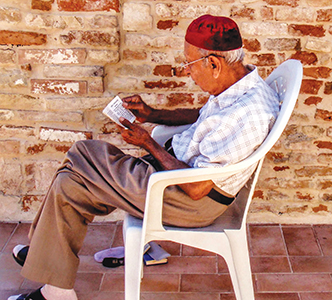
Pestonjee Pader at prayer
My grandfather, Pestonjee Pader, was a gentle man with a raucous, childish sense of humor, but not far beneath the surface lurked a sense of tragedy. He liked to tell stories, but most of them ended in one of two ways: "and then, unfortunately, we had to leave,” or "and then, tragically, they passed away too soon.” Born into a Parsi family in 1922, he grew up in the Gulf city of Aden, a thriving port then under British rule, which attracted many Parsi traders. After his father died in the late ’30s, my grandfather took over the family business, supplying food and other provisions to the ships that docked in Aden on their way between Europe and Asia. He also ran the Long Bar, where he watered thirsty soldiers from the British garrison. He negotiated a concession from Carlsberg, importing beer from Denmark and eventually making a handsome profit. By the mid-60s, he was on the verge of setting up an ice-cream factory, a sure money-maker in the punishing Gulf heat. But the plans fell through when revolution came to southern Yemen in 1967, driving out the British and, by extension, the Parsis, too. My grandparents escaped to Bombay, leaving all but a few suitcases of possessions behind.
For my grandfather, the real tragedies were still to come: between 1976 and 1983, he lost his wife and both his sons, leaving my mother as his only surviving child. When we flew out to visit him during school holidays in the ’90s, his once-grand apartment on Malabar Hill felt as if it were occupied by ghosts: a table laid with Carlsberg glasses and coasters, carefully preserved from decades earlier; photographs of the deceased on the sideboards. He padded around the too-big apartment, saying Zoroastrian prayers of remembrance for the dead several hours each day, and regularly taking the bus to the fire temple for prayers. In the evenings, he went out for dinner with his mostly Parsi friends, until they, too, started dying. For as long as I can remember, he would say matter of factly that he was ready to die, but he kept on going, remaining healthy into his late 80s. It was only right at the end, when dementia hit, that he became weak and confused. In the summer of 2017, the news came that he had finally passed away, shortly after turning 95.
My grandfather stuck to his Zoroastrian faith doggedly, whatever obstacles life tossed into his path, but my mother was (disowned) when she married out. She came to London when she was 17, to go to university and then train as an English teacher. She slipped away from a planned marriage to a good Parsi boy, and later married my dad, another teacher from Southampton. Her parents, unlike many other relatives, quickly came to accept the marriage, but many considered her no longer a Parsi. Partly, she accepted this, and partly, she just ignored it. "No religious bigot was going to define who I was,” she told me, and she continued to feel deeply attached to the cultural aspects of being Parsi.
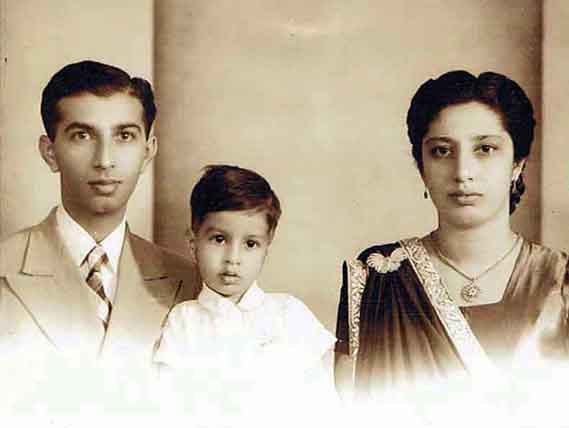
Pader with wife and son Sarosh
Seated second from left with members of Aden’s Parsi cricket
Although my family often visited India when I was growing up, my sister and I never learned to speak Gujarati, and there was no suggestion among our Parsi relatives that we should partake in Zoroastrian rituals and ceremonies to feel a sense of belonging to the community, or even that we would be allowed to if we wanted. This wasn’t something I fretted about. I liked the idea of a secret, Zoroastrian side of my identity, but in my studies and then my professional life, I gravitated towards Russia, not India or Zoroastrianism. On visits to Bombay I felt like much more of an outsider than I did when walking the streets of Moscow, where I made my home as a foreign correspondent.
But the funeral stirred in me a new interest in the 3,500-year-old Zoroastrian religion and today’s tiny Parsi community. As the religion’s followers declined, why were Parsis so dogmatic about keeping their doors closed to mixed-heritage children, let alone accepting outside converts? And did this mean that the whole Parsi community was heading for the same fate as my grandfather: a drawn-out but sadly inevitable disappearance? Nearly three years later I found a way to seek some answers: a Return to Roots trip, which took a small group of young Parsis to India for an exploration of their history and culture. The idea was loosely modelled on Birthright Israel, which brings young Jews to the Holy Land, though our version was on a much smaller scale and free of attendant geopolitics.
I landed in Bombay one night in early March, and the next morning the group met for orientation, each of us saying a few words about ourselves and what we hoped for from the next two weeks. Five of the 15 participants were from the dwindling Parsi community of Karachi; most of the others were children of Parsi parents who had moved to North America. They were divided between those who had strong connections to the religion and those who had lost touch and wanted to re-engage with it. There was one American-Iranian, whose family came from the small community of Zoroastrians who remained behind in Iran and live there to this day. And then there was me, the only halfie.
Arzan Wadia, the Bombay-born, New York-based architect who runs Return to Roots, had told me that the tour is emphatically not meant to function as a Parsi dating service, but he added immediately that new couples had indeed formed on previous tours, which was a pleasing side-effect. Certainly, on the first morning there was a tangible feeling of excitement at the presence of so many fellow members of that endangered species, the young Parsi. One of the volunteers accompanying us, Sheherazad, a 25-year-old Zoroastrian priest, told us he would be on hand to help with logistics and answer any spiritual questions, for those who had forgotten the prayers and rituals they learned as children (and for me, who never knew them in the first place). With a crop of bleached blond hair and a mischievous smile, he was far from the humorless, conservative figure I expected of a priest. He told us to call him Sherry.
After the introductions, we headed to the Towers of Silence, a sprawling expanse of forested land in the heart of downtown Bombay that takes its name from the stone structures inside the grounds, where the bodies of Zoroastrians are consigned after death.
Our guide for the tour was Khojeste Mistree, the intellectual kingpin of orthodox Parsis. Unfailingly polite yet ruthlessly dogmatic, Mistree trained as a chartered accountant before taking up Zoroastrian studies in Britain in the ’60s, and later arrived back in India armed with historical knowledge to aid the conservative Parsis who wanted to keep the faith closed.
As we walked through the greenery towards one of the two dakhmas currently in use, Mistree exalted the Parsi method of consigning the dead. "It is the best and most ecologically sound way to dispose of a corpse,” he said, explaining that it prevented the earth being polluted with the evil spirits present in a dead body. Mistree told us that each dakhma could hold more than 250 bodies, laid out on slats inside the round stone structures. When the bodies have fully decomposed, corpsebearers push the skeletons into a (well) in the middle, though the high walls meant none of this was visible to us.
"You’re standing here by this dakhma, and what can you smell?” asked Mistree in his distinctive voice, which drops just a hint of Bombay twang into the soaring cadences of an Oxford don. "That’s right. Nothing. Whatever scurrilous gossip you read in the papers about rotting corpses and so on, it’s nonsense.”
As recently as the ’80s, hungry vultures had swooped into the dakhmas and picked Parsi corpses clean in a matter of days. Then, in the space of a decade, the birds died out, mainly owing to the use of diclofenac, a drug fed to livestock that poisoned vultures when they fed on the carcasses. Bodies inside the dakhmas were instead left to decompose naturally, which could take several months. On certain days, people living nearby could catch a putrid whiff of decaying human flesh from their windows... There was brief excitement at the creation of a specially designed mixture of herbs and chemicals, stuffed into the orifices of the dead, but the dakhma floors became covered in a layer of human slurry, on which the corpsebearers kept slipping, making their unenviable job still more difficult.
Eventually, angled solar reflection panels were installed at the top of the dakhmas to speed up the decomposition process, but a small group of Parsi reformists believed a more dignified option should be available. They raised money for a funeral hall, which was opened in Worli in 2015, and that was where my grandfather chose to be cremated two years later. A little over 10% of the Bombay Parsi community now opts for this method, mainly those who want to ensure that relatives who have married outside the faith will be able to attend their funerals…
"I’m sorry to say,” said Mistree, in a tone that was notably unapologetic, "that those Parsis who opt for cremation will go to hell.” Later, he clarified that Parsis who lived abroad could choose alternative methods, though never cremation, as it sullied fire with the evil spirits present in a dead body. But for those who lived in Bombay, like my grandfather, there was no excuse. In Mistree’s severe reading of Zoroastrianism, a man who had spent most of his 95 years on earth steeped in prayer, and abiding by the exhortation to good thoughts, words and deeds, had been despatched to hell.

Born in Britain in 1981 to a father from Britain and a Parsi mother, Shaun Walker studied history at Oxford University. He later moved to Moscow where he was a foreign correspondent for The Independent and later for The Guardian. Now based in Budapest, he covers the countries of Central and Eastern Europe for The Guardian. His first book The Long Hangover: Putin’s New Russia and the Ghosts of the Past was published in 2018.