The Zoroastrian Association of Michigan is examining the
feasibility of having its own place of worship
Roxanne Kavarana Vakharia
The close-knit Zoroastrian Association of Michigan (ZAOM) moves into double figures this year. This March, it pulled out all stops to celebrate 10 years of its fruitful existence in Detroit, US, with a memorable Navroz gala. Last year it successfully hosted the Federation of Zoroastrian Associations of North America’s (FEZANA) 29th annual general meeting in Novi, Michigan.
Their fraternity of 35 to 40 families remains active, often enjoying family get-togethers and managing to organize three to four cultural/social/religious events every year — the Jamshedi Navroz function, which is a definite fixture; an all-day Khordad Sal picnic; a Mehergan jashan-gahanbar in October and a celebration at the turn of the Gregorian year. Last year, they introduced an ancient Persian celebration, the Tirgan, which also marked ZAOM’s first-ever outdoor jashan. The year before, they had a mobedyar, Gool Austin from Canada, come in for the first time to do duty during their Jashn-e-Mehergan. And this year, ZAOM president Ardeshir Sholapurwalla says they are planning to hold the muktad prayers.
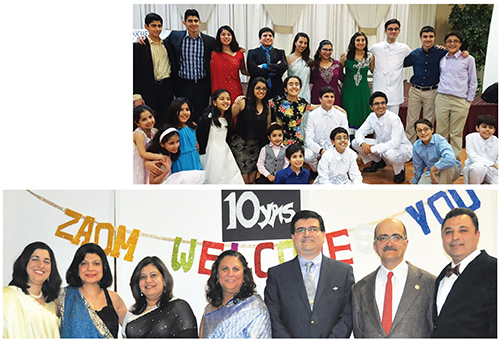
Michigan Zoroastrians at the 10th anniversary gala: (top) the youth group;
(above) committee members (from left) Natasha Patel, Bepsi Sanjana, Despina Mehta,
Shernaz Minwalla, Ardeshir Sholapurwalla, Dr Adi Irani, Firdosh Chinoy
At the FEZANA AGM in Michigan in 2016: (top) children performing
We are Zoroastrians to ukelele accompaniment; (above) gara competition
From left (top): Behroze Ghandhi, Sherrie Khambhatta, Percis Sholapurwalla,
Anahita Kavarana; (above) Hoshedar Mehta, Neville Bugli, Burjor Ghandhi
The yearly, free Mehergan jashan-gahanbar is a full house and brings out the best in the community, both in terms of turnout and spirit. "Everybody cooks and gets together for this grand occasion,” says current vice president and founder treasurer Dr Adi Irani, a pediatrician. Michigan’s own mobed, Ervad Noshir Sidhwa, officiates at the jashan, and for the past six or seven years he has been joined from across the border by Ontario’s Ervad Tehemton Mirza who stays on to give a short presentation on religion.
In 2014, ZAOM members got an opportunity to practise what they preach. Khushroo Mistry, a Parsi boy from Poona who was studying engineering in Michigan, tragically collapsed and slipped into a coma. The local Zoroastrians rose to the occasion with their compassion, hospitality and sense of community, and went out of their way to help his family who had rushed there from India.
ZAOM members are largely liberal, welcoming people of mixed marriages, including seven or eight such families in their midst. Sidhwa will not perform navjotes of children where both parents are not Zoroastrian, though the anjuman will not stop others from doing so. "Our Association does not have an official line on this issue as we are very open and broad-minded. In a country like ours, we have to be inclusive of everyone,” points out auto engineer and former ZAOM president Neville Bugli. ZAOM is currently looking into the feasibility of having its own place of worship in the near future.
The seeds of the ZAOM union were sown in August 2007 when three local Detroit residents — Irani, Sholapurwalla and Hoshedar Mehta — decided to approach others with the idea of forming a formal association. The vote was significantly in their favor — and they had crossed their first hurdle. By October-November of that year, they formed a planning committee and by the following January, they were formally registered with the state of Michigan. They would have liked the acronym ZAM for their Association; since it was already taken, they had to settle for ZAOM.
Away from the land of their forefathers, this band of Zoroastrians too is grappling with the issues of a declining population, loss of identity, inter-marriage and fading religious rituals/practices, especially when it comes to the younger generation. Its main struggle lies in trying to ensure that the youth marries within the community, and failing that to see that children of mixed marriages come into the Zoroastrian fold.
Michigan’s Zoroastrians have a close bond with their faith and have had religion classes for children dating to the pre-ZAOM days. They have an informal group called Youth Connections (YC)which is predominantly their monthly religion class for kids aged between five and 18 years. Their website zaom.org features "The Parsi Press,” a seasonal publication of articles penned by the YC students about their religion classes, cultural events and service projects. Customer service manager Shireen Ghandhi heads the YC with help from former president Shernaz Minwalla, assistant head of a high school who spearheaded their hosting of the FEZANA meeting, financial controller and ZAOM treasurer Bepsi Sanjana and physical therapist Anahita Kavarana who composed the lyrics of We are Zoroastrians, the English version of Chhaiyé Hamé Zarathoshti, which the ZAOM kids sang with aplomb with a ukelele accompaniment at the 2016 FEZANA gala night.
"Our kids are very gung-ho about keeping the Zoroastrian flag flying,” observe Hoshedar and Despina Mehta, parents of 15-year-old Zoish and 10-year-old Kayan, with a fair amount of success. In Michigan since 2004, Hoshedar was ZAOM’s founding president while Despina is currently the social committee chair, responsible for many of the activities the Association holds. "Zoish feels strongly that we should have our own place of worship like a dar-e-meher,” says the mother. "I tell her ‘your generation has to continue the work we started.’”
Despina who has been actively connected with ZAOM from the start, credits the religion classes for instilling confidence in her children. "When my daughter was in the sixth grade, she was asked to speak briefly about Zoroastrianism. She made a slide show and confidently projected it, teaching her classmates about our religion. They had no clue because there is nothing about Zoroastrianism in the textbooks here. Her teacher found the presentation so interesting he made her portray it to every class in her grade. This knowledge and self-assurance definitely came from our religion classes.”
She observes that the younger lot at ZAOM has at some point of time had to explain to their non-Zoroastrian counterparts what their religion means and what is the significance of the sudreh-kusti — especially when it peeks out from under one’s T-shirt! Contrary to general expectations, she says, they are not embarrassed or ashamed. Hoshedar plays this down though, saying, "It is no different from the time I was growing up in Bombay and was teased when my kusti used to be seen hanging out. But, in the US no outsider will touch our kusti because religious rights are so sacred. We’ve never had instances of our kids being ragged by someone pulling or touching it. They ask if it is religious and then they sort of back off.”
Despina, in fact, feels that Zoroastrian kids love the attention they get from their non-Zoroastrian friends who ask them all sorts of questions about their religion. Her daughter is often questioned about the Farohar pendant that she has on all the time. She (as other Zoroastrian kids in the same boat) likes to explain what it is and what it stands for, observes Despina, adding, "They don’t ever see a sense of fear or shame.” Hoshedar agrees, "The kids don’t want to hide their religion anymore. They openly talk about it because they are proud of who they are.”
Seventy-seven-year-old Burjor Ghandhi, internal medicine doctor and a grandfather of four, who arrived in Michigan as far back as 1964, has witnessed it all. "We are at least trying to remain Parsis. We are okay as far as our identity is concerned right now but who knows about the future generations,” he rues. "Our big problem is the youth: we don’t know what they really want. They don’t follow our traditions like wearing the sudreh-kusti. Perhaps, if we translate our prayers in English, they might start praying,” he laughs.
Ghandhi is not hopeful about the future of our community, especially when it comes to children of mixed marriages. "I may be biased but such kids are lost — they don’t know whether to follow Christianity, Hinduism or Islam. Those are the youngsters we need to bring into our religion. There must be thousands, not hundreds, of such kids but if we could get even 10% of such offspring into our fold, we would have done our duty.” Talking from personal experience, he says mixed marriage families view the religion and sacred vestments differently.
Bugli and his wife Benaifer, who have three children in the pre-teen to teen group, too would like their kids to marry a fellow community member and often have discussions about this issue at home. But Bugli admits that "at the end of the day, it is up to them to do... You can’t really stop them.”
Sholapurwalla agrees that it is imperative to influence the kids to marry within the community "as the chances of them practising Zoroastrianism are the most if both parents practise the faith. If the religion of the parents is different, the child is taught two religions and his/her interest in each is diluted. Sometimes, the child is taught no religion at all, and grows up with no roots or religion to call his own.”
With the number of Zoroastrians overseas fast catching up with the count in India, he is of the opinion that the younger generation — "the future of Zoroastrianism” — which lives outside India does not necessarily identify with the Zoroastrian religion. "Hence, it is important for us to enforce on them our values, traditions and culture. Growing up in India, we took a lot of this for granted as we had friends and family who reinforced this on a daily basis. It is very easy for our children to forget our heritage and rich ancestry unless we teach them to forge their own identities as proud Zarathushtis.”