While drawing inspiration from his childhood reminiscences, couturier Ashdeen Lilaowala focuses on sustainability
Farrokh Jijina
The ramp in "The Runway” room at JioWorld Gardens, Bandra Kurla Complex was lit with multicolored geometric patterns. Shocking pink, deep red, bright yellow and blue bands vied with crosses and zebra crossing-type designs on the floor of the ramp and on the two large screens. A brightly-hued, scrolling band proclaimed "Lakme Fashion Week (LFW)” while upbeat music welcomed the guests who had queued up well before the appointed hour. The stage was set for the 3.30 p.m. showing of Delhi-based couturier Ashdeen Lilaowala’s collection "Memories on Cloth” on February 13, 2020, the third of the six-day exposition of fashion that is in its 20th year. Lilaowala is known for popularizing gara embroidery wrought by hand. Besides saris, his range extends to evening wear, jackets, trousers and shararas (long skirts) and accessories like clutches and slippers. The designer’s atelier is located in Delhi’s Defence Colony (see "Lilaowala’s ‘enriching’ space,” Parsiana, November 7, 2018).
This was Lilaowala’s fourth foray into LFW. "We have showcased thrice earlier in Bombay for the spring-summer 2013 and 2014 shows, as well as winter-festive 2015,” he informed us. For the 2020 show, "the organizers felt our label would be ideal to showcase on Sustainability Day (SD),” stated the couturier. Earlier called Handloom Day, the focus of SD is to promote traditional fabrics and styles. "I think sustainability... is extremely important for fashion. Our idea is to create products and fashion that is long-lasting and can be cherished by generations rather than being ‘fast fashion’ which is rapidly discarded,” Lilaowala wrote. His brand works "very hard to create minimum waste.” Sustainability lies in "designing timeless craft while providing economic benefit,” believes Lilaowala.
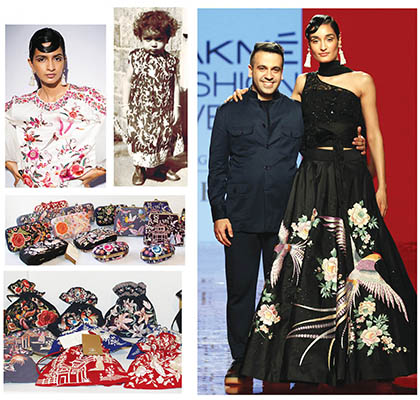
(Clockwise from above) Ashdeen Lilaowala (l)with model displaying his bird-of-paradise motif;
purses and clutches Photos of accessories: Jasmine D. Driver; patterns of peonies, chrysanthemums,
flying cranes and butterflies; Lilaowala’s maternal grandfather Minoo Bode posing as a baby in jhabla: "long-lasting fashion"
Garas, skirt and long jacket on display Photo: Jasmine D. Driver;
combining colors at the fashion event:"mindful luxury"
(Above) Studio portrait of Lilaowala’s grand-aunt Tehmina; great-grandparents
Dhunmai and Kaikhushroo Bode with his great- great-grandmother Soonamai
and great-granduncle Rustom: building on memories
The first trio of models in white dresses, trousers and shalwars were followed by those in peach and yellow saris, and pale green kurtas teamed with translucent trousers. A bright red blouse paired with high-waisted white embroidered pants was the first brightly colored outfit to appear on the ramp, followed by a shaded maroon bordered gara with an embroidered blouse. The finale comprised a trio of mannequins, with black the unifying color for a sharara teamed with a lace blouse, an embroidered kimono and a dramatic black flared off-the shoulder evening dress with the bird of paradise design that Lilaowala is known for. Accessorized with embroidered clutches and fabric bags, all the models wore wedges with embroidery on the heels.
Lilaowala remembers many fancy dress competitions during his growing up years where his mother Shernaz dressed his sister Ferzeen in a dagli and pheta, and him in a kor ni (bordered) sari with a mathubanu, he told Parsiana prior to the event. "Fabric and embroidered garments were always part of my life,” he said. Reminiscing about being dressed in traditional jhablas with siblings Ferzeen and Dilzeen for festive occasions, the couturier narrated that the memories of the past were the inspiration for the Spring/Resort collection that was on show.
Drawing inspiration from the photographs taken by his parents Shernaz and Zubin, Ashdeen stated that the 20 ensembles "interpreted traditional motifs and colors” with "simple and elegant” silhouettes in silks, organza and chiffon. Naturally, with a focus on the hand embroidery, his enduring passion. "We (have) also combined different techniques and patterns: in some there are polka dots, others use the crane, and a few pieces have all the motifs,” the designer told The Hindu on February 13.
The collection that was "three to four months” in the making incorporated the "inter-cultural flora and fauna from garas” and "combined them with the bows used to fasten the jhablas of his childhood.” Lilaowala stated that his other Parsi favorite – lace – is at the same time both "revealing and protecting.” The outfits on show "created a pattern with beads and embroidery on net fabric which gives the illusion of lace,” he wrote in a detailed email to Parsiana.
"This is a full blown sale,” gushed Lilaowala when Parsiana met him at his two-day exhibition at Yiamas in downtown Bombay on February 18. Eighty outfits, 20 stoles and about 50 accessories were on show, he said, taking a break after helping a potential customer drape a vermillion gara over herself. At the entrance to the exhibition area were four striking creations in black and red: two garas, one long skirt with a dupatta, and a long jacket. Also included in the sale were the outfits displayed in the previous week at LFW.
The "environment-friendly” nature of hand embroidery gives his creations "a rightful permanence... These heirlooms will last several lifetimes (and provide) timeless beauty,” the couturier said. As he mentioned in the introduction to the LFW show, his creations promise "mindful luxury,” while keeping memories, culture and craft alive.