When I first saw Astad Deboo perform at the newly opened Prithvi Theatre in Bombay 40 years ago his intention was to shock. His whole being was tuned into an instrument of indelible images of sensuality through movement and stillness. His theatrics unleashed an intensity that assaulted the audience. He forced us to become a part of his inner turmoil and triumph over the body that he revealed to us in all its tempestuous fragility. At a certain point he used a blade to slash his forearms. As the blood dripped to the wooden stage floor, he twisted his torso around to lick the drops off the floor with his tongue extended.
The last time I saw him at a solo dance performance, at the Goethe Institute auditorium, Madras, Astad’s movements had slowed down to an almost Noh dance like stillness. He created an image of an individual assaulted by sounds. The slow movements of a person trapped in high decibel sound effects was highlighted by the shadows against the bare wall. Abrupt bursts of electronic music machine-gunned the frail figure of a man. It reduced him to a mass of quivering hands and facial grimaces from a Kathakali repertoire that is also a part of Astad’s inheritance.
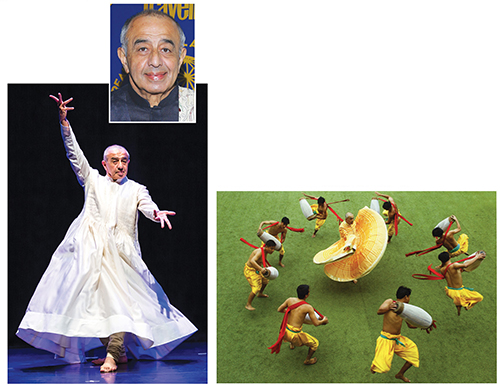
Inset: Astad Deboo Photo Ritam Banerjee; above: on stage;
right: with Pung Cholom dancers Photo: Farrokh Chothia
Deboo with Queen Elizabeth II
Deboo with the hearing impaired dancers
Pain. Anguish. Beauty. These were the elements with which Astad Deboo, the pioneer of abstract dance forms, painted his world of dance. He borrowed elements from different traditions to the very end. He was always colorful. Not just as an entertainer, for he did understand that to be on the stage was to make the air around him sing with movement; but with images that he created with a wide variety of costumes and fabrics sourced from the different countries and cultures through which he roamed.
We meet whenever he happens to visit Madras. At times it’s for a brief interview between rehearsals sitting on hard folding chairs under a rain filled corrugated roof. His hair is steel grey. It is cornrow plaited into corrugated bands that resemble the roof. At other times in the plush environments of a star hotel where Astad sits cross-legged on a sofa, like the diva he is, and fills me up on his latest adventures. He has just been to Buckingham Palace. He wore a resplendent woven shawl from the North East of India draped over his left shoulder like a cape over black jodhpurs.
"What did you say to the Queen?” I ask.
"Well, I said: ‘Good evening, Your Majesty,’” he replies.
"She had been briefed so when she heard I was a dancer, she stretched out her gloved hand and murmured, ‘I too can dance a little you know!’” As he leaned forward to watch, she twirled her left hand into a little mudra (hand/finger gesture)! And laughed with delight.
From the earliest days when, at the age of 22, he boarded a cargo ship at Bombay and escaped the humdrum life of commerce that he had studied at the Podar College, Astad was determined to meet the world on his terms. He had watched Uttara Asha Coorlawala’s experiments with modern dance when she first performed at Bombay’s Bhulabhai Auditorium and was convinced that this was what he needed to do. As the story goes, she helped him to find a place at the Martha Graham Center for Contemporary Dance, New York. Boarding the ship in what was certainly the cattle class he took his own time to reach there, traveling through Europe and South America. It was in 1974 that he finally reached New York but was he ready to settle down with the Martha Graham earth centered method of dance? Like everything else in his life Astad reached for the center only to leap out of it the minute that he found it.
To go back to his beginnings. Astad was born into a traditional Navsari Parsi family (he wore a sudreh and kusti) in 1947. When he was six the family moved first to Calcutta and then to Jamshedpur where his father worked with the Tata Steel company. He has two sisters, Kamal Antia and Gulshan Deboo. As he describes it, Jamshedpur in those days was a melting place of modern India at its best. As he is fond of saying, the Jesuits at the school gave him a strong sense of Christian values, the Bengali Hindus included in him a love for tradition, while the Kathak style instilled in him the essence of Islamic culture. It was only much later when he returned from his travels across dance world, both learning and teaching different dance techniques, that he went to Kerala to induct himself into Kathakali and the martial arts, studying under a famous teacher, Guru E. Krishna Paniker.
"My journey has been full of ups and downs. Even today after 50 years, or 40 years performing it’s difficult to get a sponsor for contemporary dance. It’s not easy to produce oneself. You are always dancing on the edge.” For all that, he has received official recognition and been a recipient of the Sangeet Natak Akademi Award in 1996 and the Padma Shri in 2007.
When he reached London on that early journey of discovery, the city was throwing off its post war darkness and re-making itself as the age of the Beatles, of Pink Floyd and outrageous fashion statements. As one of the mystical sages of the era American writer Carlos Castaneda put it: "We choose only once. We choose either to be warriors or to be ordinary men. A second choice does not exist. Not on this earth.”
Astad’s choices were eclectic and varied. He learnt the dance technique of Martha Graham, consorted with the Pink Floyd group, trained under Alice Becker Chase of Pilobolus, Pina Bausch in Germany, choreographed for the famous ballerina of the time in Paris, Maya Plisetskaya, under the eyes of Pierre Cardin and learnt the Capoeira Martial dance form from South America.
As he said at the time, "I knew I had all these worlds within my dance language that I wanted to explore.”
Nor did he shun the dark side of life. In his depiction of a drug addict in the 1990s Broken Pane he jabbed a syringe into the veins of his arm not just once, but three times in the course of the evening. He banged his head repeatedly on the ground and writhed with the agony of the wretched of the earth. Equally disturbing was his experiment with Death with the famous Parsi puppeteer Dadi Pudumjee and his giant puppets in Thanathamorphic.
"Even the French critics felt it was over the top waving that syringe around sticking out of my arm. It should merely be ‘symbolic’ they cried.”
Yet again there was also Astad the teacher who worked with the hearing impaired. First at the Gallaudet University in Washington for the deaf performing arts; and then with the Clarke School for the Deaf at Madras. When he brought his students on stage for a heart-warming performance at the prestigious Music Academy in the city that earlier on had been reluctant to sponsor a modernist like Astad Deboo, the curtain call was a fabulous moment. He had shown the audience how to raise their arms up in a "hand and finger wave” instead of clapping. The whole auditorium was filled with fingers waving thunderously as the students took their bows with Astad beaming in their midst.
In recent times his work with the Manipuri martial art dancers and drummers has led to a cultural cross-fertilization of the most vivid kind.
As he described it, the Manipuri dancers have a very strong tradition of wielding their instruments of war and swirling with the momentum of getting ready to kill and be killed. While he was in the process of de-constructing these movements for a performance-based display he observed how their traditional teachers would come and watch. "It was only when I suggested that they crouch as though crawling through the jungle that they protested. Warriors never crouch. They leap!”
After he was diagnosed with non-Hodgkin’s lymphoma Astad continued to work till the end before taking the final leap into the stars where he belonged.
He was a warrior born to make the world of dance whirl along with him.