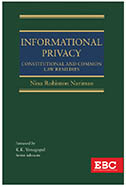
Informational Privacy: Constitutional and Common Law Remedies by Nina Rohinton Nariman. Published in 2025 by Eastern Book Company, 34, Lalbagh, Lucknow 226001, India. Pages: xxxiv+254. Price: Rs 1,495 (hardback).
For those lamenting the steep and relentless fall in standards of legal scholarship in India since at least the 1970s, Nina Nariman’s book will be a cause for cheer and optimism. It deals with a slightly esoteric subject, but one which is not entirely unconnected with the lives of ordinary people, viz. how the concept of privacy — especially as it relates to the collection, treatment and use of personal information — is dealt with by the law in India. This is a subject whose importance cannot but increase exponentially in the years to come as India, like the rest of the world, begins to grapple with the challenges thrown up by unprecedented advances in technology, including the growing impact of data collection and decision-making by machines powered by artificial intelligence.
The first thing that needs to be said about this book is that it maintains a high level of focus on the theme which it interrogates. That, coupled with the use of language which is reasonably precise and succinct, and an aesthetically pleasing layout, has the potential to make the book attractive even to people who may not be instinctively drawn to legal texts. Together, the author and publisher have succeeded, commendably, to avoid the shoddiness and superficiality that is, sadly, the stock-in-trade of most law books published on the Indian subcontinent today.
Nina Nariman: remedy for privacy rights
There is a simple but admirable purpose behind Nariman’s exertions. To put it in uncomplicated terms, it is to promote a new legal remedy under Indian law for the protection and enhancement of privacy rights. She is particularly keen to ensure that this remedy is founded on the law of torts — which, for those unfamiliar with legal jargon, means a branch of the law that deals with civil wrongs, i.e. wrongs that can be remedied through the grant of monetary compensation (or other reliefs such as injunctions) in favor of the victims. A further part of her mission is to make it possible for privacy-related litigation, especially between non-state actors, i.e. private entities, to be conducted via the structural framework provided by a provision in the Indian Constitution, Article 226, which has hitherto been applied in a somewhat restrictive manner.
Nariman makes out a plausible — if arguable — case for reform in that direction. She is fortified by, among other things, a decision of the Supreme Court of India delivered in 2023 which seems to suggest that greater use can be made of Article 226 (under which cases can be taken to any of the High Courts for the enforcement of fundamental rights and "for any other purpose”). This, if accepted, will lead to that Article applying "horizontally” (as between private parties) as well as vertically (as between individuals and the State). Nariman urges this point with passion, clarity and an adept use of first principles.
A striking feature of the book is that Nariman is no starry-eyed acceptor of precepts, canons and dicta that have been handed down — often with little intellectual solidness or internal coherence — by Indian courts in recent years. She is willing to question and criticize, albeit in polite — and, some would say, diplomatic — language. To take but one example: she queries the fundamental basis of the view taken by more than one High Court that "publicity rights” (often invoked in cases involving celebrities) are anchored in the law of privacy. "Grounding the right of publicity in notions of privacy,” she argues, "renders the very basis for the right open to challenge, while grounding the right of publicity in property rights would be more appropriate and allow for certain restraints on the right, particularly in the context of free speech.”
Nariman’s defence of free speech will strike a chord in many readers. Referring to the case of two books by the Australian journalist Hamish McDonald which showed the controversial businessman Dhirubhai Ambani in unfavorable light — one of which was taken out of circulation following an injunction issued by the Delhi High Court (for alleged defamation) — she draws attention to the "chilling effect the powerful and mighty wield (sic) within the court system.” She argues against "adding more weapons to an already well-stocked celebrity arsenal. The right to publicity ought not to be allowed to become a Damocles sword hanging over genuine criticism/artistic expression.”
There is also a heartening measure of moderation — even humility — in Nariman’s presentation of her views. She concedes, for example, that "there is, and possibly can be, no grand unified theory when it comes to privacy. One of the main problems is that the concept of privacy and property are connected to a large extent. No theory on either privacy or property has survived intense scrutiny, although some theories remain more popular than others.”
Contrast this to the cocksureness with which the Supreme Court of India declared, grandly, in 2017 that there was an overarching "right” to privacy, relying on the right to life and liberty which has, over the past nearly half a century, become an Alladin’s cave from which all manner of "rights” can be extracted, and paying scant regard to the fact that the drafters of India’s Constitution chose, in their wisdom, not to include such a right in that otherwise prescriptive document. A more intense scrutiny of the 2017 judgment than has been attempted by Nariman would have enhanced the value of the book.
Perceptive observers of the development of Indian law will find it difficult to disagree with Nariman’s assessment that "tort law has been largely static” in the country. They will also concur with her analysis of how the protection of privacy has evolved in the United Kingdom, and perhaps back her suggestion that India would do well to follow the British example: "Given that India broadly follows England in the common law, it could be the new tort remedy of misuse of private information, which has developed from the tort remedy of breach of confidence in the UK, which could give India its much needed privacy-right remedy.”
Can the book be improved in any way? Yes. In substantive terms, the exegeses of foreign law — Australian, Canadian, South African — can be expanded (they are a bit sketchy at the moment). The research could have relied more on authoritative scholarly and professional writings (currently, there is a profusion of web-based sources of questionable depth). The book could also have profited from a more extensive discussion of India’s data protection legislation (which is expected to be brought into effect soon), and of a wider range cases — including Indian ones such as the personality rights disputes involving, say, the actors Anil Kapoor or Jackie Shroff which made the news in 2024).
On the presentational side, too, there are a few blemishes. In addition to avoidable errors ("Country Court” for County Court, "Court of Appeals” for Court of Appeal, to cite but two examples), referencing could do with a lot of attention (not only have many quotations gone unreferenced, no consideration has been given to accepted norms of footnoting, e.g. the use of ‘ibid.’ when the same source is referred to in succession). More jarringly, the text is littered with superscript numbers being placed before — rather than after — commas or full stops (though there are many places where the correct punctuation is followed). Against that, it must be said in praise of the book that there is a back index of respectable quality.
It is to be hoped that some of the suggestions for improvement will be taken on board if and when a new edition of the book is planned. Meanwhile, it bears repeating that, for all its faults, this is a work of worthy scholarship which has the potential to set a new benchmark for expositions of Indian law. VENKAT IYER
Iyer is a UK-based barrister and legal academic.