Measures need to be taken to minimize the incidence of
priests being accidentally burnt
Fires probably cause the third largest number of fatalities in India, notes Dr Suhas Abhyankar, plastic and reconstructive surgeon and consultant at Masina Hospital’s Eric Kharas Burns Research Unit. And yet while cancer and other causes of death receive much publicity, prevention of fires is a low priority. The doctor, who is treating 15-year-old Ervad Zahan Turel at Masina, spent an hour-and-a-half on November 8, 2020 at Parsiana’s request, discussing possible measures that fire temples could undertake to minimize priests being accidentally burnt. Zahan suffered 48.5% burns on his neck, chest, abdomen, upper arms, etc while tending to the fire at Goti Adarian in Surat on October 24 (see "The sacred fire hazard,” Parsiana, November 7-20, 2020). Abhyankar suspected that Zahan’s cotton sleeve could have caught fire and believed that wearing fireproof gloves up to the elbows as firemen do could be adopted as a precautionary measure.
In India, the doctor was not in favor of wrapping a person whose clothes are aflame in blankets as the heat would be entrapped by the thick textile and the depth of the burns would increase. Instead he recommended a damp Turkish towel should be wrapped around the person. A bucket of water could be placed outside the kebla with a towel nearby. When a priest enters the kebla, he should dip the towel in the bucket and in the event of a fire, grab the towel and wrap it around himself or if anyone else is present they could do the needful. The advantage of the wet towel is that while cutting off the supply of oxygen to the flames, the action would have a cooling effect. If water is not available, one should drop to the floor and roll on the ground to extinguish the fire, noted Abhyankar. Whilst summoning medical help and an ambulance is imperative, he advised against removing any clothing that may have stuck to the skin. As the fire would have made the material sterile, it would not cause further infection. During definitive treatment in a specialized burns unit, doctors have to take precautions to avoid deformities forming on the skin and limbs where the burns occur.
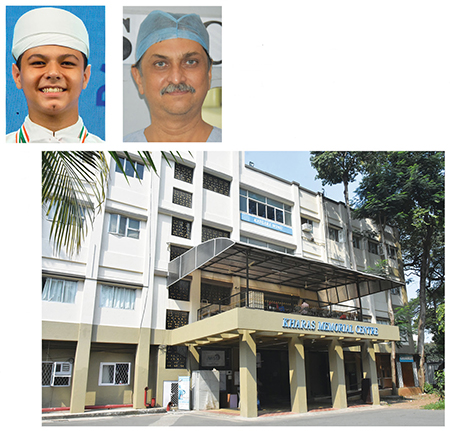
Clockwise from above l: Ervad Zahan Turel; Dr Suhas Abhyankar;
Burns Unit at Kharas Memorial Centre in Masina Hospital
Abhyankar also serves as honorary pediatric plastic surgeon at Bai Jerbai Wadia Hospital for Children and as professor and head of the plastic surgery department at Dr D. Y. Patil School of Medicine, New Bombay. When addressing children on fire prevention, the surgeon stresses that water is the best medium to use in the event of a fire. If a hand has caught fire, he recommends plunging the limb into water and leaving it there "till the agony passes.” Holding the burnt portion under a running tap or splashing water in case of facial burns also offers relief.
Ensuring the weight of a burns victim remains stable during medical treatment is essential. At the entrance of the Burns Unit at Masina, the patient on the stretcher is weighed. As burns victims are likely to suffer weight loss during treatment, extra calories can be given orally and intravenously to help in the healing of wounds. Antibiotics are administered to patients after determining their sensitivity to particular drugs. Indiscriminate use of antibiotics is discouraged at the Burns Unit during treatment. Masina is a pioneer in the care of burns, notes Abhyankar. There is a 50% chance of survival in the Masina Burns Unit for patients with 60 to 80% burns. It is probably the first private hospital in Bombay to have a dedicated burns unit. Other such units are in municipal and government hospitals.
Around 70 lakh people get burnt annually in India of which 1,40,000 die, noted the surgeon. Four out of five victims are usually women and children. "Women are more prone” to burns from internal fires, states the doctor. Cooking is often done on primus stoves at ground level. Kerosene stoves exploding, being burnt while cooking and dowry deaths are some of the major causes. In the case of men, it is those working on oil rigs, chemical factories and the like who face occupational hazards. Also at risk are those who sleep on the ground. If there is a leak of LPG (liquefied petroleum gas) from a cylinder it would descend, as it is heavier than air. Compressed natural gas (CNG) and piped natural gas (PNG) are lighter.
In November 2017 Masina opened the Bhikhoo S. Kharas Skin Bank and Research Centre. "We have 139 skin donors till March 2020,” states Abhyankar. Due to the Covid pandemic, the collection of skin from donors has ceased. The surgeon notes that the collection is an expensive process, the cost of which is borne by the Hospital. The donor has to be over 12 years of age, HIV negative, not suffering from cancer or other major ailments, etc. There is no upper age limit for donating skin. Skin is normally collected within six to eight hours of a person’s death, but Masina collects it even up to 12 hours. From one skin donor around 25 to 30 skin grafts can be harvested. The cost for treatment of a burns patient could go up to around Rs 40 lakhs. The Meer Foundation has donated Rs 15 lakhs to the Masina skin bank and is actively involved in the post-burns deformity correction program. Once the pandemic struck, donations have ceased or dried up on the whole.
The WZO (World Zoroastrian Organisation) Trusts and Empowering Mobeds (a joint initiative of the Trusts and the Athornan Mandal) put out an advisory on November 1 on how priests can keep themselves protected. The note sent by Trusts chairman Dinshaw Tamboly has offered an eight-point plan to avoid unfortunate situations in the future. Trustees and managements of fire temples should "raise awareness (of hazards) by providing regular training and demonstrations” to mobeds and behdins. Flame retardant treatment for clothing is not recommended, as it can be washed off, and is a skin irritant. On the contrary, over a decade ago, this was mooted in Parsiana (see "Guarding the guardians,” pg 4).
The note suggested that the cotton ties to fasten the jamo should be replaced by snap buttons which can help its quick removal in an emergency. With the consultation of high priests, Tamboly proposed that a badan (uncollared shirt) teamed with an ijar (narrow-bottomed pyjama) over the lengha (cotton trousers), or a sahyo (knee length dagli) can be worn by priests offering boi in adarans. "Atash behram mobeds can continue wearing the full regalia,” stated Tamboly. Other recommendations include consultations with fire safety experts to formulate training programs, and the use of properly dried sandalwood and kathi "wherever possible.” Dried kathi is more expensive per kilo as the drying process takes longer and therefore has less volume.
Water-based fire extinguishers should be made available near identified areas. The note stated that a donor who wishes to remain anonymous has gifted the Trusts with 300 "hand held cans of a fire retardant” for use in the approximately 150 fire temples all over the country.
"Quick thinking by onlookers and mobeds having been trained will certainly save lives in the future,” stated the note.