A defender of the sanctity of the Indian constitution, a champion of free speech and expression, a crusader for those seeking justice and a conscience keeper of the nation, 91-year-old Soli Jehangir Sorabjee’s demise on April 30, 2021 in Delhi when battling coronavirus resulted in a flurry of glowing tributes to his legal acumen and affable demeanor from members of the bench and bar.
The Chief Justice of India N. V. Ramana was quoted in The Economic Times as stating: "His humane and compassionate approach defined his legal work. He will be remembered as a legend who added strength to the pillars of democracy.”
"I was two years senior to Soli in the profession but as we always joked, he was two years my senior in matrimony — he married Zena before I married Bapsi. Each of us had long since celebrated not only six glorious decades at the bar, both in (Bombay) and in Delhi, but also celebrated our 60th wedding anniversary as well,” recalled Fali Nariman. Both of them had risen from the chambers of revered Sir Jamshedji Kanga and "despite all our grunting and grumbling about the increasing number of members that join the bar each year, jostling us oldies with their hustling and bustling in the corridors of the court, each of us often looked forward to the still very occasional argument in court… The trouble with ‘old dodderers’ is that they go on and on, never hanging up their boots,” jested Nariman in his front page write-up in The Times of India of May 1 that was a reprint of his piece carried in Down Memory Lane: A festschrift in honour of Soli J. Sorabjee, published by All India Reporter, Nagpur on the occasion of his 90th birthday last year. Many other contemporaries from the fraternity who had known the legal giant shared their reminiscences of him in the festschrift.
Commending Sorabjee’s oratorical skills, wit and humor, former Chief Justice of India Dipak Misra recalled Sorabjee’s comment when making a submission in a public interest litigation against the Union of India that came to be known as the 2G case. He ended with: "I am neither 2G, nor 3G, I am Sorabjee!”
With his knowledge of horses "he would often classify people, whether lawyer, judge or politician, in racing terminology. To him, Nani Palkhivala was always a ‘Derby winner,’” recalled the first junior in his chambers Avinash Rana. In the landmark Kesavanand Bharati vs State of Kerala case where by a seven to six judge majority the court ruled that the basic structure of the constitution cannot be amended, Sorabjee had assisted the indomitable Palkhivala. Their combined effort is believed to have saved democracy in India when threatened by parliamentary supremacy.
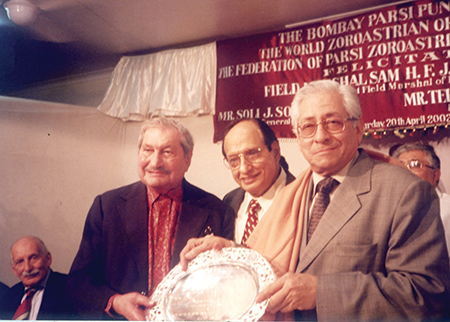
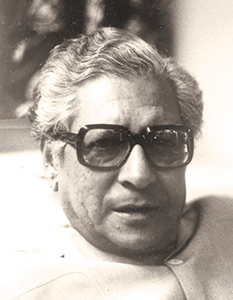
Top: Soli Sorabjee;
above at a community felicitation in 2002 (from l): Field Marshal Sam Maneckshaw,
Jamshed Guzder, Dadi Engineer and Sorabjee
Starting his first stint as attorney general in 1989, Sorabjee had received a letter from Palkhivala that he always treasured: "What you have said about the attorney general’s office — the guardian of public interest and the promoter of human rights — is so true and so little understood. The greatest glory of the attorney general is not to win cases for the government but to ensure that justice is done to the people… You will mark a new stage in the evolution of public law in India.”
Yet another junior, Harish Salve, who was solicitor general when Sorabjee was attorney general from 1998 to 2002 remarked, "I have learnt from him not just advocacy and law but lessons on what makes a good lawyer, a good constitutional law student and a good human being… I have learnt the importance of priorities — and most of all the art of handling success… Even now I would be apprehensive making a note for him — knowing that he would spot in a jiffy that one point that may have been missed…Soli was a legend at the bar but he never lost the common touch.”
During the nearly 50 years he served as office bearer of the Bar Association of India, Sorabjee was vice president for 28 years and was ex officio chairman when he was attorney general for India. To keep alive his memory, the Bar Association instituted the Soli J. Sorabjee Memorial Lecture on Freedom of Speech and Expression.
In his last known interview to the online news channel theprobe.in, Sorabjee had reiterated "If you are not independent, your soul is sold, and if you sell your soul, you sell the soul of democracy in India.” He had further stressed, "Without independent journalism, democracy is zero.” "To all those who championed the cause of constitutional rights and the freedom of the press, he was a source of inspiration and unflinching support… the very epitome of intelligence allied to courage, integrity and grace,” attested Viveck Goenka, chairman of the Indian Express group. Sorabjee was a regular columnist for their newspaper.
Eighteen years after he was admitted to the bar, Sorabjee was designated senior advocate by the Supreme Court in 1971, the same year the controversial Maintenance of Internal Security Act was passed by the Indira Gandhi regime. "It is a bureaucratic mind that is drawn to secrecy. The culture of secrecy needs to be demolished… Unless there is clear danger to national security, defence or breach of confidentiality, the public has a right to know about the working of public institutions and public functionaries,” Sorabjee had commented in an interview with Parsiana (see "At the law post,” April 1990). Espousing the cause of those unfairly arrested under this Act and those denied their fundamental rights, he was engaged in a number of press censorship litigations including the well-known Freedom First case. He had appeared pro bono for the monthly edited by Minoo Masani, a member of the Constituent Assembly, when the government passed an order prohibiting publication of articles critical of its functioning.
It was during the Emergency that the vigilant jurist had worked on the manuscript of his first book, The Law of Press Censorship in India which was followed by The Emergency, Censorship and The Press in India, 1975-77. Despite Sorabjee candidly criticizing the present government for its shortsighted policies, the President of India Ram Nath Kovind described him as "an icon of India’s legal system,” adding, "He was among the select few who deeply influenced the evolution of the constitutional law and justice system.” On Twitter, Prime Minister Narendra Modi described Sorabjee as "an outstanding lawyer and intellectual. Through law he was at the forefront of helping the poor and downtrodden.”
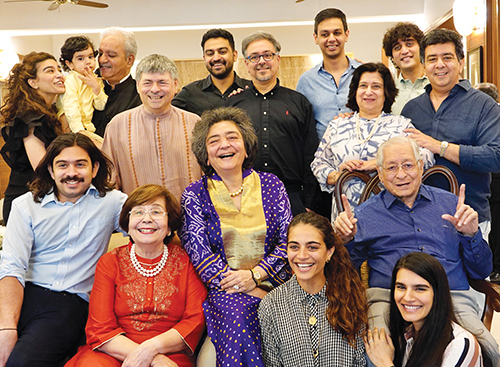
Four generations of the Sorabjee family with Soli (sitting on chair, far r)
Ever willing to support the cause of minorities, he lent his services to the Sikhs after the 1984 riots, to the Christians who were asserting their right to set up and run St Xavier’s College in Ahmedabad, to the Zoroastrians who sought to form a housing society for a particular religious denomination. He had served a four-year term on the United Nations (UN) Subcommission on Human Rights of Minorities and Prevention of Discrimination.
Among the other disputes with which he will long be associated are the Maneka Gandhi passport case in 1979 where it was held that a citizen cannot be denied a passport without ascribing a valid reason. In the Bommai case in 1989 he challenged the dismissal of the then chief minister of Karnataka thereby establishing that actions of governors could also be reviewed. On behalf of the Bhopal gas tragedy victims he questioned the earlier $ 450 million settlement between the Union of India and Union Carbide. Convinced that law is "a service oriented profession,” he believed that seniors in the profession should set an example by voluntarily accepting five briefs pro bono each month.
Respected in the international legal arena too, Sorabjee had served as a member of the Permanent Court of Arbitration at The Hague. Appointed special rapporteur for Nigeria by the United Nations, subsequently he became a member of the UN Sub Commission on the Promotion and Protection of Human Rights. Between 1998 and 2004 he was its chairman. While the Indian government had conferred on him its second highest civilian honor, the Padma Vibhushan, the Australian government presented him the Order of Australia, one of its most prestigious titles.
Sarosh Zaiwalla, senior partner of the UK based legal firm Zaiwalla and Company, in his eulogy in Asian Lite International, referred to an anecdote around six years ago in a case before Justice Walker of the English High Court. On learning that Sorabjee was to come from India to appear as expert witness, the judge recused himself from the case saying that having heard Sorabjee’s presentation at an international law conference in Australia he was so impressed by his integrity that the judge’s predilection in the case may not be fair to the opponent.
Sorabjee’s daughter Zia Mody, co-founder of a leading legal firm AZB and Partners, recalled an occasion in the mid-1980s when on her way to argue a matter before the division bench in the Bombay High Court, she felt she should refer to a particular judgment whose name she knew but citation she could not remember. In desperation, she called her father for urgent help. After taunting her that she was using him as her legal assistant, he directed her to the citation, the relevant paragraph and even lines. "Then and there I lost my competitive illusions and recognized that I should only be proud and…bask in the grandeur of a man with such prowess,” wrote the daughter in the festschrift.
"We were often told that…being an only child, my father tried to memorize everything that came his way. He was his grandmother’s delight since he knew all the (Zoroastrian) prayers backwards. His father was a steward at the Race Course and my father knew the handicaps of all the horses for the daily run,” she reminisced.
Formerly a clarinet player, Sorabjee started enjoying jazz music when instead of a record of Brahm’s Rhapsodies he was mistakenly given one of Benny Goodman. Over the years the jazz aficionado acquired an impressive collection of albums, was president of Jazz India, Delhi, played a key role in organizing jazz festivals in India and had struck up a personal friendship with prominent jazz players.
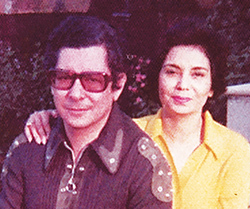
Soli and Zena Sorabjee at Mahabaleshwar in the 1970s
Referring to his father’s "phenomenal ear for music,” Sorabjee’s elder son Dr Jehangir, head, Department of Medicine at the Bombay Hospital, referred to the time when his father was advised bed rest after a hernia operation and while he was relaxing over music, Jehangir served as his "remote control,” frequently changing the albums. Over the years, the father introduced Jehangir to jazz music, taking him to Carnegie Hall to enjoy live performances or backstage to interact with popular players. "I introduced him to chamber music,” added Jehangir, marveling at his father’s ability to recall music even if he heard just faint strains when dining out at a garden restaurant.
Since both father and elder son were "very fond of reading and liked to be left alone with books,” Jehangir recalled one four-day trip to Matheran undertaken by the two of them when they would be immersed in their respective books through the day and would bond over a walk at night. Both of them also shared a love for military history, avidly exchanging little known nuggets of information. When the Kesavanand Bharati case required Soli to relocate to Delhi for several months, Jehangir remembered being sent flight tickets to join his father on weekends. A few years ago when attending a medical conference in Delhi, in a reversal of roles, Jehangir played host and urged his father to spend the night with him at his room at a five star hotel. Without much ado, Soli sportingly came over with a backpack.
Amidst fun and frolic, there was a stressful phase for the family when Jehangir’s younger brother Jamsheed, with special needs, required five-year institutional care in Bristol. With no mobiles and limited communication in those days, getting regular progress reports caused heartache and anxiety to the parents and siblings in Bombay.
"The best holidays we had were in Mahabaleshwar,” recalled Jehangir’s youngest brother Hormazd, although the family did enjoy other retreats in quiet, uncrowded destinations like Kasauli and Manali that offered "peaceful and quiet, relaxed holidays.” Sitting on his father’s lap as a 10-year-old, driving on the Polo Grounds in Mahabaleshwar, "my love for cars was triggered by my Dad,” declared Hormazd who is publisher and editor of Autocar India. Having acquired his sense of humor, the ability to play pranks and flair for mimicry from his father, Hormazd mentioned, "Our interests were very different but our DNA was common.” Describing his father as "very indulgent” compared to his mother who was "stricter as I was a rebel who had actually dropped out of college,” Hormazd appreciated that his father supported him and took pride in his success with Autocar.
Born to Khorshed and Jehangir in Bombay and having spent his formative years in this metropolis and his later years in Delhi, Soli felt that his co-religionists in Bombay and Delhi had the same "basic values and outlook on life — frank, straightforward, zest for life. But the Delhi Anjuman is more understanding and progressive,” he had mentioned to Parsiana. He had analyzed Parsi litigants as reasonable in business matters, more agitated when disputing property and wills, provocative in matrimonial conflicts, and on religious issues, "malido kaun khasé né agiary kah bandhsé, barabar marasé (will zealously fight who is entitled to eat the malido and where an agiary can be built).” Rational in his views he had opined that it was "invidious discrimination” against a Parsi mother married out of the faith if her children were not permitted to be raised as Zoroastrians. He was in favor of welcoming converts "if there is genuine acceptance of the tenets of the Zoroastrian religion.” Dakhmenashini had "outlived the historical reasons that gave rise to it,” he believed. The venerated jurist was interred at the Parsi aramgah in Delhi.
When a student at Bharda School he would spend an hour in Avestan prayers and avidly read the Shah Namah and Burjor Namah. Progressing to St Xavier’s School and St Xavier’s College, the philosophy of the New Testament and the conduct of the Jesuit fathers left a lasting impression. His love for poetry and literature being nurtured since his early days, he was a regular at the J. N. Petit Institute during his college days and despite his legal preoccupation continued to serve on the library’s managing committee.
In his inimitable way, Sorabjee had referred to the eccentricities of some of the outstanding Parsi jurists when inaugurating an exhibition at the Sir Cowasjee Jehangir Hall in 2013. He then alluded to his own quirky habit of setting his watch 23 minutes fast, then convincing himself that it was 20 minutes ahead and thereby managing to reach the court on time.
Disappointed with the lack of judicial discipline in recent years, Sorabjee would often say "PILs (public interest litigations) are not pills for every ill that plagues the country,” observing that through PILs courts are frequently used to settle personal and political scores.
In one of his articles carried in the festschrift, Sorabjee had expressed, "The crying need in the new millennium is for men and women who will relentlessly struggle against the onslaught of materialism and corruption, personalities who are sound enough and profound enough to generate ethical ideals which radiate from them as a force and thereby impart a fresh intellectual, spiritual and ethical dimension to democracy.”
The respected counsel is survived by his wife Zena, daughter Zia Mody and sons Dr Jehangir, Jamsheed and Hormazd.