The World Zoroastrian Congress trophy is now in the
custody of team New York that will host the meet in 2022
Parinaz Gandhi
Holding aloft the World Zoroastrian Congress (WZC) trophy, the organizers of the ninth, 11th and forthcoming 12th Congress posed for the shutterbugs who were vying with each other to capture the moment. "It is an occasion to be celebrated,” commented Homi Gandhi, president of the Federation of Zoroastrian Associations of North America (FEZANA) that will be hosting the 12WZC in the summer of 2022 in conjunction with the Zoroastrian Association of Greater New York (ZAGNY). Gandhi referred to "the clear and transparent process” when FEZANA was awarded the Congress by the Global Working Group (GWG) and the subsequent bids invited by FEZANA from its member associations when the Congress was awarded to ZAGNY.
Astad Clubwala (l) and Homi Gandhi with the Congress trophy
Firoz and Mahrukh Pestonji (7th and 4th from r) with the organizing team of the 11WZC
Photo:11wzcperth.com.au
"For the next Congress we have a few priorities,” announced ZAGNY president Astad Clubwala. Hoping to see an equal number of participants from within and outside North America he urged the delegates present in Perth to come "with as large a contingent as you can.” He also announced their plans to sponsor 25 overseas youths who work with their community organization by paying for their flights, hosting them during the Congress and also arranging for sister organizations to host them should they choose to travel. Team New York is equally keen to see "a quantum leap of 30-40% participation” at the Congress from those aged under 40 with the same proportion serving on the organizing committees so that no one will need to enquire "Where are the youth at the 12WZC?” A concerted effort for gender equality on the organizing team and panel speakers is also their aim. A short film then sought to acquaint the audience with ZAGNY and New York.
Prior to the handing over of the trophy, the gala dinner function on the third day of the 11WZC on June 3, 2018 had commenced with the presentation of the World Zarathushti Awards. The six Awards have been instituted to "encourage, appreciate and reward” the achievers, as announced Meher Bhesania, chair of the Ninth WZC, who oversaw the Awards program at the behest of the GWG. "The Awards journey started in February 2017 when nominations were invited and the program closed on October 31 last year,” she stated. The evaluations were diligently done thereafter in strict confidence. "Regardless of the awards, the achievements of all the nominees is praiseworthy,” stated Bhesania before proceeding to announce the winners. A subsequent email to Parsiana carried a brief introduction to each of the award winners.
The Zoroastrian Icon Award went to Dinshaw Tamboly, chair of The World Zoroastrian Organisation (WZO) Trust that undertakes diverse projects for qualitative improvement in the lives of Zarathushtis and sows entrepreneurship seeds in the community. "He possesses excellent traits of leadership, honesty, Parsipanu and community service. He is a role model for many.” Considering this recognition "a Mount Everest moment,” Tamboly acknowledged, "I would not have been worthy had it not been for my colleagues, supporters, the two gentlemen who nominated me, and the support of the Zoroastrian Charity Funds of Hongkong, Canton and Macao (ZCFHCM). Saving the best for the last, my wife Bachi has been my greatest friend and biggest critic.”
The Community Service Award went to Meher Medora, founder and managing trustee of the Ushta-te Foundation in Ahmedabad that promotes advancement of religious, social and cultural activities in the Zoroastrian community. She also works with the underprivileged and physically and mentally challenged persons. "She harnesses her time, talent and capacity in identifying problems faced by the local Zoroastrian community and provides effective initiatives to bring meaningful changes.” In Medora’s absence, the award was received by Houtoxi Contractor who mentioned that she "grew up in Ahmedabad attending lectures conducted by the Zarathushti Awareness Group” of Ahmedabad that Medora and her husband Rashid initiated. "She very well deserves this,” stated Contractor.
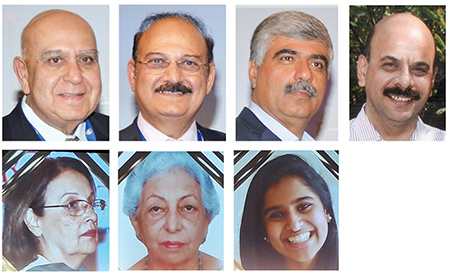
From l, top row; Dinshaw Tamboly, Dr Keki Turel, Dr Esfandiar Ekhtiyari, Khushroo Poacha;
2nd row: Dr Pheroza Godrej, Meher Medora, Ziba Colah
Clockwise from above l: Alison Betts, David Adams, Vahishta Irani, Sharmin Batliwala with her sons;
Meher Bhesania, Neville Shroff
The winner of the Science/Technology/Engineering/Medicine and Applied Sciences Award was neurosurgeon Dr Keki Turel who is known for setting up the microsurgery unit at the Masina Hospital in Bombay as well as other GCC (Gulf Cooperation Council) countries like Oman, UAE and Bahrain. He is popular for organizing camps and world events befitting the neurosurgical community. He provides free service to Parsi priests, teachers and those in the low income group. "On the fateful night of 26/11 (2008) he was attending scores of injured persons brought to the Bombay Hospital after being attacked by terrorists and continued treating several more for the next three days and nights.” In his acceptance speech, Turel dedicated the award "to all my patients who have suffered at my hands…and the team of doctors who have supported me.”
To Khushroo Poacha went the Social Entrepreneur Award. Having launched the
www.blooddonors.com website in 2000, a few years later he set up a kitchen to serve meals to patients which later grew to "Seva Kitchens” in five cities in India. In 2016 he launched "Fridge of Kindness” to provide nutrition to poor patients in hospitals. Today there are 10 fridges in seven hospitals and three schools in India. In his absence, the award was presented to Thrity Tantra.
The Woman of Distinction Award went to Dr Pheroza Godrej, a cultural icon who is the honorary director of the F. D. Alpaiwalla Museum in Bombay, a nature conservationist and the chairperson of the Godrej Archives Council. With her expertise in modern Indian paintings, prints and drawings, she has co-curated many exhibitions in India and abroad, including "The Everlasting Flame” that showcased Zoroastrian culture. Her award was received by Firoza Punthakey Mistree who has collaborated with Godrej on many cultural projects.
Ziba Colah of Houston was presented the Young Zarathushti Award. A winner of several scholarships from prestigious medical institutions in Houston, she is currently pursuing her MD (doctor of medicine) studies. "Since 2010 she has been making substantial contributions to the Zoroastrian Association of Houston and has helped the Zoroastrian community in that area in many ways.” Her award was received by Arzan Wadia, the youthful vice president of FEZANA.
A specially instituted award for Outstanding and Meritorious Services to Iran was conferred on Dr Esfandiar Ekhtiyari who has served as the Zoroastrian representative on the Iranian Parliament for three terms, for three decades. Having won many prizes over the years in sports and science, this award to Ekhtiyari was "very, very special. It is a beautiful day for me.” He wished the community "Hamazori bin, Hamazori asha bad (united in strength, united in righteousness).”
Louisa Wood, entrepreneur and Australian Salsa world champion performed a captivating dance with her colleague Diamaris and later drew parallels between dance, business and life: By practicing the same steps and focusing on one percent improvement, we can add value and become "stronger, faster, fitter, smarter, more efficient.” Like the Salsa turns "life too could throw us off balance. It is for us to adopt the ‘Spinners Mantra’ with the head up, focusing, visualizing, creating, until we are in control.” Dance also teaches the performer the importance of music, movement, timing and sensitivity to one’s audience. It is important "to perfect the choreography of your life,” she stated.
The other entertainment items lined up before the gala dinner were vivacious sequences by performers from the Melissa Jade Academy of Dance and Zeenia Sunavala, with songs by Feritta (Dadachanji Khambatta) who also shared the responsibilities as one of the four masters of ceremonies. Post dinner, the lilting music on offer by Farrokh Firozgary’s Z Band from Houston prompted the delegates, young and old, to come on the dance floor.
There was never a dearth of entertainment at the Congress: During lunch on the second day, delegates were treated to a magic show by Pierre Ulric. Later in the evening delegates who had signed up for the Swan river cruise enjoyed dances by Sunavala, Wood and Diamaris, songs by Sonia and Feritta. To the dismay of the organizers, nearly 70 participants enjoyed the cruise and did not make the additional payment despite repeated announcements. Yet another recurring announcement that did not fail to amuse the audience referred to a kusti being found in the washroom of the cruiseliner!
Reinforcing Parsipanu at the Congress, the ladies who had come attired in garas and kor ni saris at the inauguration were urged to assemble for a group photo. Not forgetting the men in daglis, they too were summoned for a separate photo. Sensitive to the needs of the Iranian congregation, the organizers had arranged for English to Farsi translation of the sessions which delegates could avail of after installing BeOnAir Listener App on their mobiles. Accessing the 11wzcwifi, they were to enter the required password and click on the ‘listen’ button. (The procedures in Perth were live streamed to a contact in Iran who would translate them into Farsi, clarified Congress chair Firoz Pestonji.)
More than words
On each day of the Congress delegates got an opportunity to view different films enshrining the message of Zoroastrianism. Bhesania’s film, Life and Times of Zarathushtra, "dedicated to Firoz Pestonji’s Congress,” was shown on the first evening. Glimpses from the newly restored film On Wings of Fire were offered on the second day. Meherji Madan, the producer and music consultant for On Wings of Fire told the audience, "The 90-minute film is a full length docu-drama on the history of our people.” Whilst seeking to popularize the DVDs of the restored film in the US and Canada, Madan spoke of harnessing "the power of the social network... preparation for an upgraded version... and a children’s workbook.” On the last day was screened Eminent Zoroastrians, produced by the Melbourne Zoroastrians. The narration for the film was done by Meher Chubb who recently passed away at the young age of 24 years.
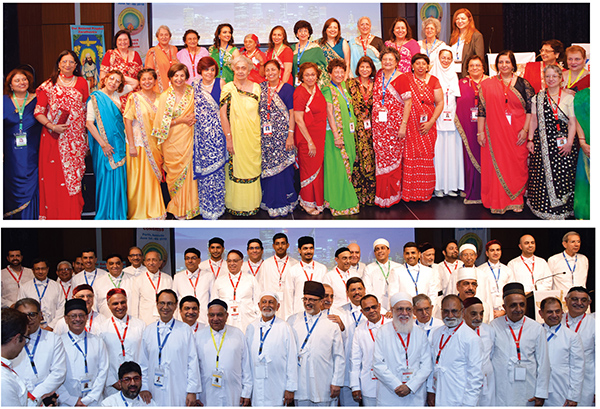
Traditionally dressed ladies and gents at the Congress; Photos below: 11wzcperth.com.au
(Top from l): Yaz Mubarakai, Zeenia Sunavala, Farrokh Firozgary, Feritta and Zeiba Randeria;
2nd row: entertainment by Z Band, Louisa Wood and Diamaris on the cruise;
3rd row: performances by Melissa Jade Academy of Dance and Pierre Ulric
"Zoroaster’s world still lies before us,” summed up photojournalist and documentary filmmaker David Adams, a fellow of the Royal Geographical Society, when sharing his experiences of exploring ancient Zoroastrian sites and his plans for a documentary series on the history of Zoroaster and Zoroastrianism. Having traveled extensively in Central Asia, Afghanistan, Iran, Siberia and Africa, Adams is best known for his investigative reporting into indigenous peoples’ disappearing cultures and historical documentaries such as Journeys to the ends of the Earth, a 13-part series made for the Discovery Network, and Alexander’s Lost World, a six-part series made with UKTV, Viasat and Sky Vision.
Archeologist Alison Betts from the Sydney University, in her presentation on "Lost art from the sands of the Kizilkum,” referred to the long-term project in northwestern Uzbekistan "revealing a remarkable new story about the early history of Zoroastrianism beyond the Iranian heartland.” A collaborative team from the Karakalpak Branch of the Uzbek Academy of Sciences and the University of Sydney have been conducting excavations at the site of Akchakhan-kala in the Amu-dar’ya delta or former Chorasmia of the Achemenid Empire. Founded in the early second century BCE and abandoned around the second century CE, Akchakhan-kala appeared to be a royal seat as seen from the richly ornamented ceremonial mud-brick complex decorated with magnificent murals. Frequent depiction of priests wearing the padan, barsam twigs used in ceremonies and human headed roosters associated with the angel Srosh indicated the Zoroastrian influence.
The Congress also provided opportunities to bring to the fore cultural and welfare activities undertaken by individuals and organizations: Seventy-five people from a dozen countries have gone through the Return to Roots (RTR) program that provides overseas youngsters insights into the Zoroastrian way of life in India. The fifth edition of the program will commence on December 19, 2018, said Wadia who has been coordinating this program at the behest of Parzor. An affirmation on the usefulness of this program was provided by Kayras Irani who attended as a fellow in 2015 and has since been revisiting it as a volunteer/alumnus.
On behalf of Melbourne based Sharmin Batliwala who has been diagnosed with chronic lymphatic leukemia, an appeal was made by her friend Vahishta Irani, also from Melbourne, urging the delegates to sign up on the bone marrow registry of their countries and donate blood stem cells that would only require hospitalization for a day but could save the life of a patient. According to Batliwala’s doctors, she could beat cancer with a bone marrow transplant but she has yet not found a matching donor from the database. Even her sister was not a suitable match. The family though is hopeful of finding a match and therefore appeals to members of the Parsi community to register as donors to help Batliwala and thousands like her desperately in need. A handout in the Congress brochure titled "Swab for Sharmin” listed the registration/contact details for different countries.
Perth based Zeiba Randeria’s lovely paintings served as mementoes for many of the guest speakers and a fund-raiser when three of her works were raffled on the last day.
The welcome kit provided by the Congress organizers included a leather handbag, peaked cap, flag and a pen bearing the Congress logo; a key pouch; Subtle Energies sachets and two compact discs – one of Zoroastrian monajats sung by Mani Rao and another titled A Journey Begins that had 12 songs by Feritta.
"Down Under, we try to do things differently,” remarked Pestonji at the closing ceremony before reiterating his faith saying, "I don’t think the Zoroastrian flame will ever get extinguished.” He urged the delegates to study the Congress brochure that featured messages from dignitaries and reports of Zoroastrians in different regions, from Pakistan to Kurdistan, Iran to UK and North America, Sri Lanka to New Zealand and Australia.
"We thank every one of you who has honored us with your presence… assistance,” stated Pestonji. When naming the members of his organizing committee he started with his three pillars: Kaizad Sunavala, Keykhosro Mazdeyasni and Mahiyar Keravala. He then proceeded to thank, Mahiyaar Wellington, Tanaz Ghadiali, Yasmin Merwanji, Arash Sethna, Shahpoor Kalantary, Mehraab Patalwala, Sheroy Irani... "The four lovely masters of ceremonies — Zarine Commissariat, Afreed Mistry, Farzana Khambatta and Feritta. As commented Hoshang Deboo, "We’ve all worked hard, but Firoz and Mahrukh have worked the hardest. He literally breathed WZC in the last few months.”
"This Congress took over two years in the making… It was so well coordinated and organized. A wonderful, magnificent, phenomenal job…The whole team deserves a standing ovation,” declared Neville Shroff, president of ZCFHCM and non executive chair of GWG that had awarded Perth the opportunity to host the 11WZC. Commending them for providing "one of the best opportunities we’ve ever had” to hear different voices at the Congress, Shroff observed that Pestonji had "defeated all skeptics… Behind every successful man is a woman. Here there were two women: his wife Mahrukh and daughter Farzana Khambatta.”
This concludes Parsiana’s coverage of the 11WZC