"There is no definition of who is a Parsi… This book has been conceived with the endeavor to aid those women and children who have been alienated from the Parsi community and help them understand their constitutional rights,” stated author Prochy Mehta at the July 7, 2022 launch of her book Who is a Parsi? at the India International Centre in Delhi. The event was telecast live on the Facebook page of the publishers, Niyogi Books. Mehta referred to the discrimination faced by children of intermarried Parsi women. "In this book, I try to show that there is no legal, religious, social or age-old custom on which it is based… I hope the book will pave the way for equality for men and women in our community.”
"When my own daughter (Sanaya Mehta Vyas, who is intermarried) was discriminated against, I decided to look into the matter further,” Mehta stated. The mother and daughter have filed an originating summons in the Calcutta High Court to determine who has right of access to their fire temple. Vyas’s children used to pray at the Late E. B. Mehta’s Zoroastrian Anjuman Adaran till a newly appointed head priest objected.
The author acknowledged the role of senior Supreme Court lawyer Fali Nariman. She appreciated his meticulous editing. "I did not know Mr Nariman…I sent him my manuscript… He did not respond.” When reminded, the senior lawyer corrected the manuscript by hand, removed pages that had incorrect information, as well as added correct information. "He advised me on what judgments to include in the book…When final, he said ‘now I will write the foreword’… He was like a magic wand.”
Ervad Yezad Kapadia, erstwhile president of the Delhi Parsi Anjuman (DPA), who launched the publication, asked whether inducting children of inter-religious marriages should be considered heresy. According to Kapadia, the core of the book lies in two cases — Petit vs Jeejeebhoy and Bella vs Saklat. The book "successfully answers the question it raises in its title,” he stated. He noted that while the Parsis consider themselves to be "racially pure,” scientific research has proved that no people in this world are racially pure.
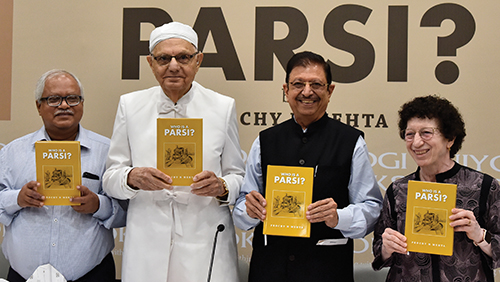
From l: Dr Nirmal Kanti Bhattacharjee, Ervad Yezad Kapadia, Kersi Deboo and Prochy Mehta
Another pertinent point made by Kapadia was that for centuries Zoroastrians in India sought advice on religious matters from priests in Iran. These were documented in 22 Rivayats, the first dated 1478 and the last in the 18th century. The queries dealt with issues like whether the children of non-Parsi domestic servants who had served their masters diligently could be inducted into the religion and permitted use of the dakhmas. "Why have we stopped seeking such advice which was willingly given?... Our co-religionists in Iran have shown how to adapt to changing circumstances. They stopped using the dakhmas as soon as there was a scarcity of vultures. We still use them despite there being no vultures.”
Kapadia also bemoaned that "Principles which were accepted by the head priests a century ago are found to be deficient by today’s High Priests!”
Vice chairperson of the National Commission for Minorities (NCM) and guest of honor Kersi Deboo narrated that the "tussle between orthodox and reformists is age-old… Reformation is slow but certain.” He noted that women have been barred from fire temples and holding office in some punchayets. "But, with time we have to change.”
Parzor director Dr Shernaz Cama stated that "The whole concept of Zoroastrianism is based on truth and that is what I am reminded of by Prochy’s book.” Writer Keki Daruwalla, a former trustee of the DPA and former member of the NCM also graced the launch.
Editorial director of Niyogi Books Dr Nirmal Kanti Bhattacharjee referred to the dwindling numbers and ascribed it to the community’s refusal to accept children born of intermarried Parsi women. "When India as a nation today is debating the uniform civil code, such personal laws should be abolished and gender justice should be safeguarded,” he stated.
A press release from the publishers states: "The author depicts the dichotomy of the community in the 20th century, between the orthodox and the reformist groups and explains the anomaly of how the reformists who followed the original Mazdayasna constituted the real orthodoxy.” The narrative states that it was a reform movement led by the high priests of the community and the most influential members of society, for a return to the pristine purity of Zoroastrianism. "This book documents, through letters, articles in the newspapers, and transcripts from court cases, the views of those brave men, Dadabhai Naoroji, Ratan D. Tata, Ratan J. Tata, Sir Dinshaw Maneckji Petit, Sir Jehangir Cawasjee Jehangir, Rustumji Byramji Jeejeebhoy, Homi J. Bhabha, K. R. Cama, and many others who had the courage to stand up and fight for what they believed in, that Parsi and Zoroastrian meant the same thing.”
Calcutta-based Mehta, the first woman president of the Calcutta Parsee Club, has earlier authored Pioneering Parsis of Calcutta (see "Calcutta chronicle,” Books, Parsiana, January 21- February 6, 2020) and Rusi B. Gimi (See "Gamut of Gimi’s life,” Books, Parsiana, December 7-20, 2021).
Niyogi Books was established in 2004 and has published more than 500 titles. The program was anchored by their chief operating officer Trisha De Niyogi.
FARROKH JIJINA