The exhibition “Threads of Continuity:
Zoroastrian Life and Culture” at the Indira Gandhi National Centre for the Arts projected the
resilience of the community
Text: Parinaz M. Gandhi Photos: Jasmine D. Driver
"In this exhibition we try, through the metaphors and symbolism of this ancient faith, to answer a question many have raised as to how a tiny community, thinly spread across the globe, has contributed and continues to contribute to all aspects of human endeavor…” Curator Shernaz Cama’s thoughts were distinctly displayed at the exhibition "Threads of Continuity (ToC): Zoroastrian Life and Culture” that was inaugurated by Dr Najma Heptulla, union minister for minorities in the presence of Dr Cyrus Poonawalla at the Twin Art Gallery at the Indira Gandhi National Centre for the Arts (IGNCA) in New Delhi on Jamshedi Navroz, March 21, 2016.
Installation depicting atash kebla
Amesha Spenta as conceived by Dadi Pudumjee
1) Silver cup or rhyton;
2) bowl with decoration;
3) chlorite stone goblet;
4) human figure in clay, all from the National Museum, Tehran;
5) replica of the stone statue of Darius I;
6) ceramic Cyrus tomb depiction by Adil Writer;
7) at the entrance to the exhibition;
8) Dr Homi Bhabha’s oil on canvas, Abstract, and his memorabilia
The third in the series of three exhibitions mounted at different venues in the capital, as ParZor director Cama commented, "The Zoroastrian journey has not been easy. However the threads of continuity which bind together this small community, their capacity to adapt to circumstances while keeping their core beliefs intact has enabled this population of less than 100,000 individuals across the world to integrate both east and west, drawing color and strength from the warp and weft that weaves together a unique tapestry of humanity.”
"Today is a special evening in more ways than one: the last exhibition in the series; beautiful weather, beautiful evening and beautiful moon if you have the time to look at it,” stated Chinmaya Gharekhan, president of the IGNCA Trust who admitted that he could not desist from having "a sneak preview of the exhibition” the night before the inauguration and would like to "congratulate the curators… Not many would have visited Yazd,” and the section on Iran offers a "memorable experience,” he declared. He was happy to inform the audience that the library at the 25-year-old IGNCA is "the biggest in India in the study of art and culture.” It is the custodian of the national cultural audiovisual archives with "the richest collection of slides on music and dance traditions of India.”
Heptulla "stood by us and helped our dream come true,” announced Cama, additionally acknowledging the commitment of her family and her ParZor colleagues who "were here till 3 a.m. every day,” to present a community known for "its ethical beliefs, humility, pursuit of excellence.” As she reminded at the evening function, "Mankind has faced the same existential problems” through the centuries. When showcasing the Parsi Zoroastrian culture for the Delhi populace, the exercise became more meaningful for they were "able to build relationships” with other international, cultural and educational institutions like the School of Oriental and African Studies (SOAS); British Library; Iran Cultural Heritage, Handicraft and Tourism Organization; National Museum, Tehran; Khane Farhang O Honar Museum; Yazd Marker Museum. She appealed for a standing ovation for platinum sponsor Dr Cyrus Poonawalla whose largesse brought "80 cooks from the famous Joss kithchen to Delhi for the Navroz dinner that night.”
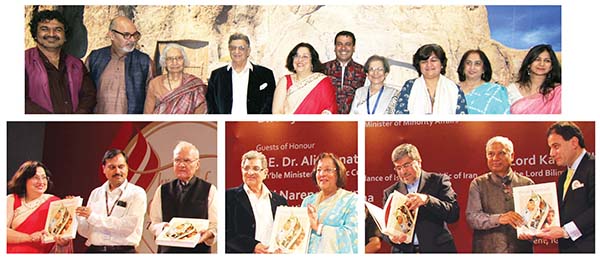
(From left, 1st row): Neeraj Sahai, Dadi Pudumjee, Dr Kapila Vatsyayan, Dr Cyrus Poonawalla,
Dr Shernaz Cama, Ashdeen Lilaowala, Ava Khullar, Pallavi Sahai, Kerman Mehta, Joyoti Roy;
(2nd row) Cama, Narendra Kumar Sinha, Chinmaya Gharekhan, Poonawalla, Dr Najma Heptulla,
Dr Ali Jannati, Rakesh Garg, Lord Karan Bilimoria
Astad Deboo (inset) and troupe in "Elemental Divine;"
In his introduction to Poonawalla, Lord Karan Bilimoria of Chelsea, UK, noted, "We have our own Cyrus the great, an entrepreneur extraordinaire (whose) vaccines have saved millions and millions of lives. His was not an overnight journey.” He commended Poonawalla’s ability "to aspire and achieve with integrity when the odds were against him and his guts to take on the pharmaceutical giants.” Always respectful of his homeland, Bilimoria declared, "India is the most secular, pluralistic country in the world.”
According to Poonawalla, it is "with God’s blessings” that his Serum Institute of India has been able to save 10-20 million children’s lives in 170 countries by supplying vaccines at the cost of a cup of tea. An appreciative Poonawalla mentioned that "It is very good that the Modi government has gone out of its way to encourage this…minuscule minority.” Having co-hosted "The Everlasting Flame” exhibition in London in 2013, he was grateful to Cama for "motivating me to sponsor this event and making the exhibition a success… I hope it will help the world to understand our culture.”
He chose to dedicate the Navroz celebratory event to the memory of his late wife Villoo "who devoted a lot of time to go to Udvada and help the priests.” As he further urged the gathering, "I want you to enjoy today’s dance by Astad Deboo followed by lagan nu bhonu (wedding feast).” On the lawns of IGNCA that wore a carnival look were four Navroz tables laden with sweets, fruits, dryfruits, gaz and falooda that guests were invited to partake of to celebrate the festival of spring, as also tents selling Parsi and Iranian delicacies.
"No two countries would have contacts more continuous than the people of Iran and India,” commented Dr Ali Jannati, minister of Islamic culture and guidance of the Islamic Republic of Iran. Besides the "spiritual affinity,” there are "strong cultural and civilizational ties” between the people of these two nations, he added. Viewing Parsis as "the custodians of Iranian culture in the wake of attacks by Arabs,” he hoped that the relations between the Parsis and Iranians would "continue with greater intensity… It is high time for both civilizations to have bilateral cooperation against global terrorism. Today the culture of peace is under serious threat with the rise of violent extremists...
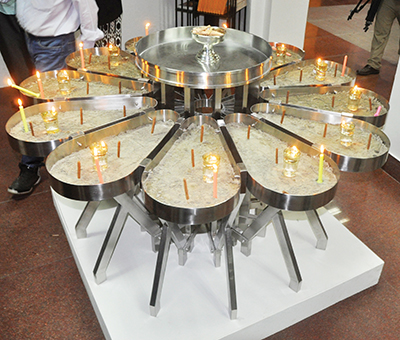
12-petal lamp as found in Chak Chak or Pir-e-Sabz
"It is a matter of great pride that some Zoroastrians still live in Iran. It has been a matter of immense delight to the homeland. Their service to society and their homeland are significant. They are hardworking (and) played a role in the development of Iran,” remarked Jannati, adding, "Parsis have integrated with other people gracefully…All present here would agree that their contribution to industrial and economic areas and growth and development of art and culture has been immeasurable.”
"I am not going to come between you and the bhonu,” declared Heptulla, addressing the community on the third consecutive evening. She did however feel obligated to give the interfaith audience an overview of the work she does for the six minorities who come under her purview. "Parsis being minuscule, need more support and care. It is like taking more care of the weakest in the family,” she explained. "It doesn’t mean however that we don’t care for the (others).” Muslims as the largest minority are "economically backward, socially isolated” and are helped with scholarships which next year will total one crore rupees, she said. "Sab ké saath, sab ka vikas,” (in harmony with others and progress for all) is the credo of "our Prime Minister who does not want lopsided development. He wants the Madressa children to carry the Quran in one hand and a computer in another.”
"Elemental Divine,” the dance program choreographed by Deboo, started with his dancers joining him in the Yatha Ahu Vairyo prayer. The lithe dancers showed their prowess with their percussion instruments as they twirled and gyrated on stage while Deboo served as the central anchor comfortably taking over 700 chakkars (circles) non-stop.
The seven-course dinner that night, no connection with the mystic seven, was initally planned as a sit-down meal over four sittings but finally ended within three. Unlike the Bombay crowd who are used to waiting for sittings to enjoy their gahanbar meals, the Delhi gathering did not have the patience to find a seat at their assigned paats (sittings) and hence many left before partaking of the meal.
The compendium and collection
The 520-page compendium, Threads of Continuity: Zoroastrian Life and Culture, released on the occasion, encapsulating 17 years of research, is "an attempt to help the world understand the endurance of this ancient thread in the tapestry of humanity,” wrote Dr Kapila Vatsyayan, chairperson, India International Centre — International Research Division, in her preface to the book. "The powers of oral transmission, the voices of the people of this culture are highlights of this collection,” she writes.
"In contemporary times, it is obvious that the Zoroastrian community in India, Iran and the diaspora continuously negotiates change. Globalization, compounded by the demographic decline of the Zoroastrians has been the subject of sociological study and discussion recently, with prophesies of impending extinction. Yet the common perception is that of an economically rich community refusing to adapt and accept change. Therefore, they are seen as the creators of their own impending doom. The voice of a community, often drowned in debate, or overruled by scholarship, is heard speaking here about itself candidly, on several issues… India has protected communities from the beginning of time. They came as refugees and became part of a rich tapestry, each thread adding to the making of this land. Thus by the discussion of one ancient strand in the tapestry of India, supported by pictorial evidence, this book will preserve in permanent form, an ancient heritage of humanity.” This compendium is available from ParZor for Rs 2,500.
The ToC exhibition "aims to showcase the philosophy of a Bronze Age prophet who was a humanist offering a modern philosophy of choice to humankind… Choice leads to the issue of man’s responsibility — to himself, to humanity, to the Creation,” explained Cama who was assisted in her curatorial work by Dadi Pudumjee, Ashdeen Lilaowala and Kritika Mudgal.
A kaleidoscope of colors and threads criss-crossed, merged and parted to create a compelling artifact that was specially designed for the ToC exhibition. In the midst of a plethora of exhibits showcasing the lifestyle and culture of this community, yet another compelling exhibit was the tree of life installation using the kusti. Symbolizing creation, the 72 threads of white lamb’s wool that constitute the kusti were shown as branches that merge into the trunk of the tree depicted through the spun sacred symbol. "This is the most important installation,” stressed Cama when accompanying Poonawalla at a preview of the exhibition. While earlier efforts gave a form to the seven Amesha Spentas, Pudumjee tried to give a face to the seven immortal spirits connected with creation.
At the entrance to ToC stood the 12-petal metal lamp similar to the one at Chak Chak in Iran, a shrine venerated as Pir-e-Sabz for its miraculous vegetation in a desert region. Adil Writer’s rendition of the Cyrus tomb in ceramic with the wordings "…grudge me not these few feet of land on which I lay my body as I was the master and emperor of Asia” was another contemporary piece.
The majority of the exhibits were artifacts assembled from many corners of India and Iran. The exhibition was divided into different sections encompassing: Birth of the Religion, Rituals, History, From the Iranian Plateau, Ichto (Iran), Life Cycle, The Landing in India, Parsis in India covering Navsari, Udvada, Ahmedabad, Bharuch, Bombay, Deccan and Modern India. Many visitors enjoyed soaking in the ambience of a specially created Irani Café. To depict the boat journey, replicas of sailing vessels were shown suspended against a backdrop depicting a storm.
The lifestyle of the Deccan Parsis followed a distinctive pattern. Several of them enjoyed titles from the court and observed its cultural rules in dress, material objects and music. In the last century, a woman’s pandaan (container for betel nut) was like her purse.
The ability to work with wood is seen in the customized wooden furniture in Parsi homes across Gujarat. Each object, often of Burma teakwood, was unique while the chests and cabinets held within them embroidered textiles like garas, kors, ijars, special clothing and linen. Portraits, decorative figurines, porcelain vases, music boxes were the other favorites in Parsi homes.
Threads of continuity was witnessed even in the Tanka system of rain water harvesting in Bharuch, similar to the Persian qanats and kariz. In the smaller homes in Parsi vads, tankas or underground tanks for storage of pure drinking water were constructed within the kitchen area while in larger homes, there was a separate place for the tanks that ensured a year round supply of drinking water and additionally kept the premises cool.
Members of the Hakim family guarded their healing and potent cures. One such treasure from the family of Jamshedjee Rustamjee Hakim of Rangoon has been presented to ParZor and even contains recipes for curing the plague!
Staying in a joint family was the norm and a portrait of the Pudumjee family in early 1900, Khetwadi, Bombay, shows four generations, with children and adolescents in the forefront, great-grandparents seated behind them, ladies with babes in arms constitute the third row and standing behind them a row of men in black daglas and phetas, pugrees and topis.
Alluding to the "arbitrary” collection of artifacts that were "begged for, borrowed or loaned,” designers Pallavi and Neeraj Sahai of Picture Street, referred to Cama having "a farm full of objects.” The last six months prior to the exhibition involved "intense work,” although efforts had been initiated seven years ahead when they made their first trip to Navsari. For the designers, it was "a problem of plenty… there was so much material, it was difficult to determine what not to display.”