Forts in Maharashtra have Portuguese, British, Muslim and Maratha origins
Farrokh Jijina
While the Portuguese built many coastal and inland forts during their occupation of India, they ultimately fell to other powers like the English and the Marathas. Many of the forts lacked sufficient Portuguese commanders and troops. A large number of the Portuguese administrators were more inclined towards private trade – many were advisors to the sultans of Gujarat. Also, Brazil, with its mineral riches, became more important to Portuguese. These were some of the factors historians noted on the second day of the seminar on the "Forts of Maharashtra” held by The K. R. Cama Oriental Institute (KRCOI) on February 17 and 18, 2019.
Bombay’s skyline from Worli Fort Photo: Dr Jehangir Sorabjee
Aerial view of Mahim Fort in foreground Photo: Dr Jehangir Sorabjee
Fort wall with series of bastions, Naldurg Photo: Abdul Aziz U. Rajput and The Trustees, KRCOI;
Outer walls of Revdanda Fort Photo Damitr/Wikipedia
Gopal Gad Photo: Directorate of archeology and museums, government of
Maharashtra and The Trustees, The K. R. Cama Oriental Institute (KRCOI)
Speakers and chairpersons of sessions with Dr Nawaz Mody (seated 2nd row, 2nd from l)
"The English (colonial historians) were interested in painting the Portuguese as the bad guys… (their) texts had a tendency to exaggerate for political or cultural reasons,” said Dr Dejanirah Couto, professor of early modern Portuguese overseas history at Ecole Pratique des Hautes Etudes, Paris. She was speaking on "Early modern Portuguese fortifications on the coast of Maharashtra: the case for Chaul.” "I prefer to talk of Portuguese presence, rather than the Portuguese Empire, in South America and South East Asia,” said Couto. What began as a Portuguese maritime network became more "territorial” in approach in the 16th century. Chaul (present-day Revdanda) in coastal Maharashtra about 125 km south of Bombay is where the Portuguese established a "primitive” fort in 1521. The fort was part of Portuguese India’s Northern Province, which by the mid 17th century extended 100 km along the coast of today’s Maharashtra and Gujarat from Chaul to Diu. The headquarters of the Northern Province was at Vasai, north of Bombay. The stretch included fortifications at Vasai, Asheri, Thana, Tarapur, Mahim and Daman.
Fortifications provide insights into political alignments, noted the scholar. The fort at Chaul has Muslim and Mediterranean heritage, she noted. The "culturally hybrid” fortification was built using local designs and with local manpower, stated Couto. Portuguese officers and soldiers assisted in carrying local material during its construction as they were "manually underpowered.”
Diu (now a town in the union territory of Daman and Diu) housed the northernmost Portuguese fort, explained Dr Fleur D’Souza, erstwhile head of department of history and vice principal at St Xavier’s College. Stressing the importance of the Northern Province, D’Souza explained that undivided Thana district alone was larger than Goa, the capital of Portuguese possessions in India. The Portuguese "studied creeks, marked sandbanks and noted tides,” before selecting the location of their forts, explained the historian while speaking of "Feitorias (factories or trading posts), fortes (forts) and fortalezes (fortresses): Portuguese colonial policy and maritime control of the coast from Bacaim (Vasai) to Chaul.” Co-speaker Dr Joaquim Rodrigues dos Santos who has a doctorate in architecture from the University of Alcala, Spain, demonstrated that the forts in Portuguese India were based on the designs of theoreticians and experts in Europe. For instance, when cannons became more important than catapults in warfare, fort walls became thicker, but maintained the same height to withstand cannon fire.
The major fortresses of Vasai and Chaul were supported by smaller fortresses, watchtowers, bastions, fortified manor houses and even churches, stated Dr Mayur Thakare who works in the directorate of archeology and museums of the Maharashtra government. Thakare’s images demonstrated the fortification strategies of Dahanu, Asheri and Tarapur. These minor fortifications are an under-researched subject, he said, while talking on "In the second line of defence — architecture, typology and spread of Indo-Portuguese defence structures in the North Konkan.”
The morning sessions were chaired by Dr Rashna Poncha, assistant professor, history at Sophia College for Women.
Speaking of the south
Conservation architect Tejaswini Aphale in her paper the "Bahamani legacy in the forts of Marathawada” that traced the evolution of forts noted, "Almost every village or town in India had its own fortification. As life became more complex and communities developed into kingdoms... rivalries grew between every two kingdoms and with that grew the art, science and technique of fortifications.” Initially the fortifications were built of mud, then brick and finally stone. "In certain circumstances, walls of mud were again constructed.”
Freelance historian Abdul Aziz U. Rajput in his paper "The splendor forts of Naldurg and Ahmednagar” noted, "The imposing Naldurg fort stands above the river Bori and is one of the most fortified strongholds of the Deccan.” Naldurg is a municipal town in Osmanabad district. The second massive fort at Ahmednagar was built in 1562 by the first Sultan of the Nizam Shahi dynasty "to defend the city against invaders from the neighboring Sultanate of Idar. Initially it was made of mud and took four years to build. In 1600 when Akbar attacked, "the fort went into the hands of the Mughals.” The architecture of medieval forts and fortifications comprised many defensive features such as "trenches, merlons, ventilations, bastions, etc.”
The sessions were chaired by Dr Louiza Rodrigues, professor and head of history at Ramnarain Ruia College.
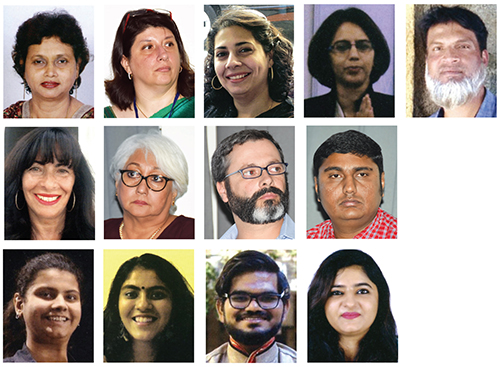
From left, 1st row: Dr Louiza Rodrigues, Dr Rashna Poncha, Janine Coelho, Tejaswini Aphale, Abdul Aziz U. Rajput;
2nd row: Dr Dejanirah Couto, Dr Fleur D’Souza, Dr Joaquim Rodrigues dos Santos, Dr Mayur Thakare;
3rd row: Riddhi Joshi, Sakshi Nebhani, Jason Johns, Heena Sofi
Student voices
Janine Coelho, professor of history at St Andrews College of Arts, Science and Commerce commented that had she not known the academic papers she was reading through were from students, she would have thought they were from professional historians. As noted KRCOI honorary secretary Dr Nawaz Mody, the Institute received feedback at a previous seminar that students should be allowed to present their work.
The fort at Mahim traces its origin to 1140 when Pratap Bimba of the Bimba dynasty ruled over that location (then known as Mahikavati). When the students of Ramnarain Ruia College approached the police station about their planned visit to the Mahim Fort to survey the 75 sq m area, they were told "It is not safe.” Totally encroached by about 500 families, "two-storey houses now are built on remnants of the walls,” said Riddhi Joshi on behalf of her co-students. The Sion Fort is relatively better maintained, with a garden, an office of the Archeological Survey of India, a study area for students, said Joshi. Most of the 60 respondents to the students’ survey said that there was scope for improvement of the facilities at Mahim and Sion Forts. Problem areas identified included encroachment, the presence of bamboo factories and erosion due to tides (at Mahim), littering and insufficient signage. "There is some work done on conservation, but not enough,” said Joshi, with which Tejas Garge, director in the directorate of archeology and museums of the Maharashtra government, who was present in the audience, agreed.
Sir Dinsha Wacha noted in 1920 that to the citizens of that period Bombay Castle was only a name, said Sakshi Nebhani on behalf of the second-year history students of Sophia College. Their paper "The forgotten fort: Bombay Castle,” traced the origin and development of the manor house of Portuguese herbalist Garcia D’Orta. From being among the oldest houses on the island of Bombay "with roses, medicinal plants, jackfruit and mango trees,” the house was fortified to become the Castle. The English acquired the house under the 1665 Instrument of Possession signed between the Portuguese and the English in Europe when Portuguese princess Catherine of Braganza married the English king Charles II. The Castle that the English built around the manor house had four bastions, with two facing seaward, narrated Nebhani. A sundial and a sentry box above the main entrance still survive. Now a naval establishment called INS Angre, after the Maratha naval leader, the Castle is out of bounds to the general public, but a handful of students/delegates were to be taken on a tour later.
Who actually built the fort at Worli is unclear, noted PhD student and visiting faculty at the department of ancient Indian history, culture and archeology at St Xavier’s College, Jason Johns. While some scholars believe it was the Portuguese who constructed this fortification, others believe it is an English monument dating to 1675. Johns was presenting a paper on "The Sewri and Worli Forts in Mumbai.” Built on a steep promontory jutting out into the sea, the Worli Fort has no regular form and is built on rock stones laid upon one another with no mortar to cement them together. The stones are held together with an ingenious interlocking device. With a video, Johns demonstrated that this Fort would have provided a good view of the Arabian Sea, and therefore would have been used to keep guard and send out warning signals for dangers of invasions from Gujarat, Europe and Africa. Even today, the ruins of the Fort are used as a naval base though surrounded by encroachments. Connected to the Mahim Fort which is a few kilometers to the north via an isthmus at low tide, the channel was blocked during British times.
The British-built Sewri Fort stands on a quarried hill with land surrounding it on three sides and the sea on the fourth. Used as a prison once, the Fort is under possession of the Bombay Port Trust. Though a Grade I heritage site, it remains in poor condition, rued Johns.
The history of Bombay is intricately intertwined with the fortifications on it, stated Heena Sofi of the Maritime History Society. Her presentation summarized the growth of Bombay from its early years, the building boom of the 1860s, the tearing down of the Fort walls to "the city of dreams” that it is now.
Concluded
"Much, much, much more” needs to be done to restore the Bombay Castle to its old glory, noted architect Kirtida Unwalla, who was involved in conservation efforts of this "culturally significant asset” in the city. The Castle is one of the oldest defense structures still standing in the city. Speaking at The K. R. Cama Oriental Institute on "Restoration of the Bombay Castle,” on April 11, 2019, the conservation specialist detailed the efforts of her firm K. Unwalla Architects in two phases of the restoration of the four-century-old monument between October 2004 and June 2007. Working within an international charter to which India is a signatory, Unwalla explained that restoration needs to be mindful of the emotional and cultural values of a monument, taking into consideration the current use it is put to.
Kirtida Unwalla (l); sundial at Bombay Castle (r)
Photo: Cmde Odakkal Johnson, curator and head of research,
Maritime History Society and The Trustees, KRCOI
"Efforts have to go beyond the single asset that is being restored,” she emphasized. Which is why the first phase of the restoration efforts included a survey of all the buildings within the Castle, even those built later, Unwalla noted. The "context” in which the Castle was used had changed over the centuries. Once a fortification by the sea, successive reclamations had now pushed it inland. The history of each of the four bastions of the Castle had to be studied separately, she said. During the restoration, one of the walls revealed an escape route to the harbor, she revealed.
The lecture was chaired by Cmde Dr Odakkal Johnson, curator of the Maritime History Society.