Field Marshal Sam Manekshaw’s contribution has not been celebrated enough in popular culture, especially at a time when the political leadership likes to take credit for military victories in jingoistic narratives. India’s most famous military hero, and certainly the most popular in modern times, has not received the attention he deserves. Director Meghna Gulzar’s Sam Bahadur thus fills a much needed gap even if she has given us an adulatory biopic of an outspoken military strategist who had the spine to speak the truth to those in power.
Top: Vicky Kaushal as Field Marshal Sam Manekshaw; inset: poster of movie
Manekshaw lived through some extraordinary periods of change. Born into an India ruled by Britain, he joined the army and fought for British-Indian interests against Japan in the Second World War. On the partition of India in 1947 he was assigned to a new unit as his previous regiment became part of Pakistan’s armed forces. He later oversaw India’s campaign in the Indo-Pakistani war and, in 1973, became the first Indian army officer to be promoted to the rank of field marshal just before his retirement.
The film is at its most watchable when narrating fun anecdotes from Manekshaw’s life. When he receives chest wounds from a round of machine-gun fire, he is carried by his orderly to a doctor. When the doctor asks what happened to him, Manekshaw quips he was kicked by a mule! Unsurprisingly, the doctor determines that any man with such a sense of humor must be saved. The film also delves into the challenges he faced, including efforts to label him as anti-national by someone close (Lt Gen B. M. Kaul who was Chief of General Staff and later general officer commanding-in-chief during the China debacle. Manekshaw succeeded him, restoring the army’s morale). The film also showcases his candid behavior, such as playfully referring to Prime Minister Indira Gandhi as "Sweetie.” He called almost everyone "Sweetie,” something that a slightly annoyed journalist discovered when she thought that Manekshaw was trying to flirt with her.
Manekshaw is presented as a hero throughout: brave, correct, noble, witty and forgiving. Whether he’s standing up to politicians (then defence minister V. K. Krishna Menon), boxing a rival or charming his future wife, he can do no wrong. The best part of the movie, and certainly the best reason to watch the film, is Vicky Kaushal who plays the titular role. His is undoubtedly the standout element of the film. His impeccable mannerisms, reproduction of Manekshaw’s gait and flawless diction, all bring the soldier to life, providing a portrayal that feels remarkably authentic. Twinkling eyes and bristling moustache, Kaushal treads the fine line between authenticity and caricature very well and comes up trumps. Kaushal plays Manekshaw like a young Dev Anand, with the bluntness of a hardcore soldier sheathed in affability. His performance goes a long way in redeeming what becomes at times a flat and somewhat episodic narrative.
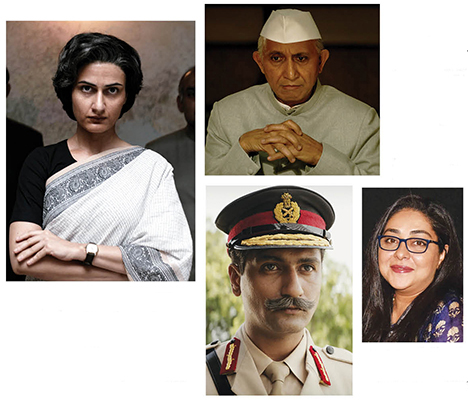
Clockwise from top l: Fatima Sana Shaikh as Indira Gandhi;
Neeraj Kabi as Jawaharlal Nehru; director Meghna Gulzar; Kaushal
In real life Manekshaw was a charismatic figure about whom myths began to accumulate very early on. His valor was unquestioned, and his men idolized him. He was, by all accounts, a great cook and loved gardening. And his wit and bluntness were as legendary as his charm. Early on in the film we see the very dashing Manekshaw earning his spurs at the Military Academy. A romance with the pretty young Silloo Bode (Sanya Malhotra) follows in what is made out to be a case of love at first sight (if the film is to be believed). She soon becomes his wife. His stint in Burma during the Second World War sees him grievously wounded, but he manages to survive. That he was destined for greatness was clear from the accolades he began gathering right after his miraculous recovery. Even as his friend Gen Yahya Khan stayed behind in what became Pakistan, Manekshaw’s loyalty to India was never in doubt. The film also painfully reminds us how the colonial power divided the best gentlemen cadets on the basis of religion. It’s interesting to know that there was a time when Yahya (Mohammed Zeeshan Ayyub) rode pillion with Manekshaw but years later ended up on opposite sides in the conflict in East Pakistan. Manekshaw had sold Yahya his motorcycle but never received any payment for it.
Malhotra, in the role of Manekshaw’s wife, makes only fleeting appearances and contributes little to the film’s plot. Fatima Sana Shaikh, who portrays Indira Gandhi, is miscast and puts in a wooden performance. Neeraj Kabi as Pandit Jawaharlal Nehru and Govind Namdev as Sardar Vallabhbhai Patel do not impress either, leaving Kaushal to do the heavy lifting. (They have limited screen time, in any case.) There is little depth in the narrative, nor can Manekshaw, portrayed as the ultimate sigma male (one who is popular, successful but highly independent and self-reliant), do any wrong. It is essential for a biopic to have a central theme around which the life of the personality is portrayed, given that this genre is constrained by the need for veracity and consequent lack of cinematic licence. A perennial problem for biopics is how to give events the momentum of fiction when the underlying narrative is fact. Lacking such a central theme, the linear narrative of Manekshaw’s life, Sam Bahadur, ends up becoming a patchwork of all his famous quips and incidents, with the screenplay merely a series of snapshots of anecdotes about him.
The film, however, has its moments. Manekshaw’s interactions and shared moments with Gurkha soldiers, his comical exchanges with the grumpy South Indian cook, and the scenes featuring his encounters with Indira Gandhi — all add a unique flavor to the narrative (notwithstanding the limitations of the actress who plays the then prime minister). While the film, overall, has an engaging quality, one gets the impression that several milestones from Manekshaw’s illustrious career have been pieced together, resulting in a final outcome that is slightly underwhelming.
Sam Bahadur endeavors to encapsulate the chequered career of a decorated army officer who epitomized bravery and nationalism, leaving an indelible mark as a larger than life persona. However, the film only partially succeeds in capturing those moments, lacking a cohesive portrayal of this illustrious journey. Sam Bahadur ends up as a hagiographic account that has its moments, but is essentially a missed opportunity to showcase the life of a charismatic soldier amid a period of great upheaval in Indian history.