Despite the misgivings, many Parsis do welcome the non-Parsi spouse
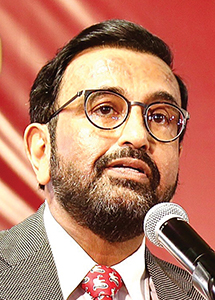
Dr Rajesh Parikh
Ever since I remember I have been surrounded by Parsis. My mother had a few close Parsi friends and my dad, an obstetrician and gynecologist was mentored by Zoroastrian doctors like Nergish Motashaw and Kaikhushroo Masani. Over the years they became family to us and when I met Firuza, my wife, I discovered she was related to Drs Motashaw and Bomsi Wadia who were indeed very kind to both of us. Several of Bombay’s legendary Parsi doctors have been close family friends of ours.
My maternal grandmother, a proud Rajput woman, was widowed within two years of her marriage, a year after the birth of my mother. Her elder brother took full responsibility for them and invited them to stay in his home. His closest friend and partner was the legendary Ardeshir Irani, doyen of Indian cinema. He was by all accounts a colorful character (as was my mother’s maternal uncle)! Irani would be over at their home frequently for lunch or dinner and swore liberally much to the embarrassment of my grandmother.
So, it is not surprising that when my grandmother met Firuza for the first time when we were teenagers, the second question she asked me was whether the sweet, charming, young girl used foul language! The first question, of course, was whether she was a Parsi. Between the two questions was an order that I should marry her. (We barely knew each other then and got married 10 years later after much persuasion from both our families. By then Firuza had found her métier in reproductive medicine and I in neuropsychiatry.) I found it curious that my grandmother ordered me to marry Firuza before enquiring about her linguistic skills. I guess the fact that she was a Parsi absolved her from any incriminating judgment!
Years later, Firuza was requested by one of the directors of the hospital to carry out a medical procedure on a close relative of his which, though perfectly legal, was the ethical equivalent of crossing a yellow traffic light. Firuza sought my advice on how to decline tactfully and we went over several possibilities. When she came back triumphantly after the meeting, I asked her which of our strategies had she deployed. She answered matter-of-factly, "I just told him I can’t do it because I am a Parsi!” That was it. He understood!
I grew up learning to appreciate the gentle elegance and sophistication of my parents’ Parsi friends as well as a fascination with their bonhomie and great sense of humor. In school, two of the most profound influences in my life were my Parsi teachers, Khorshed Bhathena and Banoo Ghadially as were my numerous Parsi friends.
In the course of my relationship with Firuza, I got to know her extended family well and was touched by how kind they all were and accepting of someone from outside their fold. However, every now and then I remembered my place at the periphery of this loving, broad-minded community. For instance, when Firuza was pregnant with our first son, her mother forbade her from entering the fire temple as she was carrying a non-Parsi within her! Similarly, the children and I could not be a part of any jashan that the family held but we were invited to join them for the fabulous food.
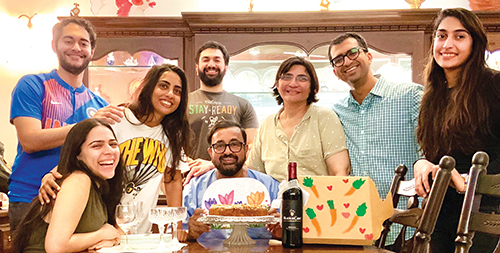
Top (and above, seated center): Dr Rajesh Parikh with Dr Firuza (3rd from r) and family
I have, over the years, got some understanding of the astonishing history and tenets of Zoroastrianism, one of the first religions of the world. I am also interested in the genetics of the community. But above all I have an enduring fascination for the amazing story of this tiny community which has brought so much well-being to India and the world. My fascination with every issue of Parsiana is just one reflection of the overarching interest in Zoroastrianism.
Among the authors and books that have shaped my understanding of Zoroastrianism are Max Muller with his three-volume scholarly work The Zend Avesta and The Gathas of Zarathushtra: Hymns in Praise of Wisdom by Piloo Nanavutty. In Search of Zarathustra: The First Prophet and the ideas that changed the world by Paul Kriwaczek and The Dawn and Twilight of Zoroastrianism by R. C. Zaehner have provided me fascinating details into the early history of Zorastrianism. The Hymns of Zoroaster: A New Translation of the Most Ancient Sacred Texts of Iran by M. L. West, The Chaldaean Oracles of Zoroaster by W. Wynn Westcott and Zoroastrian Rituals in Context edited by Michael Stausberg have helped in my quest to understand this great religion and its philosophy. I look forward with anticipation for further guidance from Zoroastrian scholars in my highly enjoyable journey into the religion of my loved ones.
When Firuza makes trips to Udvada, I accompany her and spend the time that she is in the Atash Behram by myself on the delightful beach. Every now and then there is a strong breeze that blows the sand harshly onto one’s face. I turn gently and rather than blame the wind for the temporary discomfort, thank the divinities for the strong wind that blew the ships of Firuza’s ancestors towards Sanjan bringing with them unimaginable joy and prosperity to the country where they landed. And centuries later to the recipients of the love of their descendants!