Zoroastrianism: Mother of All World Religions by Keki R. Bhote. Published in 2015 by Bhote Press, Wilmette, Illinois; website: www.bhote.us. Pp: xvi + 462. Price: $ 65.
Author, the late Keki Bhote (pictured), was my friend. I will never forget the outstanding lecture he gave in 1993 at the Parliament  of World Religions in Chicago in which he compared Zarathushtra’s teachings to his own (business) field of quality control — the best lecture I heard at that event. Therein lies one of the values of this book. It shows that Bhote found the teachings of Zarathushtra relevant not only to his life, but also to his work as a successful international businessman. This integration of belief and ‘real life’ shines through the entire book.
Perhaps a brief look at Bhote’s public life will illustrate what I mean. He was born and raised in India where he became an engineer; lived and worked in the USA earning an MS in applied physics and engineering sciences from Harvard University, worked for 42 years at Motorola, first in its microwave long-lines communications group, rising to become its senior corporate consultant in quality and productivity in all of its 50 plants worldwide. He authored over 20 books, including World Class Quality (a New York Times bestseller). On retirement he formed his own consulting company, specializing in Six Sigma Quality and productivity improvement, and helped more than 450 companies in 33 countries. In short, he was a success in the international business community. He was a founder and trustee of the Zoroastrian Association of Metropolitan Chicago, devoted many hours in service to Zoroastrians worldwide, and was named by the World Zoroastrian Organisation as one of the 10 top Zoroastrians in the world. Yet his ruling passion was not international acclaim and the many business and governmental awards he was given. It was (next to his family) to make known Zarathushtra’s beautiful teachings, their setting in antiquity and subsequent history, present day Zoroastrians, and his hopes for the future of a community that was dear to him — a comprehensive view of Zoroastrianism — which resulted in this book.
His style of writing is easy to read, incisive, laced with wit, and shows a keen, intelligent mind. If there is one minus, it is that he does not footnote his sources, sometimes states opinions as facts, and does not identify the translator(s) of the Gatha verses, the Ashem Vohu and the Yatha Ahu Vairyo prayers which he gives. But most folks are aware of the differences of opinion that exist in such matters, so that is a small minus.
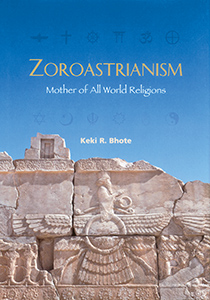 The book is divided into three parts. Part 1 looks at ancestral beginnings — that of the Indo-European tribes, detailing interesting archeological evidence (not generally known) of far flung ancient settlements and weather changes, giving rise to opinions that these tribes may have originated closer to the Arctic Circle, migrating later into various parts of Europe, Iran (where they were the genesis of Zarathushtra’s family), and India — with even some evidence of possible migrations across the Bering Straits, down to South America (where an Arya swastika symbol was found). He then recounts stories of Zarathushtra’s early years in which he went up into the mountains to think about the divine, and existence, his temptations, and his ultimate conclusions — what Bhote calls Zarathushtra’s "mysticism and revelation of God” — pointing out parallels in the experiences of the founders of other religions. He gives his thoughts on how the idea of deities developed amongst the Arya tribes, in which certain abstract "gods” were virtues such as justice, truth, courage, etc, concluding: "As an example, instead of defining a divine personality with an attribute, the attribute itself becomes a God. Instead of saying that ‘God is love,’ the Indo-Iranians would say that ‘Love is a God.’” Most insightful.
Devoted to Zarathushtra’s teachings, one chapter in Part 2 gives the teachings in detail. Bhote recommends that those who want just a summary should skip this and proceed to the next chapter (thus accommodating diverse needs). While I may disagree with the author in certain respects, this book is so full of good things, that it would take more than a book review to do it justice. Suffice it to say that Bhote bends his keen intelligence to tackle many questions about life and living that perplex us, and attempts to work through them using the framework of his understanding of Zarathushtra’s thought.
Part 3 is devoted to what happened to the religion and its beliefs in the centuries after Zarathushtra, with some historical chapters on the Achemenid, Parthian and Sasanian Empires, the oppression under Arab/Muslim rule in Iran, the resulting diaspora to India, the Zoroastrian (Parsi) contributions that shaped India, and concludes with Chapter 12, "Zoroastrianism in the Worldwide Diaspora, and Zarathushtra’s Prescription for a Life in the 21st Century.” This chapter gives a comprehensive overview of Zoroastrians worldwide today with tables of statistics, discussing the various causes of ancient and modern migrations which have resulted in Zoroastrians living in Canada, the USA, Europe, Australia, New Zealand, the Middle East and the Far East. He touches on present day religious and social issues which concern them, the tragedies facing Zoroastrians in Iran but a possible renaissance there, the resurgence of Zoroastrianism in Kurdistan, Tajikistan, Russia, Belarus, Ukraine and South America. The chapter ends with a list of generous people today — Zoroastrians and non-Zoroastrians — who have contributed to the knowledge of the religion in our times.
The Epilogue raises the eternal question — will the religion survive — "A Footnote in History or a Resplendent Renaisance?” Bhote considers the issues which support both a pessimistic and an optimistic answer. He concludes that hope for the future lies in Zarathushtra’s teachings, that if materialism and selfishness ("what’s in it for me?”) continues, the religion will disappear by 2500 AD, but if a passion for these teachings is used to transform our world, Zoroastrianism will never perish but will resonate in the future and lead to happiness.
In the last years of Bhote’s life, and after his death, his wife and children worked on preparing this book for publication — dividing among themselves the tasks of keying in his handwritten manuscript into a computer, doing the layout and design, arranging for a good editor and publisher. In their "Posthumous Note” Bhote’s wife and children are obviously proud of Keki. I think he must be proud of them.