"The ceremony was particularly interesting in that a Parsi place of worship was being opened by a Hindu Prince,” reported The Times of India of May 24, 1905 referring to the inauguration of the newly built fire temple in Bhuj at the hands of His Highness Maharao Shree Khengarji Sawai Bahadur. A day later, Jam-e-Jamshed carried a report from their Kutch-Bhuj correspondent that the place of worship was endowed by the late Khan Bahadur Pestonji Sorabji Bhujwala in memory of his late father Sorabji Dadabhai Bhujwala. This report stated that a contingent of the police force presented a guard of honor and that a band was present. The royal personality was seated near the entrance to the agiary and, as the family of the Khan Bahadur approached him, they showered him with "gold and silver flowers.” The report referred to a shamiana (tent) made of velvet, festooned with flowers and flags.
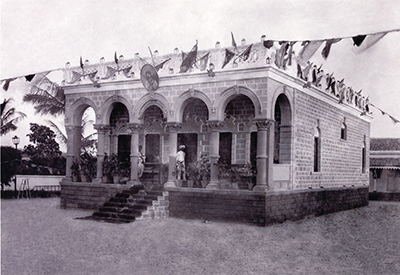
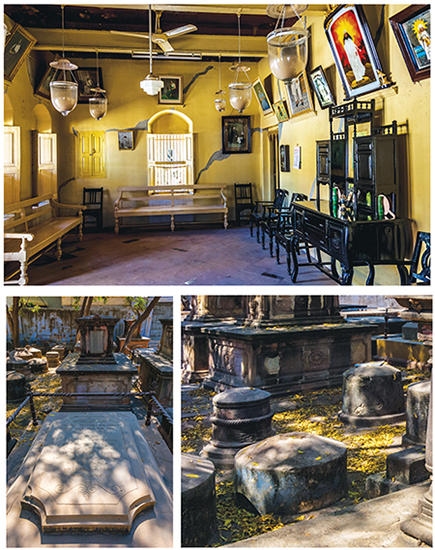
(Top): Bhuj Agiary Photo: Capt Pestonji Bhujwala; (center): interior;
(below, l): graves in aramgah; (below, r): circular graves
Photos: Pallon Daruwala
A century and a decade later, the westernmost agiary trust in India is in need of funds. Shree Kutch Parsi Anjuman Trust Fund looks after the maintenance of the erstwhile place of worship and aramgahs at Bhuj (about 100 graves) and Mandvi (in Kutch, with about 10 graves) which is 45 km away. Some of the graves are unique in that they are circular in design. A great-grandson of the Khan Bahadur, also named Pestonji, visited Parsiana’s office with memorabilia of the place of worship — pictures and press cuttings, including those referred to above. The agiary has been in disuse since the late 1990s due to lack of worshippers and the inability to retain a mobed. A caretaker cleans the premises, "but does not light a diva in the building,” narrates Capt Pestonji Bhujwala who retired as a pilot from Air India many years ago.
"There are no permanent Zoroastrian residents in the town which has a population of about 3,00,000,” he explains, adding that the Parsi population of Bhuj peaked at about 60 families in the early decades of the last century. The Zoroastrian population of Mandvi was only a handful. Many families had at least one member in the service of the Maharao, he said, continuing that a handful of families now remain in nearby towns, referring to Anjar and Gandhidham. Between him and his son Jehan they "spend about one month a year in Bhuj,” in their family home that was built in 1894. Pestonji does not believe the agiary trust falls within the definition of defunct anjumans of the Federation of the Parsi Zoroastrian Anjumans of India (FPZAI) which stipulates a minimum membership of 15 individuals.
Pestonji’s cousin, Roda Boatwala, also a great grand-daughter of the Khan Bahadur, who in her final years looked after the upkeep of the agiary passed away in 2010 (see "Benediction in Bhuj,” Parsiana, July 7, 2005). Paramobeds don’t stay long, complains Bhujwala. Also, being so close to the national border, the newcomers need to be screened for security reasons. He narrates that school children are brought to the building on field trips as part of their cultural studies programs. Bhujwala shows a coffee table book Kutch ni anmol virasat (The precious architectural monuments of Kutch) published by the Gujarat Mineral Development Corporation which features a picture of the place of worship.
The trust is in the process of building a one-storeyed structure in the compound of the agiary from which they can generate revenue by leasing it out for commercial purposes, to augment its small corpus. Funds are needed to maintain the agiary structure as well as the aramgahs. Drawing a map, the captain explains that the proposed building to be built over 2,000 sq ft will be about 70 feet away from the defunct agiary building. The trust envisions an expense of approximately Rs 40 lakhs, of which they have collected Rs 20 lakhs from various Zoroastrian trusts. The plinth of the proposed building is complete, and if they are able to muster up the balance amount, they expect to complete the construction by early next year. Architect Kiran Waghela is providing his services at a very nominal fee and intends to use locally quarried sandstone, similar to that used in the now-disused agiary.
The current board of trustees comprises, besides Bhujwala, Saroosh Dinshaw, Adil Sethna, Maneck Nanavaty and Jehan Bhujwala. The Trust will welcome donations which can be sent by cheque to Shree Kutch Parsi Anjuman Trust Fund. For further information, please contact Capt Pestonji Bhujwala by email on
pervinepbhujwala@gmail.com or telephone: 09870081042.