Ravana Refuses to Die by Rustom Dadachanji. Published in 2019 by Duckbill Books and Publications Private Limited, F2 Oyster Operaa, 35/36 Gangai Street Kalakshetra Colony, Besant Nagar, Madras 600090; email: platypus@duckbill.in; website: www.duckbill.in. Pp: 135. Price: Rs 250.
Rustom Dadachanji (pictured, l) started his career as a stage actor before attending film school where he graduated with a masters in screenwriting and directing. He has worked as script doctor, restaurant manager, copywriter, antique furniture restorer,  film studies teacher and children’s book author. His book Ravana Refuses to Die has been written for "middle readers.” It is a collection of four interlinked stories, with references to mythological characters Ravana and Hanuman from the Ramayana, but focuses more on the adventures of the Babubari Gang: Muru, Jitu, Chippa and Chipkili. Under Dadachanji’s observant eye, the town of Babubari as well as the four protagonists come to life.
Dadachanji describes Babubari with great affection: the overpowering heat, the flies buzzing around an empty glass of masala tea, the half-smoked beedis scattered everywhere, the excitement of the population assembled for the seventh and last night of the Ram Leela, the night when Ravana will burn. The four young characters who appear in the stories are also well delineated. Chippa is full of the tales told to him by his father, the town barber; Murali, the captain, is the courageous one who leads the four into trouble; Jitu is the timid one; and Chipkili, the only girl in the group, holds her own against the overweening male majority.
In the first story, "Ravana Refuses to Die,” Dadachanji brings the scene alive with a detailed description of the gang visiting Ravana in his tent prior to the performance. There is a vivid portrayal of the demon half-dozing with his belly overhanging his frayed VIP underwear, while swatting with his bare palms the flies which have "come to sip the beads of sweat” on his brow and double chin. 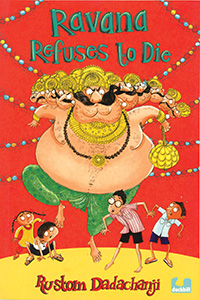 Tensions in the audience rise when, as the title suggests, Ravana, for what he considers to be valid reasons, refuses to die and continues to batter Lord Ram.
In "Hanuman’s Army,” Babubari is invaded by an army of monkeys who create havoc and pandemonium in the town. Tiwari Sir, the seniormost elder of elders of the municipal corporation of Babubari, requisitions monkey costumes from the Ram Leela troupe and advises his "Hanuman Army” to frighten the monkeys but not to harm them. While the gang is involved in this venture, Chipkili suddenly disappears and they have yet another problem on their hands.
In "On Ravana’s Belly,” the gang encounters a tribal boy, Bhollu, who has been deprived of his land by an evil moneylender, the pompous Sethji Ranjeet Jaichand Yadav. Bhollu is in search of water and is convinced there is a stream nearby as, in the myth, Lord Rama shot an arrow into a hillside and created one to extinguish the fire on Hanuman’s tail. The gang helps Bhollu to find the stream and to ensure that it does not fall into Yadav’s hands.
The stories are interesting and Dadachanji manages by and large to hold the interest of the reader. The least successful is "A Vimana Lands in Babubari.” The story is a bit long drawn out and could have been edited to make it more effective. Sometimes Dadachanji indulges in flights of fancy, like the cleaning of the ears of Ravana’s 10 heads, which tend to distract from the main events of the story. He is also fond of playing around with different word fonts and construction of sentences which may be a bit distracting.
The stories have been amusingly illustrated by Priya Kuriyan (pictured, r), an independent animation filmmaker and illustrator based in Delhi, and form a valuable accompaniment to the stories. The book would probably be more suited to the young reader than the middle reader. F. G.