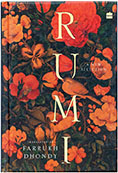
RUMI: A New Selection translated by Farrukh Dhondy. Published in 2025 by Harper Perennial, an imprint of HarperCollins Publishers, 4th floor, Tower A, Building No 10, DLF Cyber City, DLF Phase II, Gurgaon, 122002. Pp: xiii+147. Price: Rs 499.
RUMI: A New Selection is the third collection of Jalal al-Din Muhammad Rumi’s poems which has been translated by Farrukh Dhondy who has recently also published an excellent translation of Hafiz’s work. In addition to these translations, Dhondy has written fiction, short stories, verse, non-fiction, stage and TV plays, films, biographies, his autobiography, Fragments Against My Ruin, and writes a regular column for the Asian Age.
Both Hafiz as well as Rumi are considered as the most famous poets in Persian literature. Rumi began his career as an Islamic jurist, giving sermons in the mosques of Konya and teaching in a madrassa. It was his meeting with Shams-i-Tabrizi on November 15, 1244 that completely changed his life.
Much of Rumi’s verse is devoted to the expression of his relationship with and especially of his love for poet Tabrizi. Rumi’s verse celebrates love, but Dhondy hastens to add that this is not the love of a Romeo for his Juliet nor "an expression of a gay relationship, but rather of a divine bond, a union of individual souls in a universal soul.” Hence, in one poem in moments of joy, Rumi and Tabrizi being one, destroy "the distinctness of body in one soul.” Though they are distinct individuals, they are "still one whole.”
Farrukh Dhondy: union of souls in verse
"In love our separateness is undone
The garden’s beauty is we two as one.”
Their "merging hearts have absorbed” each other. This is the essence of Sufism, "a metaphor for a divine bond, a union of individual souls in a universal soul.”
But when his lover’s heart becomes a hard, impervious "granite rock,” and disregards all his requests, Rumi compares himself to glass which is totally splintered.
"Starved of the Master’s captivating wine
The herd lingers by the roadside like swine.”
The same feeling of love is expressed in the poem, "Shams.” Dhondy uses very vivid and brutal imagery to convey the pain of separation: when the goblet of wine is "shattered” and both the body as well as the mind are "tattered” only Shams, who is referred to as "the Prince,” can bring back "the drowned soul into being.” Only he can bestow life, music, festivities, laughter, wine and light.
Dhondy chooses verses where Rumi associates light with the divine. Rumi eloquently tells the moon not to sleep but to shine brightly
"…and penetrate the deep
Darkness that surrounds all the universe
As crescent or as orb your promise keep.”
In the same poem, he criticizes humans who, when the moon breaks the darkness of the night, turn away from the light: "And thus we mortals turn fortune away!”
The most accessible poems for the lay reader are Dhondy’s poetic translations of Rumi’s parables in the "Masnavi.” They are engaging stories most often with a lesson and a moral. As Dhondy himself confesses, "these, perhaps are the least abstract of Rumi’s methods of instruction.”
However, despite this Dhondy manages to capture the substance of these verses in a subtle and poetic manner. In "The Muslim and the Zarthushti,” Rumi narrates an amusing exchange between two friends. The Muslim wants his friend to convert to Islam. If he does so, he will be saved from hell; he blames his friend’s ego which "persists in disbelief.” The Zarthushti gently replies that if God controls the entire universe he also controls his ego. Nothing happens without His knowledge and consent, in which case it is strange that he continues to be a Zarthushti. He wisely concludes the argument:
"The dictates of free will are His bequests
To humans to believe as they think best.”
In "A Donkey’s Burden,” a donkey, whipped and starved, has the very difficult task of spending the entire day carrying heavy water-skins. A friend of the donkey’s owner, the Master of the Sultan’s Horse, suggested that he would take the donkey into his care and, as the season was slack, and the cruel owner would not have to feed the donkey, he readily agreed. The donkey seeing that the horses "have meals of / luscious hay” and comparing his life which is full of hardship and suffering, he complains to the creator of this injustice. Very soon there is a war and the horses are taken to the battlefield from where they return "with battered limbs and blinded eyes,” crying in pain. It is then that the donkey realized the folly of his complaint to God and when the time came he left the stables and went back
"to carrying the heavy water-skins without a murmur
Knowing that God and Justice have their schemes
And destiny is never what it seems.”
Sometimes the poems deliver their message with humor and lightness which Dhondy manages to convey with his skillful choice of words. A man was sitting on a narrow seat comfortable for a single person when another man joined him, much to his irritation. The latter viciously slapped the former on the neck and before he could retort asked him whether the noise resulting from the slap arose from his palm or the skin of his neck. The man who had been slapped called the latter a fool and an idiot and said he should be locked up as he has nothing better to do than waste other people’s time. So saying he got up and walked away, leaving the bench to the second man. Rumi concludes in a tongue-in-cheek manner:
"What moral for this tale must we infer?
He’d left the bench to the philosopher.”
In the "Aphorisms” Rumi gives advice to his readers in the form of brief couplets. Dhondy mentions that each of these "can be embraced as a personal guide and injunction or as a universally illuminating thought.”
Here, Dhondy’s style becomes spare as required. Rumi compares wisdom and love and concludes that where wisdom leaves you with the feeling you are earthy, love elevates you to a star. In another, he compares the meeting of friends to a "sunny hour;” and concludes that "friendship is as spring rain to the flower.” Once again, in some of the couplets there is the movement from darkness to light. He wonders why men crawl through life like worms clinging to the earth when God has gifted us with wings. He questions why we remain "imprisoned in the dark” when all we have to do is "step into the light, the door’s open wide.”
In his introduction Dhondy mentions a little known fact that though Rumi wrote by and large in Persian, his work is read not just by followers of Islam. The sales of his books in American translation surpass those of William Shakespeare, John Keats, Walt Whitman, T. S. Eliot to name a few. After reading the present volume, so creatively and beautifully rendered in verse, the fact does not astonish us.
FIRDAUS GANDAVIA
Gandavia holds a doctorate in English literature and is a retired chartered accountant. He is a compulsive reader of fiction.