Writing poetry helps Shaista Tayabali
deal with her medical condition
Firdaus Gandavia
Tucked away in an idyllic village of Little Shelford in Cambridge is a charming house surrounded by an ethereal garden (her mother has green fingers), probably the ideal place for Shaista Tayabali (pictured) to write her poems and books. Furniture transported from India fills the rooms and on the walls hang beautiful paintings which have been done by her parents, Dr Chotu and Perveen (née Nadirshaw) Tayabali. Perveen is also an author of fiction and it is little wonder that Shaista has inherited both the qualities of an excellent wordsmith and an artist — she has illustrated her second book of poems Two Women, herself. Whereas her first publication Something Beautiful Travels Far is devoid of pictures, when she saw her nieces and nephew drawing in her book she realized that there should be images in Two Women.

Her achievement is even more to be commended as she suffers from lupus; many of us have heard of it, but have little knowledge about the ravages this ailment can cause. Lupus is the Latin word for "wolf;” the immune system attacks its own tissues and there is no cure for it. She was 18 when it was first diagnosed, and neither she nor her parents (in spite of the fact that her father is a doctor) knew exactly what they were in for. "We just sat there in the clinic and the charming and friendly doctor handed me this diagnosis. It was all very nice; we shook hands and left. I hadn’t a clue and mom and dad discussed some inconsequential domestic matter on the way home.”
One of the epigraphs to her book, Lupus, you odd unnatural thing is from English writer George Orwell. "Writing a book is a horrible, exhausting struggle, like a long bout with one painful illness. One would never undertake such a thing if one were not driven on by some demon whom one can neither resist nor understand.” It was her dream to write this book "ever since I was first diagnosed but I think I lacked a sense of perspective and humor. I did not realize how exhausting it would be or how authors manage to do it. One of the aims was to find out about this ‘thing’ that neither my dad nor I had heard about. There were no books on the subject.” So who did she have in mind when she wrote the book? Not patients suffering from lupus — they have their own stories; possibly, it was to educate the general public about the illness of which we know so little, but generally the doctors. Though she is all praise for the National Health Service and realizes the pressure under which these doctors work, they often do not realize how terrified and vulnerable a patient is when he or she enters the hospital and is looking for a drop of human kindness. The rotation of doctors is constant as expected in the Accident and Emergency department and when they ask the patient to describe their illness "in their own words,” they don’t realize that the patient does not have the necessary vocabulary to do this. This inability and fumbling are especially painful to Shaista as she is an author and a poet and "wants language.” In Something Beautiful Travels Far she has praise for her eye-surgeon Keith who is also "an architect, an engineer, and a local construction worker; his site: the parameters of my cornea, he measures in millimeters.”
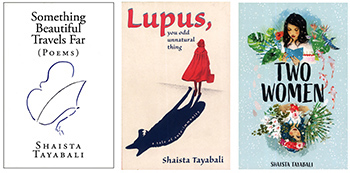
The epigraphs also have a quote from Pulitzer Prize winning American writer Alice Walker, "You don’t always have to be doing something. You can just be, and that’s plenty.” It is true that Shaista can’t "be” the person she wanted to be. She could not achieve her dream of getting into Cambridge, not being able to do things she wanted to do academically. She loved acting and took part in plays when she was younger. She would have liked to have children of her own but is blessed with three nieces and a nephew who she dotes on. She would have loved to do her PhD on Walker who "opened my eyes to feminism and writes about race, gender and spirituality all in one but my eyes are getting worse and I’m daunted by the amount of reading I would have to do.”
But, to come back to Walker, Shaista has always "done something.” She has also fulfilled her mother’s advice and done her best, in fact she has done more than her best. She thinks of herself as "being the size of an aeroplane hugging the ground, too heavy for the skies.” Yet, she soars through the skies on English poet John Keats’ the "viewless wings of Poesy (poetry).” She has published two volumes of poetry which have been well-received and her seminal book on lupus. Why does she refer to it as a "book” and not a "memoir?” "My brother objected to my calling it a memoir as it would be limiting and also people always think it is ridiculous that one should write a memoir, when one is young.” However, she does not quite agree and feels a memoir is an impression, a memory and anyone can write a memoir, even a child could do so about a holiday.
Poetry existed in the family even before she was born. In fact, her dad wrote a poem to his wife every day when they were courting. Shaista started writing poetry when she was a child. "Poetry just spoke to me.” She used to read a lot of English children’s literature writer Roald Dahl and was able to memorize poems and recite them for her school /class assembly. She just could not comprehend how other students could not think in terms of poetry. "You just know who you are when you write, the form takes a certain look on the page, you write in images.” When the family moved to Cambridge from Bombay, alienation was a huge amorphous subject which she could not talk about, but it was poetry which showed her a way out. Even when she was sick she used poetry as a mode of expression. She feels that there is a certain efficiency and economy about it because you don’t have to stretch it out into long paragraphs. It is like painting in language. She loved the odes of Keats when she was younger but her major influences are: American poet Billy Collins, who is famous for his conversational, witty poems full of humor as well as profound observation; Kathleen Raine, a visionary British poet; and American poet Emily Dickinson who is closest to her style of brief poems.
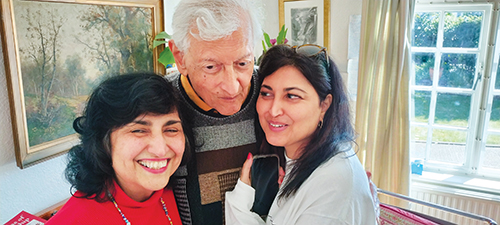
From l: Perveen, Dr Chotu and Shaista Tayabali
Shaista wishes she could write on funny subjects, escapist literature, happy stories, love stories. She fondly remembers her childhood and the doors which were opened to her by English children’s writers Enid Blyton, Richmal Crompton and comic books. Later she found comfort in Walker, Lebanese author Khalil Gibran, English writers Jane Austen and Eva Ibbotson, American novelist Toni Morrison and American humorist David Sedaris. "I love reading humor, as we read so much serious literature during my degree course. One of the books which made a great impact on me was American playwright Arthur Miller’s Broken Glass which I found deeply moving.” She started writing a novel for her MA. She had constructed the framework and the story sitting around the house, haunting her but she felt that she needed to get the lupus book out of the way first. Her proposed novel touches on difficult subjects, the first one being the riots in Bombay, one of the first traumas in her life. She discussed with her friend and poet Clive James whether a writer should be of service and he replied that it was a ridiculous question because a writer just writes.
And where is home? "In England you are always an immigrant. You are always ‘othered’ very easily. Even in Cambridge, a university town, people keep on asking me if I am student here. People believe that being a student is the only reason to be in Cambridge; they never think for a moment that this is your home.” People always ask her where she is from and try to work out where and how she fits in. She is frequently asked how she speaks English so well and she found this particularly irritating when she was working towards a degree in English Literature. When she arrived in England, British kids had no idea where India was. "We have lived here (Cambridge) for 30 years and because of my illness, I have never been ‘home.’ I don’t know where home is, but Bombay is the vessel for my original story and memories.”
And does she feel like a Parsi? "Parsiness is a much stronger side in our family, not only do I feel Parsi but I wanted to become a Zoroastrian. I took it very seriously and I realized that there was a time limit for girls and at nine I went to my parents and both were very touched and moved that I was considering this. I wanted to make sure that the line with my mother continued.” At the beginning of every scholastic year when she was asked what her religion was she would say she was half Parsi and half Muslim. Then she would be asked what her father’s religion was, which made her very cross because a vital part of her was being ignored.
Broken objects occasionally appear in her poems. In the first volume it is a broken flower pot and in the second it is a bowl. "Am I broken? is what I often ask myself. If you are ill and have poor eyesight? But my mother firmly believes that when something is broken bad luck comes to an end. Maybe that is why it is a Jewish custom to break a glass on the wedding day.”
In the poem Shaista, she mentions she is proud of her name.
It is the Rajput name for warriors
It is the Persian name for poets
…….
Sword and pen are ready.
One can only hope that she continues to wield the pen in future.