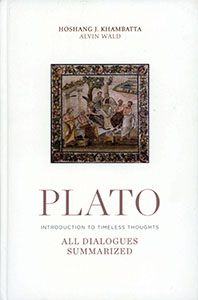
Plato: Introduction to Timeless Thoughts. All Dialogues Summarized by Hoshang J. Khambatta and Alvin Wald. Published in 2016 by Normed Verlag Gm6H, Bad Homburg, Germany. Pp: x + 248. Price: US $ 26.
It is no easy labor to condense the equivalent of 1,500 close printed pages of Plato’s Dialogues into some 250 summarized ones, further shared by essential "overviews” that precede each of the 42 listed compilations (shown in italics). Some, by traditional reckoning, are marked "not authenticated”; others as "not generally accepted.” With this finely produced hardback edition — deceptively slim, but weighty in content — general readers and newcomers to Plato’s timeless philosophy are assured a robustly reliable introduction to the 5th/4th century BCE Athenian’s cultivated thoughts.
Around 380 BCE Plato had founded his Academy in an olive grove just outside Athens. The delightful color illustration of the open air Academy on a mosaic from a Pompeii villa is presented as "Prologue” — a singularly apt choice. And, in truth, it has none of the ponderously Italianate architecture depicted on Raffaello Sanzio’s School of Athens Vatican fresco.
The authors Hoshang Khambatta and Alvin Wald modestly declare that their painstaking work "is directed at the novice, a teenager who has reached an age of understanding or an adult.” They class it as "our interpretation,” which is acceptable by any standards. The précis which heads each Dialogue matches the "interpretation”; it is here that this reviewer senses a certain shortfall — because an insufficiency is felt, given the sizeable eastern contribution towards early Greek (pre-Socratic) thought. This, being beyond the authors’ purpose, remains contentious; it could round off with the Iranian and Indian influences whilst adding to an all-too-brief Preface.
Discounted somewhat are rather overstated claims for Plato as "the greatest thinker for all time” (!) Professor Harold Bailey had pointed to "European investigators, whose mental basis has been saturated for 2,000 years with Hellenistic fantasy.” In a Fragment reportedly by Aristotle, he had traced philosophy’s true beginnings to the Magi and to the Babylonian or Assyrian "Chaldeans.”
Influences on Plato had flowed in from far and wide, from Socrates’ dialectic and earlier natural philosophers, mathematicians and pioneer explorers. The kind of Orphism absorbed by Pythagoras in India had convinced him against the killing of animals and flesh-eating. Plato recorded an Orphic verse in his Cratylus.
By philosophy as a science is meant the systematic explanation of aspects of the universe by rational argumentation. To the pre-Socratics it became evident that the way to truth was its suprasensory perception by the mind. When the Greek city states of Ionia in the eastern Aegean fell to the conqueror Cyrus II they came under Persian administration. Contacts between Greeks and Persians were not confined to military conflicts and naval engagements: they were open to new ideas.
For classicists set in the Graeco-Roman tradition, ideas stemming from the orient were strenuously denied or at best only grudgingly acknowledged, informing "barbarian” seekers after truth that only these western texts really mattered as philosophy; the rest were dismissed as superficial coincidences. Such dismissive observations held until detailed investigations into eastern treatises surfaced to obtain better balanced perspectives.
The Khambatta-Wald volume amply fulfils its stated purpose. It is not distracted by external interjections. The newcomer would, nonetheless, have better appreciated more background before embarking on a closer acquaintance with what are widely recognized as difficult texts from difficult times conveyed in a difficult Socratic mode.
The multiple issues associated with suggestions of "influence,” nevertheless, do bear investigation. It is well known that the Asiatic Greek colonizers in Ionia were prompted in various ways to enquire into the nature of the universe through analyzing its underlying fundamental elements. Thus, Thales (of Phoenician descent), Anaximander and Anaximenes were to form the 6th century BCE "troika” of pre-Socratic "natural philosophers” from Miletus (today’s Milet). None of them were anti-religious: oriental science had emerged from schools that lay in the shadow of the temple, and rationality was sought for diverse religious beliefs.
Thales had expressed his ideas in logical, not mythological, terms. His cosmology was based on the infinite; the fundamental substance being water. For Anaximenes it was aer, ether, which effected exchanges of fire and water.
But it was the Ionian "gloomy philosopher” Heracleitus from Ephesus (Turkish Efes) whose supposedly obscure sayings found their way into Plato’s Dialogues. He had taught that all things are in a state of flux, ever changing through the passage of time, using the argument of it being impossible to step into the same river twice, for its ever-moving, ever-changing waters are forever flowing past the wader.
Of particular note to Parsiana readers interested in tracing the subtle westward progress of Zarathushtra’s philosophy, it must be via the universal primary fire. Heracleitus had been made aware of the metaphysical presence of this abstract Gathic component. The western Asiatic Magi had taught: fire is strengthened through truth; fire distinguishes man’s good and evil deeds; as Mazda’s agent fire distributes appropriate rewards. These functions are all to be found in the Gathas.
For Plato, his encounters with the Magi were in his official capacity of proxenos or consul in Athens to oversee Persian interests. He mentions Zoroaster by name once (Alcibiades) as "son of Horomazes.” He is said to have held learned conversations with these oriental priests. Philip of Opis, who was Plato’s student and then secretary, reports that on the last night of his life he was comforted by a visiting Magus. One misses these sidelights in Khambatta-Wald’s additions to their thumbnail sketch in the book’s Preface whilst repeating that this work deals strictly with Plato’s Dialogues and no other ancient literature. These Dialogues are reported between Socrates (Plato’s mentor) and others; Plato never appears as participant in these interlocutions, although questions arise on the extent of his own teachings amidst the overwhelming Socratean dialectics (Socrates himself wrote nothing!).
A visiting Magus had foretold the death of Socrates whose last hours before his death by state-sanctioned hemlock poisoning has been movingly narrated towards the close of Phaedo. He had been indicted for "impiety” by the self-appointed guardians of justice and morality, among the accusations being "the corruption of the youth” and "the neglect of the gods when the city worships and the practice of religious novelties.” To the last Socrates refused to recant or escape from his month-long imprisonment, comforting his distraught friends and offering a philosophical justification for his acceptance of the capital sentence. And thus passed a wondrous sage who had prayed "Give me what is good”!
Plato was convinced that his death was encompassed by a complot of the Sophists. Both master and student friend had abhorred them as bogus practitioners of philosophy whose actual knowledge and unethical methods were despised.
In their quest for a coherent philosophy several Asiatic Greek thinkers sought out the western Magi from whom they garnered valuable elements of Iranian teachings. They travelled east and south to obtain the wisdom of the ancients in Babylon, Persia, Phoenicia and Egypt.
Among the pre-Socratic travellers was Pythagoras, the bane of school students who grapple with proofs of his 3-4-5 theorem. This ancient philosopher and mathematician was in Egypt when the Persian Cambyses II, its 27th Pharaoh, had him carried off to Iran whence he proceeded eastwards to imbibe the wisdom of the Indian sages who inculcated non-violent principles and prohibition of animal killing. From India he had obtained some elements for his deeply ingrained Orphic religious beliefs and practices. The later Greek historians generally suppressed specific acknowledgement to oriental sciences and philosophical religions just because they had originated in the "barbarian world!”
Nevertheless, Plato himself journeyed to the Levant/Phoenicia (today’s Lebanon and Syria) to enquire into their ancient cultures. In Asia Minor he made contact with the Magi who steered him towards his now famous Theory of Forms. It should be explained that for Plato these were immutable celestial archetypes of all earthly creations. The Forms figure in his Cratylos and Timaeus among other Dialogues. In the Gathas the specific connexion of some Mazdaic entities with their appointed earthly charges is mentioned in passing: Armaiti with earth, Haurvatat with water, and Ameretat with plants, without the rigid links of the six creations and their respective six tutelary forms seen much later in the Pahlavi Bundahishn’s first chapter.
Foremost among the Athenian’s students at the Academy was Aristotle who amicably worked and taught alongside Plato for some 25 years. Taking his terrestrial approach as "ideas” differing from the master’s Forms, he concluded that the archetypes of all material creations existed here on earth. The concept of Mazdaic abstract entities (to become the Aməša Spəntas) being attached to some earthly creations in the Later Avesta is seen from Yasna 16.
In a Parsiana article of March 7, 2016, "Demystifying the School of Athens,” the Vatican fresco identified the two mid-ground central figures deep in discussion over this debate: to the left (as viewed) is a barefoot Plato pointing upwards and gripping his Timaeus; to his left a blue-clad, sandalled Aristotle gesturing earthwards and holding his Ethics. Raffaello had been briefed on the matter in the early 16th century by his friend and patron Pope Julius II: he had included Heracleitus, Pythagoras and, most importantly, the figures of Zarathushtra (with celestial sphere) debating with Claudius Ptolemy (with terrestrial globe). The old dispute had survived over 2,000 years, and now was made public!
This was during the era of the Italian Renaissance when cultural values from the east were welcomed and assimilated. In the mid-15th century there arrived a non-Christian Greek octogenarian to help heal the 400-year rift between the Roman Church and the Greek Orthodox establishment. For this extended review it is firstly noted that he, Gemistos, claimed that Zoroaster was his master; secondly, he had brought with him some invaluable manuscripts, in Greek, of Plato’s Dialogues.
From this innocuous fact arose a two-fold benefit for the Italians: they had very little Greek, which deficiency they promptly set to remedying through concentrated study under the tutelage of some of the Orthodox contingent; secondly, the study of Plato whose philosophy had hitherto been literally a closed book. Schools were set up and, under the patronage of the Medicis, an Academy was founded. Plato had finally conquered the Renaissance West in company with Zoroaster!
For sound reasons this review must conclude with Socrates’ pious invocation "to the gods” (Phaedrus, 279c) : "O dear Pan and all the other gods of this place, grant that I may be beautiful inside. Let all my external possessions be in friendly harmony with what is within. May I consider the wise man rich. As for gold, let me have as much as a moderate man could bear and carry with him... I believe my prayer is enough for me.” To this Phaedrus devoutly entreated, "Make it a prayer for me as well. Friends have everything in common.” A perusal of Zarathushtra’s prayer to Mazda, as wisdom, in Yss. 28.2 and 43.3 offer precious clues to the Athenian’s formulation. Both had philosophically outlined the holistic nature of man for all time.