Neville and Michelle Vazifdar cater pan Asian
cuisine to suit every palate and pocket
Mehroo Kotval
"When they visit high end restaurants in London or Paris I’d like my customers to say they had a better crispy soft shell crab at Jia in Bombay,” says Neville Vazifdar proudly referring to the authenticity and quality of the dish he serves at Jia, The Oriental Kitchen (JOK) operating from Dhanraj Mahal located a few meters away from the historic Gateway of India. The area is replete with dining establishments to suit every pocket so getting the taste right is imperative. "Michelle (his wife) or I taste every dish.” They did this for six months before the official launch of the restaurant on Chinese New Year this January 28. This is the couple’s fourth eatery in Bombay — the others being Royal China (RC), KUAI Kitchen (KK), a fast food outlet at Colaba which they want to expand to shopping malls and other similar places, as it means fast in Mandarin; and one in Bandra, to restart once Brihanmumbai Municipal Corporation gives them awaited permissions.
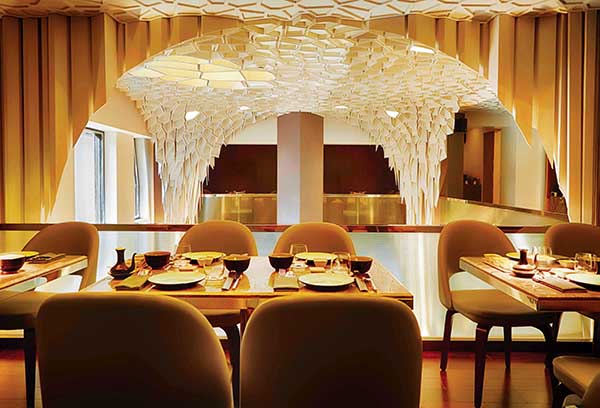
A view of Jia’s interior and logo at entrance
Michelle and Neville Vazifdar
The casual ambience at Jia
Jia means family in Mandarin and JOK caters to family units at both the levels of their restaurant. JOK not only serves Chinese food but has also added some Japanese and Thai dishes. Why not Korean, we ask, as we see the description "The Oriental Kitchen.” The 35-year-old entrepreneur candidly says his expertise does not extend to that national cuisine because "we do not have a strong enough menu. It must be 100% authentic.” Both the Vazifdars are purists and want the traditional taste: "if you say chicken à la Kiev, there must be butter inside — not ham and cheese. There is nothing like ‘this is our version of chicken à la Kiev’… There is only one classic standard version. Wherever I go internationally, I know what to expect when I order a well-known dish.” Their signature dish, Peking duck, at RC compares with any internationally. In fact, RC remains Cantonese by and large.
You guessed right, no fusion at JOK. Neville adds: "Our chefs are trained with us, whether they come from London, Hong Kong or Bombay. We do not put out a recipe just because our chef says he knows how it tastes.” They want the real McCoy. For JOK, Neville is the sole mentor and guide. The entrepreneurs do not want to have 200 items on the menu. "We want the right items for the palate. Being in the business for 14 years with the RC brand in Bombay (see "Choice Cantonese,” Parsiana, August 7, 2013) they have mastered Indian preferences. Both proprietors are passionate about food. They create new dishes especially as they expand their Chinese vegetarian fare. As you sit at your damask covered table, the beverages and the JOK menus are presented. Though vegetarian dishes are all incorporated in the general menu, a separate vegetarian menu is also handed over "as most vegetarians do not like to sift through everything,” Michelle tells us. She also states that they have been complimented on this innovation. There is a take-away menu, as well.
As you pore over the beverage menu, you find wines from most wine producing countries — France to South America, Africa to India. The cocktails and beer lists are also substantial. Mocktails are dismissed in half a page. The JOK menu starts with Dim Sum from Rs 300 to Rs 795 per basket, a large choice of Japanese sushi and sashimi (at an average of Rs 650 for five pieces). The lobster and crab dishes are at Rs 2,350 per dish. The other fish dishes are an average Rs 950. The owner claims that the water buffalo is so tender that no one will ever realize that it is the fatter, larger animal than the holy cow. It’s all in the marinade, we are told. They also have a certificate from the beef supplier in case there is a belligerent customer who creates an issue about the meat served being of the cow. The proprietor informs us that there is no mono sodium glutamate, popularly called ‘MSG’ on the JOK premises. If MSG is present in the sourced sauces he is unable to know but none is put in the dishes prepared by the restaurant.
For Jains who do not eat anything that grows underground, there are options on the menu without onions, potatoes, carrots and other tubular vegetables. Similarly there are gluten free options as well. A take-away menu is distributed but the options are slim. Catering to vegans is easy in Chinese food as the cuisine is not milk reliant. Neville adds that there is no need to introduce faux fish or mock meat as Indian vegetarians do not aspire to replicate that flavor, "it is for religious reasons they do not eat flesh so there is no demand to substitute the taste.”
The couple wants to create a brand catering to different clientele. RC is already known as a traditional, formal, fine dine restaurant. JOK aims at a younger, more casual base and there is the fast food KK. Michelle says quietly that they want each brand to stand on its own feet.
Neville calls Bombay the food capital of India. "Bombay has the best restaurants, the best chefs. Competition is fierce. It’s a buzzing market with constant change. Poona is slow paced… busy, but slow paced.” Neville claims that Poona is somewhat seasonal — both with Indians and foreigners — who come for industrial or educational purposes.” The Poona RC is at Koregaon Park for the past three years. Delhi is operational for seven years now. The Vazifdars believe that Delhi prefers the five-star culture and large restaurants.
Their high end restaurants are priced so that the average expenditure, sans alcohol, is about Rs 1,500 per person. At KK the tariff is much lower at about Rs 500 per person. Painstakingly, the promoter tells us how if fried rice or sushi is served at RC, jasmine rice forms the roll, at JOK it is Thai or Japanese rice and at KK it is basmati. They claim the taste and aroma is immediately realized by the gourmet. The ingredient makes the dish.
The affluent Indian today is well-travelled and wants to eat in India what she has eaten abroad. A fallout of this is the huge excitement truffles have created today, says the restaurateur. "Ten years ago no one had heard of it. It has now upped the ante in dishing out a new product.” In fact, there is a huge demand for every dish having this cousin of the mushroom as an ingredient, we are told.
On asking what the future trends of the food industry will be in India, Neville portends it will be more and more casual dining. Indians want value for money yet they yearn for a feel-good place "that is plush and has an international feel. Indians entertain a lot and Asian food is easier on the pocket as it is shared (not pre-plated) and is closer to Indian cuisine (in taste).”
They definitely have plans to expand but don’t intend taking partners, at least not yet, though their business currently dominates south Bombay. They operate as a limited liability partnership so that one partner has only limited liabilities. In the meantime, the two go in tandem wherever they travel in Bombay. Their staff does not know where they are during the day or where their next destination will be, once they leave. This is partly how they manage their quality control on a daily basis.
The couple’s twin sons Marcus and Luca have just turned three. The little ones miss the usual doting grandparents as both sets live in the UK. Michelle’s parents Michael and Mary Michael are retired in the UK. Phiroze and Sherna Vazifdar run two country home hotels outside of London which seems to have given their son a penchant for his profession. The young Vazifdars claim this profession is for them, they would opt for no other.