Oh! Those Parsis: A to Z of the Parsi way of life by Berjis Desai. Published in 2019 by Zero Degree Publishing, No. 55(7), R Block, 6th Avenue, Anna Nagar, Madras 600040; e-mail: zerodegreepublishing@gmail.com; website: www.zerodegreepublishing.com. Pp: 292. Price: Rs 500.
Berjis Desai’s (pictured) Oh! Those Parsis: A to Z of the Parsi way of life is a selection of the columns he has written for Parsiana over the past three years. Desai literally covers the entire alphabet of the Parsi way of life starting with abuse and ending with 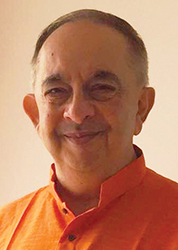 Zoroaster. He paints an endearing picture of the community, warts and all, and the selection has a wide appeal: humorous, nostalgic, sometimes irritated, often concerned but always perceptive and written with warmth, affection, understanding and in a style which is evocative and approachable.
He starts with a characteristic quality of the community: the free and occasionally excessive use of swearing. But the point he makes is that the swear words are more terms of endearment and great affection "devoid of bitterness, rancor or anger.”
Some columns begin on a frivolous note but have a thought-provoking conclusion. Desai agrees that it is a generalization to suggest that Parsi women are superior to their male counterparts in all areas except "the armed forces, judiciary and thoroughbred racing” (ironically, two of the three areas in which Desai is personally involved). But Desai quietly suggests that the "formidable” Parsi grande dame may adversely affect her children: the male child, sympathizing with the father, may be reluctant to marry, and the girl who takes after and is inspired by her mother, may remain a spinster.
In an amusing column, Desai pokes fun at the Parsi "selective” sense of hygiene. Children are not allowed to use a straw to sip a cold drink as a fly may have settled on an exposed part of the same; no pani puri — the bhaiya’s (vendor) nails are dirty and the water is suspect; freshly cut fruit to be avoided as the knife is rusty…the list never ends. At weddings and navjotes, Parsis will wash the paatru (banana leaf) with ice and water, but will happily tuck into the meals never once questioning the provenance of the saas ni machi which may have languished all day in the sun occasionally licked by "canines,” the lagan nu achaar possibly visited by lizards and cockroaches. One of his aunts even mistook flies settled on the lagan nu custard to be a liberal sprinkling of raisins. "Delicious is never dirty,” he concludes. In "Not fair, but lovely,” he is amused with the Parsi obsession with fair skin and with comments like a person being a wonderful human being, "if only he were not so black.”
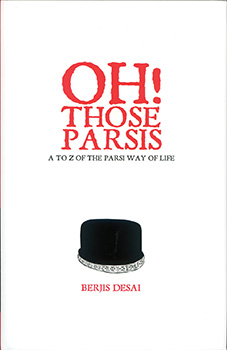 In some of the columns, Desai laments a way of life which is fast disappearing. He reminds us of the dhobi ni chopri (washerman’s book) and the mèla kapraa nu pinjru (dirty clothes cabinet) and weekly heated arguments about the missing clothes or the wrongly delivered garments. Also, he regrets the disappearance of the pheto and the dagli and the general neglect of the traditional sari in favor of the ubiquitous Parsi frocks! He brings to life the time when every family ate Polson butter and bought rich, creamy milk from "a battalion of blue clad bhaiyas” employed by Parsi Dairy Farm. He mourns the disappearance of Dippy’s pumpkin murabba (sweet preserve), jams, ketchup, and fruit crushes, the spicy pickles of the Kohlas of Navsari, and OK Wafers which have long since vanished and are now merely a "pleasant memory.” Few Parsis today hang portraits of the Prophet and the Parsi calendar in their living room. He reminisces about Parsi weddings where the entire moholla (locality) would take part in the celebrations which lasted over six days, "portly Goody Seervai” with his accordion or "feisty Nelly Battiwala” or the naankhatai (local) bands of the towns of Gujarat. He suggests that couples interested in destination weddings should choose Udvada to revive "these rich cultural traditions.”
Desai is critical about the unfair treatment meted out to Parsi women who have married outside the community and who are not, along with their children, strictly speaking allowed to enter the fire temple. Equality of the sexes is a fundamental right under the Constitution of India. "Culture and way of life is imbibed from the mother, and not so much from the father.” He describes an amusing incident, when the child of a Parsi father and a non-Parsi mother horrified the priests and the devotees in the Iranshah by shouting "Ganpati Bapa Moriya,” to prove this.
Several of the suggestions he offers seem to be sensible and very workable. If solar panels are used to disintegrate a corpse, is it not feasible to examine the possibility of installing a solar powered crematorium? "The sun will remain as the energy which disposes, exactly as the scriptures dictate.” He also writes about the focus the community devotes on the youth and on procreation quite forgetting the old and the abandoned who languish in dismal old age homes or in charity wings of hospitals. Desai etches a dismal picture of these individuals, suffering from Alzheimer’s or Parkinson’s living the last few years of their lives in "gnawing loneliness.” He suggests that the community should "invest in its youth and ensconce its old.”
Since most of the Parsi words which require clarification are explained in the text itself, it seems a bit redundant and repetitive to add a glossary. It would be helpful to place a chapter in time and memory if the date on which it was originally published were mentioned. Strangely enough in several places whenever the letters "ses” follow each other they appear in italics, "glasses” and sometimes with the letters "boi” as in "boisterous.” These, however are inconsequential and may be rectified in future editions of which, I am sure, there will be many.
It would be helpful if some of the cartoons and illustrations were enlarged. It is not possible to read the text on the illustration of the sign outside Seth Cowasji Behramji Banaji Aatash Behram forbidding entrance to Parsi ladies who are married to non-Parsis.
In his Introduction, Desai mentions that the purpose of this book is "showcasing this tiny, harmless and eccentric community.” Judging from the range and the variety of the articles, Desai fulfils this aim which he does with kindness, good nature and without any acrimony or bitterness even when dealing with the Bombay Parsi Punchayet. Jurist Darius Khambata, who wrote the Foreword, compares the collection to "a wonderful quilt of history” — scholarly, nostalgic and "a foreboding for what perhaps looms ahead of us in the future.”
The articles are a lesson to all writers whether of fiction or non-fiction especially at a time when language is used carelessly and books are not carefully proof read. Khambata rightly mentions that the book is a kind of "time capsule” not just for Parsis but for the world at large.
FIRDAUS GANDAVIA
Gandavia holds a doctorate in English literature and is a retired chartered accountant. He is a compulsive reader of fiction.