Chinese made Hindu idols sell for far less than those made in India
Farok J. Contractor
Wander the dusty bazaars of India’s 645,467 towns and villages, and you will soon light upon a tiny shop selling gaily colored polyester resin Hindu gods. The smaller ones, just a few inches high, retail for Rs 280 (USD 4) or less, while larger sizes may be offered at Rs 1,050 (USD 15) or more. The shopkeepers usually do not know where the images originated, or if they do know, they will not tell.
Indians are religiously observant. Most Indian Hindu households will have a prayer area, or at least a niche in a wall where a daily pooja, or prayer, is offered. Pooja may be accompanied by an oil lamp, prasad (sanctified food), and kumkum (red paste made with saffron and turmeric). To many Hindus, the idol is not the deity but only its representation, a means of connecting to the divine.
Incomes, as well as a spirit of Hindu nationalism, are increasing in India, which explains the growing demand for household images. For the very poor (around 500 million Indians earning less than Rs 200 per day), idols made locally from brass or clay were previously unaffordable. However, over the past 15 years, mass-produced idols of Hindu deities imported from China — retail prices starting at Rs 200 — may well number in the low millions.
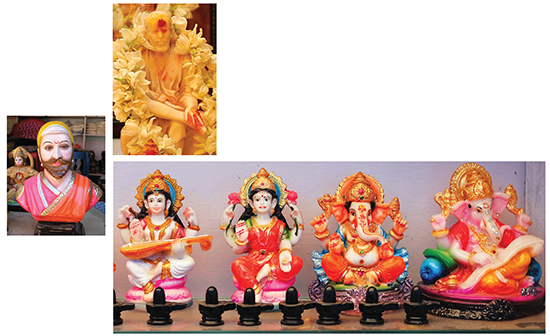
Clockwise from above: Chinese made statuettes of Shivaji, Sai Baba and Hindu deities
China-India trade imbalance
In 2016, Indian merchandise exports to the world were only $264 billion, while China’s were $2,098 billion.
Sellers squat on the sidewalk displaying China-made quartz watches. Hard bargaining can reduce the price to as low as Rs 90. (I once wore such a watch for 18 months, and it kept perfect time. But once the battery was exhausted, I threw it away since the cost of a battery exceeded the cost of the watch.) Perfectly functional locks made in China carry an asking price of Rs 25 for the smallest sizes, to Rs 400 for a large, multi-lever version carrying the famous renowned Indian brand name which specializes in such hardware. Many contain Indian raw materials such as iron ore shipped to China, only to return in the form of finished goods at amazingly low prices. India’s total import of locks from China could exceed 75 million annually.
Scale
Most manufacturing in China is done on a large scale. Where an Indian producer may have three plastic injection-molding machines, the Chinese counterpart may have 70 to serve its large domestic market and clients all over the world. A larger scale means that the same overheads and fixed costs can be spread over more units of production, thereby reducing the cost per unit produced.
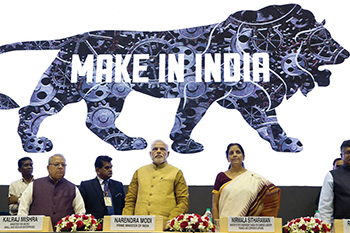
Prime Minister Narendra Modi (4th from l) with colleagues launching the Make in India initiative
The Indian market is not as large as China’s (and lacks China’s export reach). But it is still huge, with 1.08 billion Hindus (80.5% of India’s population), most of whom can afford a Rs 200 statuette. So what has prevented Indian manufacturers from reaching the scale of their Chinese counterparts?
The Indian worker can be as motivated and hardworking as any in the world, given the right incentives. However, a McKinsey report notes that "…workers in India’s manufacturing sector are almost four and five times less productive, on average, than their counterparts in Thailand and China, respectively.” Chinese workers may be paid four times the Indian hourly wage. But if their output per worker is more than five times greater compared with workers in India, then China has a competitive advantage.
Why is Indian labor unproductive? Most of the explanation lies with management, not labor. The McKinsey report details how Indian management lags in the degree of automated equipment installed, capacity utilization, execution and processing within portions of the supply chain that precede and follow production, and quality control.
But that then raises the next question: What prevents Indian management from pursuing better methods, installing more automated equipment and achieving larger scale?
Labor laws in India
My friend in Bombay owns a factory that produces electronic components. He is familiar with the latest technologies in his field. Given that the demand for electronics is growing at more than 10% annually, his success potential seems unlimited. But his company’s growth is near zero (on an inflation-adjusted basis). Successful as he is, he has no further ambitions for expansion beyond the 99 or so workers in each of his plants.
Increasing the size of an Indian company beyond 100 employees can cause considerable difficulties for management. Government approval is needed under the Industrial Disputes Act of 1947 to lay off any employee, even if demand drops. Firms that have gone bankrupt and shut their doors have been forced to pay monthly wages for years following closure.
Transparency International’s "Corruption Perceptions Index 2016” places both India and China at rank 79 (out of 176 countries). But despite the apparent tie, there is a difference. With much larger amounts at stake, corruption in China occurs at a higher level, and less frequently, having comparatively little impact on ordinary day-to-day operations. By contrast, bribery in India is petty, pervasive and frequent, impinging on everyday actions. Ultimately, India’s corruption is more psychologically and economically debilitating than China’s.
But my friend is content with the level of success he has achieved and has no desire to expand. His Chinese rivals’ output is 100 or even 1,000 times larger in giant factories employing thousands of workers each. For example, Foxconn’s Longhua factory in Shenzhen employs more than 3,00,000 workers.
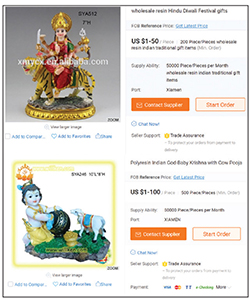
Advertisements for online sales of Chinese made idols
Transport costs
Surprising to some, the transportation costs from Canton to Bombay (7,367 km by sea) can be roughly compared to truck freight from Delhi to Bombay (1,416 km by road), even though the international distance is five times greater.
Assuming 25,000 Hindu idols per container, and ocean freight costs averaging Rs 71,000 per container from Canton to Bombay, the transport cost per statuette is less than Rs 3. By contrast, assuming for the same cargo that two nine-tonne capacity trucks are needed between Delhi and Bombay at a total cost of Rs. 60,000, the cost per idol works out to Rs 2.50.
True, the time in transit from Guangzhou is between 15 and 21 days, whereas the truck journey from Delhi to Bombay takes between seven and 10 days. But the point is simply that transport costs from China to India are comparable or lower than transport within India, and the delivery time difference is only around one week or so.
Electricity
Nominally speaking, electricity costs for industry are comparable in China and India at approximately Rs 5.50 per kw hour. But there is a big difference. A continuous supply of power is ensured for Chinese businesses, whereas India still suffers from chronic blackouts and brownouts because demand outstrips supply. In some cases, factories have their power cut off for a few hours every day. Even worse, the interruption may not be announced in advance, causing havoc with production schedules and deliveries. Incidentally, more than 300 million Indians live in households with no electricity connection whatsoever.
Land
Despite comparable-sized populations in India (1.32 billion) and China (1.38 billion), India has less than one-third the land (2.97 vs 9.4 mn sq km). But the real constraint on starting a new business in India is its multi-ethnic, democratic, and compassionate traditions, which make it legally difficult to acquire land because of an arduous, protracted process. By contrast, a government fiat in China is sufficient to immediately displace thousands, if needed. Delays and bureaucracy, as much as cost, constitute the impediments to expansion in India.
International marketing savvy
Many of the 50-odd companies in China that produce Hindu idols attend trade fairs not only in India, but also in Frankfurt and Las Vegas. Besides Hindu deities, they produce Christian and Buddhist figures, fake animal heads and household knickknacks. In Chinese value chains, a shared culture of international marketing savvy extends to even the smaller enterprises.
In the last decade, medium-sized enterprises in China have been greatly aided by websites such as Alibaba.com, which have an international reach. A related internet search for Indian producers does reveal some who make larger wooden, alabaster or plaster statues, but priced in the Rs 2,000 to Rs 7,000 range. Some Indian sellers at Indiamart.com sell figurines at below Rs 1,400, and even though they are made in China, that fact is not mentioned.
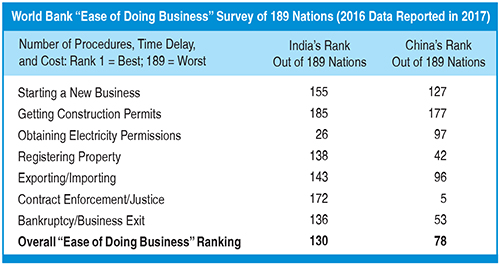
Conclusions
It must be embarrassing for Prime Minister Narendra Modi — one of whose first steps on taking office was to launch the "Make in India” campaign in September 2014 — to realize that thousands of images of Hindu deities (possibly totaling over a million in 17 years of imports) originated in Chinese factories. In the last five years, the trade imbalance with China has worsened with Chinese exports to India more than four times India’s exports to China. The sidewalks and shops of India are awash with amazingly cheap (by Western standards), reasonably well made consumer goods ranging from toys, locks, electronics, light bulbs, and socks to Rs 2,100 smart phones, to name just a few examples.
With labor rates in India unmistakably lower than in China, and a surplus population (with college graduates in some instances working as taxi drivers and security guards), India should logically be taking on China’s mantle as the "factory to the world.” India has already shown how it can excel, as in information technology and computer services, because that sector freed itself from the baggage of the past and flew under the radar of bureaucratic interference so as to avoid the bottlenecks to business expansion.
China is considerably ahead of India in terms of an efficiently functioning economy for three salient reasons:
Firstly, China’s liberalization began much earlier. Only two years after Mao Zedong died in 1976, his successor, Deng Xiaoping, began to dismantle the apparatus of state control. In India, it was not until 1991 that a balance-of-payment crisis forced the Narasimha Rao government to unshackle Indian business.
Secondly, the Chinese leadership under Mao had some heinous faults. But one foundational policy they instituted immediately in 1949 was to insist on full literacy for both males and females. By contrast, in India, a democracy, politicians saw no immediate payback from investing in basic education, which was severely underfunded and remains neglected. India’s literacy rates — even today — are barely above 77% for males and possibly below 50% for females (only 23% of whom participate in the workforce). Literacy does not merely confer the ability to read and write. It changes people’s entire worldview, making them efficient workers and functioning members of a modern economy.
And thirdly, as noted, India is a democracy. I would not have it any other way. And I cannot imagine the country being able to cohere under any other system, given its diversity and multiplicity of religions and traditions. But democracy is a messy, slow process, and it sometimes delays needed reforms. India has 22 official languages, 3,000 dialects, and thousands of gods. By contrast, large as it is, China is one of the most homogeneous nations on the planet, with 92% of its population being Han, with one language, one culture, and one powerful government.
India’s leaders are beginning to behold how modern economies function and are taking steps to shed the elements of its past that have inhibited economic growth. After a long night of colonial domination, and decades of socialist somnolence, the India giant is beginning to stir.
Reprinted with permission from Rutgers Business Review.
 Dr Farok J. Contractor is Professor in the Management and Global Business department at Rutgers Business School. He is a graduate of the Wharton School, University of Pennsylvania, where he received his PhD (Managerial Science and Applied Economics) and MBA, and the University of Michigan, where he received an MS in Industrial Engineering. He has written over 75 scholarly papers and books and is rated by several surveys as among the top-ranked contributors of scholarly papers to the field. He was elected a permanent Fellow of the Academy of International Business in 1995.