Going: Stories of Kinship by Keki N. Daruwalla. Published in 2022 by Speaking Tiger Books LLP, 125A, Ground Floor, Shahpur Jat, near Asiad Village, New Delhi 110049. Pp: 130. Price: Rs 499.
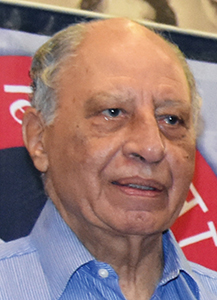
Keki Daruwalla’s (pictured) new collection of short stories, Going, has been sub-titled Stories of Kinship. A common theme of family relationships as well as the motif of "departure” or "going” characterize these short stories. But does anyone really "leave” home? Daruwalla does not think so; he uses for his epigraph some lines from Maya Angelou’s Letter to My Daughter: "I believe that one can never leave home. I believe that one carries the shadows, the dreams, the fears and the dragons of home under one’s skin.”
 The story "The Brahmaputra Trilogy,” as the title suggests, is divided into three sections. Daruwalla builds up suspense in a very skillful and effective manner. We know nothing about the two men, Barua and Bhowmick, who are waiting for a ferry boat to dock. We only learn their names later on. Once again, we are unaware of why they follow Vikram, a passenger who disembarks. Daruwalla raises one’s suspicions as Vikram has covered his face with a muffler; though he is fair-skinned and looks like an Anglo-Indian, he fluently speaks the dialect of the place like a "rickshaw-puller or coolie.” Daruwalla later discloses that their destination is Cuthbert Tea Estate. They are searching for a "real gora” and Vikram, who has "left” the town 10 years ago, wants to take revenge on the white manager and attack the manager’s house by throwing a bomb. Why after "going” away from his home has Vikram returned?
In "Bird Island,” Sudhakar is visiting his school friend, the nawab of Shamasabad, for a hunting trip. He has no interest in the hunt and is quite depressed because it is 10 years since his son has "gone” away from his home. The son has always been a recluse staying away from his family and friends and locking himself in his room. His mother continues to hang on to the hope that he is alive. Sudhakar and the nawab’s destination is Bird Island which is their hunting ground. Daruwalla describes the location in evocative and poetic terms. There were so many birds it seemed "as if a bird god had summoned the entire waterfowl kingdom to the skies.” On this island they meet a bearded man, seemingly poor. They question the man, as to who he is and why he is living on the bird island. Why is he reluctant to divulge his name and why is there a spark in his eyes as the story ends?
There is a similar situation in "The Long Night of the Bhikshu” where, to the displeasure of his family and especially his mother, a man has "left home” and converted from Hinduism to Buddhism late in life. This situation is exacerbated further when he decides to become a bhikshu (monk). The bhikshu lives a nomadic life moving from place to place. Daruwalla stresses his loneliness and alienation when, at the beginning of the story, the only person the bhikshu seems to communicate with and talk to is a scarecrow. But does he ever really leave home? His thoughts constantly return to his mother and eventually, after all his wanderings, he comes back to the place from where he had started.
 In "Daughter,” Ardeshir is obsessed with closing each window of his house. Even when his servant, Shyam Singh, has secured all the windows he would start "the ritual again, each window put through scrutiny.” He is worried that "out in the night the biggest thieves, crooks, kidnappers, rapists could be prowling around sticking their knives into people…” But all is not well within the family. The first sign that something is wrong is when he notices that his wife, Firoza, who is very particular about her appearance, has not painted her toe nails, which is a sure sign of her suffering from stress. Arnavaz, their daughter, has gone out and the mother is convinced that she is going to meet Anwar. Anwar has all the qualities a parent would look for in a son-in-law: he has a good job with a multinational bank, he is fair and good looking, speaks with warmth in "a low, modulated voice,” is well read and intelligent and can speak confidently and knowledgeably on many subjects. The only negative is that he is not a Parsi but a Pathan. Is Ardeshir obsessed with security because he is worried that his daughter will elope with Anwar if he leaves a door or window ajar? Ardeshir has always been very secular and broad-minded when it comes to religious matters. He has often supported the Muslims in an argument. However, when his own home is threatened, he corners Arnavaz and gives her a long lecture in gory detail of "what happened to the people of Iran when they fell to the sword and Islam.” He hopes that this will have a salutary effect on her. But does he succeed?
Departure takes on another meaning in "Going,” where a granddaughter, estranged from her mother, goes to visit her grandmother who is very old and frail. Daruwalla paints a poetically striking and vivid portrait of old age with "the bone working its way out of the flesh and skin. Time seemed to have burrowed into her cheeks and turned them hollow…” The old lady’s temperature rises to 102° and she has trouble with her breathing. She seems to be at the end of her life.
The stories are extremely moving. With his keen eye, Daruwalla narrates stories of rifts between parents and children, stories of "kinship” and loneliness. One rarely finds a person who can write poems, short stories, novels and plays and do all of them with such great dexterity and sympathy. F. G.