Astad Deboo — An Icon of Contemporary Indian Dance by Ketu H. Katrak. Published in 2024 by Seagull Books, 36C, Shyama Prasad Mukherjee Road, Calcutta 700025; email:info@seagullbooks.org. website: www.seagullbooks.org. Pp: xxv + 201. Price: Rs 999.
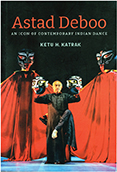
The world has seen dancers renowned for their grace or agility, strength or mastery, but dancers who push the envelope to create something new are astoundingly rare: one such was Astad Deboo (1947-2020), who lived up to his name "Astad.”
The biography, Astad Deboo — An Icon of Contemporary Indian Dance, sheds light on the life and pioneering work of this gifted dancer. Structured into four parts, the book explores his metamorphosis from an artist rooted in Indian classical dance to a contemporary dancer incorporating the best from all over the world.
In "Enter Astad Deboo” author Ketu Katrak describes Deboo’s middle class upbringing in a Parsi household. Although Deboo was born in Navsari, his father’s job with Tata Steel took him to Jamshedpur at the age of five. The encouragement that Rhoda and Adarbad Deboo gave to their male child to learn Kathak in the 1950s was unusual. After his matriculation at Loyola School, he graduated in Commerce from R. A. Podar College in Bombay, though dance remained his first love. On the personal front, the author talks about Astad’s legion of friends, right from his school days, with whom he maintained close relationships throughout his life. Like most Parsis, Astad loved good food and cooking. Coming out as a gay man in the India of the 1970s was largely unacceptable, but he was open about his sexual orientation within his closed circle.
A performance by the Murray Louis American Dance Company during his college days drew Astad’s attention to the physical prowess of the human form. His yearning to learn about different dance forms led him to hitch-hike across Europe in 1969. Japan and South Korea followed. Not only did he acquire contrasting dance styles along the way but he also developed sensitivity to various musical instruments. In 1972, he returned to India and became a student of Kathakali. He was able to fuse elements from Kathak "with its intricate footwork, chakkars (whirls) and natural facial expressions to convey narratives and emotions.” In 1974, his quest for dance took him to the USA where he studied the Jose Limon technique of modern dance as well as Afro jazz dance moves. South America, with its sensual dance moves, was next on Astad’s itinerary. These encounters helped him to craft his unique dance style that was better appreciated on the world stage than in India at the time.
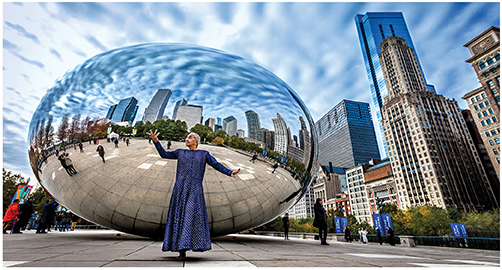
Dancer Astad Deboo performing in his signature style in Chicago
Top, from l: Adarbad, Rhoda and Astad Deboo;
above: Astad with Queen Elizabeth II
In "Milestones in a Dancer’s Life” Katrak takes us through Deboo’s experimental journey starting with his first solo performance, Space Odyssey, in 1978-79. The author highlights three innovations that came about in the dancer’s work. "First, he pushed the boundaries of representation into what we would describe today as performance art, a form in which an artist challenges the audience with in-your-face depictions that can take spectators to the edge of discomfort, even shock… A second innovation in Astad’s work of the 1980s was that he used speech and drama in playing different characters as in Sunil Shanbag’s play, Mangalore Street. Third, Astad and Ratan Batliboi worked closely on what Shanbag described as design-driven choreographies in Basics, Search and Chrysalis, for which Ratan designed huge props.”
As far as costumes go, Deboo stuck to leotards and unitards initially but his exploration of Kathak led him to experiment with an angarkha — a long flowing robe similar to the garment worn by Mughal emperors — which heightened the effect of his signature spinning movement. Gradually his style became "minimalist, meditative and meaningfully slow.” By 1984, his repertoire had reached 50 cities across five continents, yet he longed for recognition within India. It was only in 2007 that the government of India conferred upon him the fourth-highest ranking civilian award, the Padma Shri.
In "Pioneering Choreography with Marginalized Communities” Katrak introduces us to Astad’s work with the deaf, street children from the Salaam Balak Trust and Manipuri dancers. True to the Zoroastrian spirit of giving, he choreographed shows with these distinct groups for 16 years, even devising a new way of communicating with the deaf dancers. These endeavors culminated in the establishing of the Astad Deboo Dance Foundation in 2002 to provide financial support to marginalized dancers, which was a boon during the pandemic.
Ketu Katrak: offers insights
In "Collaborations with Artists in India and Beyond” Katrak refers to Astad’s engagement with global dancers and musicians. In 2015, he had an opportunity to work with South Korean performers in a show called Hamlet-Avatar. The same year he worked with Yukio Tsuji, a Japanese flautist, percussionist and multi-instrumentalist.
Katrak, professor emerita of drama at the University of California, Irvine, draws a comprehensive portrait of her childhood friend Astad Deboo, the man and the dancer. Not only has Katrak researched the vast body of articles written about Astad but she conducted interviews with the significant people in his life for this study. Through black-and-white as well as color photographs, we get to meet the Deboo family and see his famous dance stances. The book is insightful as Katrak has evidenced the dancer’s evolution through his own words and the words of people he worked closely with. While it is meticulous in listing the dancer’s achievements, the book reads more like an academic research paper; perhaps a more creative approach would have connected the reader more intimately to the artist and his evolving persona.
It has been edifying to read about Astad, whose birth in 1947 makes him one of "midnight’s children.” His progress through endless struggle, improvisation and feats of endurance, mirrors the progress of our fledgling nation, India.
ZARIN VIRJI
Virji is an educator and a writer who dabbles in poetry, short stories and fiction for middle grade readers. Her reading favorites are detective stories and crime thrillers.