Mindfulness, biases, financial literacy and Artificial Intelligence
impact business opportunities
Text: Parinaz M. Gandhi Photos: Jasmine D. Driver
"Receive inspiration, form intention, take action, experience growth,” advised Danny Khursigara as his mantra to tread the "Road to Success.” He was the first of the five speakers from Hong Kong, UK, USA and Canada who offered varied perspectives in the course of the second day of the World Zarathushti Chamber of Commerce (WZCC) global meet organized by the Central Florida Chapter at Marriott’s Residence Inn in Orlando on May 2, 2019. Khursigara, Dr Zubin Sethna, Chuchi Arevalo, Dr Mahzarin Banaji and Afreed Mistry referred to the psychological, sociological and technological factors that could impact entrepreneurship. After over five hours of intellectual stimuli through talks, the WZCC registrants got an opportunity to unwind at the evening entertainment program when local talent surfaced.
Miracle of mindfulness
The key characteristics of "super successful and happy people” as enumerated by Khursigara, co-author of Road to Success, are clarity about their life purpose and identity; powerful success habits and discipline; taking 100% responsibility for quality of their life and results. The power lies in one’s response. "Quit blaming, complaining and making excuses,” he urged. If you feel hurt by someone’s criticism, it is because you realize there may be truth in that accusation. "Focus on what you want; not what you don’t want,” he recommended.
A person’s choices, according to him, are governed by "eight compelling forces:” four of which satiate the needs of ego; two, the needs of fulfillment; and two, overcome fears. Included in the needs of ego are: certainty (health, family, salary); uncertainty (surprise element to ensure life is not boring); significance and power (name and designation); unconditional love and connection. Need for growth and need for contribution result in fulfillment. Fear of not being good enough or healthy are the two other factors. The two dominant factors in an individual determine the choice of actions. "The quality of your life is in direct proportion to the amount of uncertainty you can comfortably live with.”
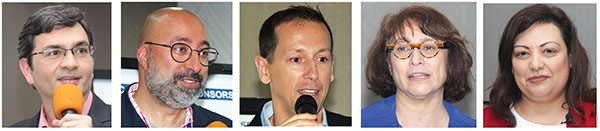
Below (from l): Danny Khursigara, Dr Zubin Sethna, Chuchi Arevalo, Dr Mahzarin Banaji, Afreed Mistry
He considered fear an acronym for Fantasized Experience Appearing Real. While fear is "imagination directed towards the worst outcome, faith is imagination directed to a higher outcome.” Fear and the accompanying stress can impede performance whilst its absence can lead to expanded creativity and increased motivation resulting in fruitful actions. For those who fear rejection, he advised them to say "next” and move on, reminding them that Chicken Soup for the Soul was rejected 144 times by publishers before it became a bestseller. Barriers to success are guilt, resentment or anger, shame, and fear or stress. He explained stress as toxic thoughts you have chosen to repeat over and over again until it is considered a belief. To those who hold on to pain, he advised, "don’t suppress or depress, but express.”
One’s net worth is determined by one’s network. "You are the average of five people you spend your time with. While there are some people who make you feel good, there may be others whom you would prefer ‘ké kaaré chaali jaay (when will they depart).’” Having recently started Make a Change foundation in Hong Kong, he reminded the audience of the prescribed "four hugs a day for survival, eight hugs for maintenance and 12 hugs for growth/happiness.”
When individuals and organizations focus on strengths instead of being absorbed by competition, the outcome is positive. "Comparison is the thief of joy.” Visualize a positive outcome for "what your mind can conceive, your body will achieve.” Successful people are able to "make their vocation a vacation.”
Equally important, he felt, was the need "to do something for a higher purpose… positively impact others.” After 19 years of working as chief operating officer and chief financial officer for Fortune 500 global banking institutions in Japan, China, the Philippines, Taiwan and Hong Kong, Khursigara is devoting himself to executive and life coaching and business transformation of chief executive officers, entrepreneurs, spiritual practitioners and international heads through FreedomOne International founded by him. He is also author of Inside/Out 8 success Keys to Help Millennials Thrive.
A firm believer in the "miracle of mindfulness” he explained, "Mindfulness or awareness brings you in the present moment… instead of being fixated on past losses or trauma, or being anxious and worrying about the future. Mindfulness opens the doorway to creativity, ideas and inspiration that would never find their way through a cluttered mind.” He urged the audience to see the good in every situation reminding them, "Turn your expectations into appreciation and your whole life will change… Inject contagious optimism… We make habits and then our habits make us.” The brain has place for either gratitude and love, or fear and stress.
The science of good and bad
Clockwise from above left: Farida Irani (standing, ext r) with fellow dancers;
Perseus and Sarosh Mistry; Mani Rao; Aileen and Viraf Vaghaiwalla; Dr Daryush Mehta; Roomy Irani
"Human beings are not inherently good or bad but situations can make them so,” stated Banaji, chair of the Department of Psychology at Harvard University and professor of social ethics in her participatory session titled "An Emerging Science of Good and Bad” to reveal mental blind spots that impact our decision making. The science of good and bad, the concepts by philosophers and the domain of morality have considerable overlap. Studying the disparities between values and action, she has explored its impact on individual responsibility and fair treatment in democratic societies. She is co-author of Blindspot: Hidden Biases of Good People.
She alluded to common biases that influence human behavior. Similarity and familiarity are important to each of us. The old-fashioned ways of recruiting made one hire those with whom they felt comfortable. Venture capitalists tend to believe those with lower pitched voices. Dropping an accent after the age of 13 or 14 years is not easy, she mentioned.
She further cited "the thumbprint of culture on one’s brain” or "accumulation of cultural learning” where among job applicants a white man is favored, or when voting, 70% are inclined to support a candidate with wide eyes, or when one is referring to a surgeon, the general assumption is that the surgeon is a male. "Are we changing? Getting better?” she wondered.
To illustrate gender bias she cited the instance of knee complaints among patients. A ratio of four males versus one female was referred to an orthopedic surgeon, the rationale being a male must be a breadwinner and cannot afford to skip work because of a knee ailment. Further, an orthopedic surgeon will recommend an operation for 11 males as versus one female, the reason once again being a male is expected to resume his active lifestyle while a female can take it easy. Also because when a man needs hospitalization, there is someone to take care of him while the reverse may not hold true if a female needs hospitalization.
The audience was then showed a short video clip and asked to count the number of passes made during a game of basketball. Once the accuracy of the responses was determined, she posed another question: Did we see anything unusual on the basketball court? The apparition of a lady holding an umbrella walking across the court had missed everyone barring one lady in the audience. This, Banaji attributed to the "power of expectations” because of which we fail to pay attention to all the data. "When the data contradicts your expectations, the brain overwhelms the data.” The prefrontal cortex (cerebral cortex covering the front part of the frontal lobe) of the human brain that controls behavior and decision making shows a two percent difference from other species. Those interested in determining and understanding biases were directed to two websites: implicit.harvard.edu and outsmartinghumanminds.org
She quoted a 13th century Sufi poet who stated that each one of us is a jackass but with wings of angels tacked on. We have the capacity for conscious awareness, a self reflective capacity turned inwards. She cited a study where tempting marshmallows were put in front of children with instructions that they should not eat them. In the absence of adult supervision, some ate them and others did not. Those who delayed gratification ended up being more successful in later life, the study revealed.
Repeatedly winning recognition for excellence in teaching as also for distinguished scientific and intellectual contributions, Banaji showed the delegates a visual of the portals of Harvard with the words clearly inscribed: "Enter to grow in wisdom. Depart to serve better thy country and thy kind.”
Banaji related that since the past 32 years she has been trying to understand the minor, implicit/complicit ways in which people do things wrong. Born to parents who were "not deeply religious, but secular,” she noted, "My Zoroastrian upbringing may have played a part” to pursue this study. Her early education was in Secunderabad but she "learnt a lot about Zoroastrianism from Prof Stanley Insler at Yale University.”
Opportunities and obstacles
"An ethnic network based on group solidarity, kinship and common culture provides to its members economic advantages plus economic resources,” declared Sethna in his talk on "The Psychology behind Entrepreneurial Marketing — Company and Consumer Perspectives.” A professor of entrepreneurial marketing and consumer behavior at Regent’s University, London, he is a qualified marketing practitioner as well as an entrepreneur who has successfully launched five businesses. South Asian businesses that succeed depend on thrift, hard work and familial labor, he remarked. Many ethnic businesses are more viable as supervision of labor is easier and finance is made available from within the community. Ethnic markets though are a transient phenomenon.
His parents having divorced, he referred to his first efforts to become an entrepreneur by approaching an uncle for a loan of £ 3,000 that was denied to him on the pretext "vakhat soo kharab thai gayoch (times have become so bad).” But the same uncle lost £ 15,000 at a game of cards the following Saturday. "He lit a fire in me that day,” acknowledged Sethna.
An entrepreneur recognizes opportunities where others see only problems. An entrepreneur is shaped by the environment, asserted Sethna, co-author of Entrepreneurial Marketing: Global Perspectives, and author of Consumer Behaviour, a popular textbook that is now in its fourth edition. He quoted Prof Humberto Barreto’s statement, "The entrepreneur is shorthand for uncertainty, imperfect information, and the unknown. He operates in the shadow world of intuition, ignorance and disequilibrium…”
The word entrepreneur is believed to have been introduced by the Franco-Irish economist Richard Cantillon (1680–1734). An entrepreneur has to show results in the face of considerable pressure. Effective entrepreneurs take calculated risks as environments change.
Globally small and medium enterprises constitute 95% of all marketing, said Sethna who as managing consultant at Baresman Consulting has integrated marketing strategy/communications with management consultancy and training for numerous organizations in the UK and internationally. A small organization with a flatter structure facilitates quicker and flexible response in the form of customized offerings. The five functions of marketing are customer focus, competitor focus, integrated functional coordination, organization culture and long-term profits. He elaborated on the challenges of conceptualizing marketing in an era of change, complexity, chaos, contradiction and diminishing resources. The marketing mix depends on four Ps — product, price, place, promotion.
As compared to profitability, value is determined by the usefulness and importance of a product or service. Values are prescriptive and guide conduct. The benefit received should outweigh the price. Dharma, a Sanskrit word meaning the natural law of duty, is derived from the Avestan word daena that refers to one’s path of virtuous behavior in society and right conduct, explained Sethna.
Fruits of financial literacy
"How do you address a crisis of financial illiteracy in society? Start young,” recommended Arevalo in his brief presentation, "E is for Entrepreneurship — Capitalism for age five and up.” A chartered financial analyst, charter holder and a certified fraud examiner with 20 years of professional expertise in finance and economics at leading financial institutions, he is the founder and chief executive officer of SPARK Business Academy, an innovative educational organization that is pursuing a mission to promote financial literacy, entrepreneurship and business skills in schools across the country.
Whilst some adults question the need to impart financial literacy to little children in the belief that they will learn it eventually, Arevalo stressed on "the importance of teaching kids about money,” stating that it is as important as teaching them reading and math, social studies and science. Traditionally, if topics like mortgage are not discussed at home, for a child progressing to college, budget education has to be learnt the hard way. As explained by him, "We live in an increasingly cashless society where if a mother tells her child she doesn’t have money to buy something that the child demands, the immediate response will be ‘but you have a credit card.’”
To ensure that children understand financial concepts, it has to be age relevant, realizing that understanding of concepts differs from ages five to seven, eight to10, 11 to 13, 14 to 17. Learning is better when it is FUNdamental and introduced as gamification (games and not book learning). In partnership with banks, corporations, youth organizations and libraries, the life skills can be imparted outside of a classroom as an after school program or ad hoc workshop, specially earmarked project days, week long summer camp or end of semester camp. Further, it should be relatable for a child. If promoted with a sense of ownership, by asking the child which charity they would like to support, the effort is meaningful.
The results of such financial learning can be seen when children are required to make college decisions. It inculcates in youngsters a sense of financial responsibility. For a country like USA that is known for its consumerist culture, it would encourage frugality like in Japan. Further, early financial knowledge results in mature investments, aspirations to become a chief executive officer, and sound plans for retirement.
There is need for continuous motivation, problem solving and perseverance for entrepreneurship to become a major force, stated Arevalo. "One never knows where the next Steve Jobs will come from.”
Intelligence and interpretation
"Artificial Intelligence (AI) is the broad study of building machines that mimic intelligent behavior, encompassing many disciplines,” stated Mistry in her talk on "How Artificial Intelligence, Blockchain Technology and Smart Contracts are changing the world.” Executive vice president of the Zoroastrian Society of Ontario, Mistry who works as an infrastructure network specialist with the Bank of Montreal is well versed in these subjects. AI can be divided into insight and decision on one side and interpretation on the other. Insight and decision encompasses different kinds of learning: machine learning where a computer is able to play games like chess; deep learning requiring further analysis; robotics that are designed and constructed to undertake tasks that could replicate or substitute humans. Likewise there are three kinds of interpretations: natural language processing involving human language; speech recognition and synthesis; computer vision and image recognition.
She cited the different uses of AI as in farming where 250 species of weeds that are resistant to herbicides are identified, or when the machinery has the built-in precision to spray the weed and not the crop, or when a robot is able to identify strawberries to be picked from 10,000 to 11,000 acres of farms in California and Arizona.
In the healthcare sector she referred to its use when her 90-year-old grandma fell down six times in five weeks. They got her a medical necklace that through AI immediately alerts paramedics in case of an emergency. Yet another medical bracelet with an AI device with a GPS monitors all her vitals. Mistry referred to Molly, world’s first digital virtual nurse, that monitors a chronically ill patient between doctor’s visits.
An AICure App that is under clinical research uses the front camera of a smartphone to confirm whether a patient is adhering to prescription, or is equipped with facility for medical imaging of the eye that can instantly diagnose diabetes and variations in blood sugar. Likewise, advances in drug development are making it possible to come up with radical cures.
Call centers have facilities for virtual assistants or live chat agents as used by airlines. The IVRS (Interactive Voice Recognition System) is able to recognize the language and service required, comb through all communication to analyze sentiments and if there is an irate customer, transfer the call to a live chat agent.
Robotic Process Automation handles high-volume, repeatable tasks previously performed by humans as when assembling cars. Further, AI has prompted Tesla to introduce an autopilot driving mode with two options — driver assistance or fully autonomous mode. Programed with a lot of machine learning the car can predict whether a person will cross, whether there will be lane crossing by another vehicle.
Blockchain technology can record transactions across many computers whilst ensuring there is no modification of the original data. It is a peer to peer network that is safer than a standard server-client network. Blockchain could be public or private and permissioned. Its four fundamental features are transparency, efficiency, immutability (unable to modify) and anonymity.
There are thousands of Blockchains. Bitcoin, introduced in 2008, is the biggest blockchain. In the case of Bitcoin, a digital, decentralized cryptocurrency, the purchaser who buys it on the exchange can store it in a soft wallet like a desktop or mobile that can be accessed through a key with 20 words. The other option is a hard wallet. Cryptocurrency is not advisable for those hoping for appreciation. Cryptokitties, a blockchain game allows players to collect, breed and sell virtual cats.
Countries that use cryptocurrency are Australia, Canada, Bermuda, Malta, Gibraltar and Switzerland. It is banned in China, Bolivia, Columbia and Ecuador. Japan recognizes Bitcoin. US feels the need to introduce regulations before starting business.
Ethereum started Smart Contracts that use Blockchain technology. Smart Contracts digitally facilitate, verify, or enforce the negotiation or performance of a Smart Contract in the absence of a lawyer. A digital contract that is self executed cannot be changed. There are different types of tokens — utility, security (not legal or controlled by regulations), equity (to raise funds, as for real estate). A vendor equipped with a Smart Contract can facilitate supply chain management as in the case of airline parts or perfumes where temperature control is essential through beacons that have GPS and temperature sensors, Mistry tried to demystify the concepts.
Local stars
Talent from the Florida Zarathushti community surfaced before dinner on the second day. "Cherish the Memories with our Local Stars” provided entertainment in the form of Bollywood dances by Farida Irani and a local dance troupe, ballroom dancing by Viraf and Aileen Vaghaiwalla, clarinet recital by Dr Daryush Mehta, magic show by Sarosh and Perseus Mistry, Hindi film songs by Roomy Irani. Music continued post dinner with Mani Rao’s renditions.